The Victorian era celebrated ornamental craftsmanship.
Everyday objects were transformed into art.
People valued:
- Detailed engraving
- Precious metals
- Decorative symbolism
- Handmade artistry
Even functional items became luxurious.
Posy holders reflected this obsession perfectly.
Many were crafted from:
- Sterling silver
- Gold
- Brass
- Pewter
Some included:
- Gemstones
- Filigree work
- Floral embossing
- Intricate handles
Owning beautifully crafted accessories signaled refinement and social standing.
The Forgotten Art of Handmade Metalwork
One reason antique objects feel so captivating today is because they reveal levels of craftsmanship rarely seen in mass production.
Victorian artisans spent extraordinary time on details.
Every engraving was intentional.
Every motif symbolic.
Every curve carefully shaped.
Modern manufacturing prioritizes speed and efficiency.
Victorian craftsmanship prioritized beauty and permanence.
This difference becomes obvious immediately when handling authentic antiques.
The Folding Tripod: A Small Feature With Big Meaning
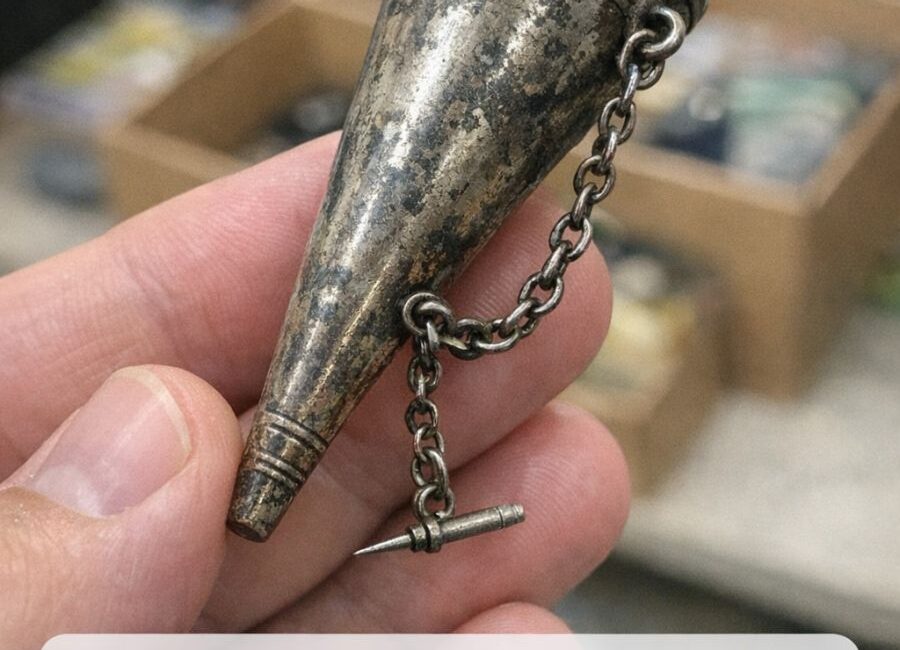
One of the most unusual aspects of the discovered object is the folding tripod handle.
At first glance, it seems strange and unnecessary.
But it reveals something important:
The posy holder was meant to be displayed publicly.
When unfolded, the tripod allowed the bouquet holder to stand upright elegantly on tables or surfaces.
This transformed flowers into visual centerpieces during social gatherings.
Again, the Victorians understood presentation masterfully.
Nothing was accidental.
Why Antique Discoveries Trigger Emotional Reactions
Finding mysterious antiques creates a unique emotional experience.
It combines:
- Curiosity
- Nostalgia
- Imagination
- Historical connection
- Mystery-solving
People become emotionally invested because the object feels alive with untold stories.
Who held it?
Who received flowers inside it?
Was it connected to romance?
Did it witness heartbreak?
Was it gifted during courtship?
These unanswered questions create emotional depth far beyond the object itself.
How Objects Become Time Capsules
Antiques preserve more than physical material.
They preserve behavior.
A posy holder preserves an entire social system:
- Courtship rituals
- Gender expectations
- Emotional communication styles
- Fashion culture
- Artistic values
Holding such an object feels like touching a fragment of vanished human experience.
Why Victorian Romance Still Fascinates Modern Audiences
Modern culture remains deeply fascinated by Victorian romance because it feels emotionally intense yet restrained.
People today live in a world of instant communication and constant digital exposure.
Victorian relationships, by contrast, often relied on anticipation, subtlety, and symbolism.
This creates a sense of mystery modern interactions sometimes lack.
A hidden message inside flowers feels more poetic than a late-night text message.
How to Identify an Authentic Victorian Posy Holder
If someone discovers a similar object, several clues may confirm authenticity.
Hallmarks and Silver Marks
Authentic silver pieces often contain stamps indicating:
- Silver purity
- Manufacturer
- Region of origin
- Date marks
These tiny markings can dramatically increase collectible value.
Craftsmanship Quality
Victorian pieces usually display:
- Fine engraving
- Symmetry
- Detailed artistry
- Elegant construction
Mass-produced replicas often lack this precision.
Functional Elements
Authentic posy holders frequently include:
- Folding stands
- Pins or chains
- Water compartments
- Intricate handles
Why Collectors Value Victorian Posy Holders
Collectors love Victorian posy holders because they combine several highly desirable qualities:
- Historical significance
- Romantic symbolism
- Decorative beauty
- Rare craftsmanship
- Social storytelling
The most valuable examples are often:
- Sterling silver
- Signed by famous makers
- Highly ornate
- Exceptionally preserved
Some rare examples can become highly sought-after collectibles in antique markets.
The Emotional Difference Between Modern and Antique Objects
Modern objects are designed mainly for utility.
Antique objects often carried emotional meaning alongside function.
A smartphone is useful.
A Victorian posy holder was meaningful.
This emotional richness explains why antiques continue captivating people even in technologically advanced societies.
Why People Secretly Long for Slower, More Symbolic Communication
The popularity of Victorian artifacts reflects something deeper happening psychologically.
Many people feel overwhelmed by modern communication.
Fast replies.
Constant notifications.
Shallow interactions.
Digital exhaustion.
Victorian symbolism feels romantic because it required patience and interpretation.
People miss mystery.
They miss gestures that feel intentional.
The Poetry of Forgotten Objects
There is also something profoundly poetic about discovering beauty where others saw trash.
A forgotten object in a junk bin becomes a reminder that value is often hidden beneath neglect.
The posy holder survived decades — perhaps over a century — before being rediscovered.
It passed through unknown hands.
Witnessed vanished lives.
Outlived entire generations.
And somehow remained intact long enough to spark curiosity again.
Why We Anthropomorphize Antiques
Humans naturally assign emotional narratives to objects.
Especially objects connected to personal rituals.
A posy holder feels intimate because it once participated in emotional exchanges.
It held flowers chosen carefully for someone specific.
That emotional association lingers psychologically even after the original owners are long gone.
The Decline of Symbolic Social Rituals
One reason Victorian objects feel so fascinating today is because many symbolic social rituals have disappeared.
Modern communication prioritizes speed and efficiency.
Victorian culture prioritized meaning and nuance.
Even small gestures carried layers of significance.
This made ordinary objects emotionally powerful.
Preserving Fragile Pieces of Human History
Antiques are not merely decorative.
They are educational.
They preserve evidence of:
- Human creativity
- Emotional culture
- Social evolution
- Artistic standards
- Daily life practices
Proper preservation ensures these objects continue telling stories for future generations.
Why the Past Continues Pulling Us Back
Despite technological progress, humans remain emotionally drawn to the past.
Especially eras perceived as:
- Elegant
- Romantic
- Symbolic
- Artistic
- Slower-paced
Victorian artifacts embody many of these qualities simultaneously.
They remind people that emotional depth once existed even inside ordinary social interactions.
Final Reflection: The Tiny Metal Cone That Opened a Door Into Another World
What began as a strange metal cone hidden in a junk bin turned out to be something extraordinary.
Not because of its monetary value alone.
But because of what it represents.
A Victorian posy holder is more than an antique accessory.
It is a surviving fragment of a lost emotional language.
It reminds us that human beings have always searched for ways to express affection, admiration, longing, and beauty.
Sometimes through words.
Sometimes through gestures.
And sometimes through flowers carefully placed inside an ornate silver cone carried into candlelit ballrooms more than a century ago.
In today’s world of instant messages and disappearing attention spans, that kind of symbolism feels almost unreal.
And perhaps that is exactly why objects like these still captivate us so deeply.
Because beneath the metal, engravings, and faded silver lies something timeless:
The human desire to communicate emotion beautifully.