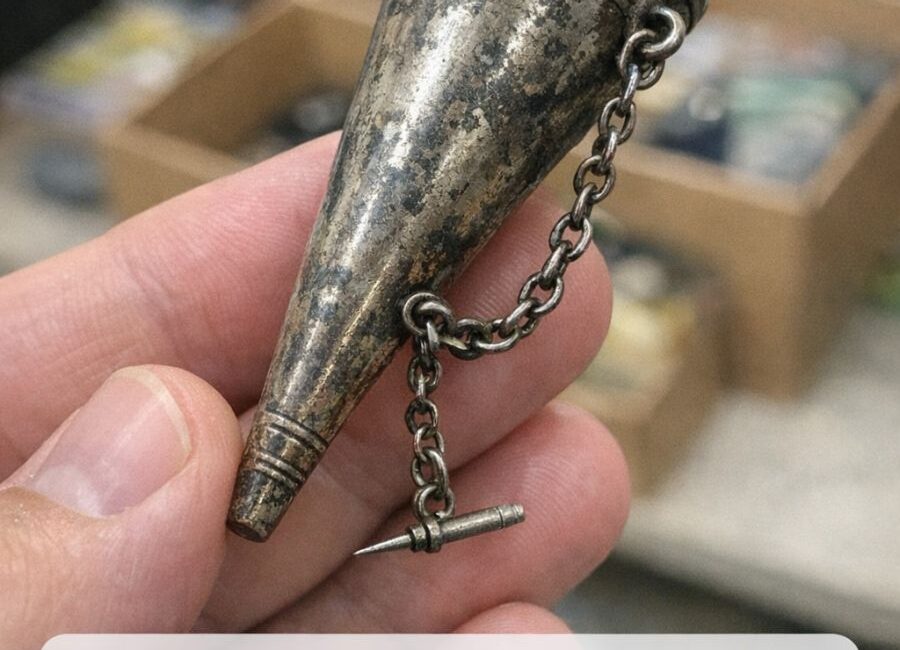
A Strange Discovery Hidden Among Trash and Forgotten Objects
Every now and then, an ordinary day turns unexpectedly fascinating.
You walk into a rummage sale expecting nothing more than clutter: dusty books, broken lamps, tangled cords, chipped plates, old tools nobody wants anymore. The kind of chaotic pile people dig through absentmindedly while hoping to uncover something unusual.
Then suddenly, buried beneath random objects and forgotten household debris, something catches your eye.
A small ornate metal cone.
Heavy enough to feel valuable.
Decorated with delicate engravings.
Attached to a tiny chain and pin.
Equipped with a folding handle that transforms into a miniature tripod stand.
At first glance, it looks impossible to identify.
Too elegant to be industrial.
Too strange to be modern.
Too detailed to be accidental.
The object feels important — but why?
That is exactly what happened in the fascinating discovery described in your source material , where an antique metal cone discovered in a junk bin turned out to be something far more romantic and historically meaningful than anyone initially imagined.
What appeared to be a bizarre decorative relic was actually a forgotten artifact from the Victorian era: a posy holder, also known as a tussie-mussie or bouquet holder.
And behind this tiny object lies an extraordinary story about romance, social codes, hidden emotional language, craftsmanship, and an entire world that communicated feelings through flowers instead of text messages.
Why Forgotten Antique Objects Fascinate Modern People So Deeply
There is something psychologically irresistible about mysterious old objects.
Modern products are easy to identify instantly:
- Phones
- Chargers
- Headphones
- Kitchen gadgets
- Electronics
But antiques often feel mysterious because they belong to systems of life we no longer understand.
An object from the Victorian era carries invisible context:
customs, rituals, emotional meanings, and social rules that disappeared generations ago.
This creates intrigue.
The brain immediately begins asking questions:
- Who owned this?
- What was it used for?
- Why was it designed this way?
- What stories does it carry?
- How did it end up forgotten in a junk bin?
Objects like Victorian posy holders captivate us because they feel like physical portals into another civilization.
The Curious Design of the Ornate Metal Cone
The object itself appears deceptively simple at first.
A narrow cone.
Intricate engravings.
Decorative floral patterns.
A chain with a small pin.
A folding handle that becomes a tripod stand.
Yet every design detail had a purpose.
This was not random decoration.
Victorian craftsmanship combined beauty and function in ways modern mass production rarely attempts anymore.
The cone shape was designed specifically to hold flower bouquets upright.
The chain and pin allowed attachment to dresses or accessories.
The tripod stand enabled elegant display on tables during social gatherings.
Even the smallest detail reflected social sophistication.
The Victorian Era: A Society Obsessed With Symbolism and Elegance
To truly understand the posy holder, you must understand the Victorian world itself.
The Victorian era, spanning from 1837 to 1901, was a period of extreme social refinement, emotional restraint, and symbolic communication.
Society operated through layers of etiquette.
People could not always express emotions openly.
Especially women.
This restriction created alternative forms of communication through:
- Clothing
- Jewelry
- Hand gestures
- Fans
- Letters
- Flowers
Everything carried hidden meaning.
Even silence communicated something.
In that world, a bouquet of flowers was never “just flowers.”
It was a coded emotional message.
The Language of Flowers: When Bouquets Spoke Instead of Words
One of the most fascinating aspects of Victorian culture was floriography, often called the “language of flowers.”
Every flower carried symbolic meaning.
For example:
- Red roses symbolized passionate love
- White lilies represented purity
- Lavender suggested devotion
- Yellow flowers could imply jealousy or friendship
- Forget-me-nots symbolized remembrance
A carefully arranged bouquet could communicate entire emotional conversations without a single spoken word.
This was especially important in strict social environments where direct romantic expression was considered inappropriate.
Flowers became emotional vocabulary.
And posy holders became the elegant devices that carried those messages.
What Exactly Is a Posy Holder?
A posy holder was essentially a decorative bouquet holder designed to carry small arrangements of flowers.
But calling it merely a “flower holder” dramatically understates its cultural importance.
A posy holder was:
- A fashion accessory
- A social symbol
- A romantic communication tool
- A luxury object
- A display of status and refinement
Victorian women carried them during:
- Balls
- Dances
- Social visits
- Courtship events
- Formal gatherings
These objects allowed flowers to remain fresh throughout long evenings while also becoming visible symbols of admiration and social attention.
Why the Cone Shape Was Genius
The cone design was not only elegant but highly practical.
Inside many posy holders was a small compartment capable of holding water.
This kept flowers hydrated during lengthy events.
Without this design, bouquets would wilt quickly under warm ballroom conditions.
The narrow cone also concentrated the bouquet visually, making it appear fuller and more dramatic while remaining easy to carry.
Victorians understood presentation deeply.
Everything was designed to maximize elegance.
The Hidden Social Psychology of Carrying Flowers
In Victorian society, carrying flowers was not casual.
A woman’s bouquet communicated social signals.
The flowers she carried could imply:
- Romantic interest
- Availability
- Emotional attachment
- Mourning
- Friendship
- Rejection
People at social gatherings often interpreted bouquets carefully.
This transformed posy holders into tools of subtle emotional theater.
Imagine entering a ballroom holding flowers gifted by an admirer.
Everyone noticed.
Everyone interpreted.
Courtship Before Modern Dating
Modern dating relies heavily on direct communication:
- Text messages
- Social media
- Dating apps
- Instant replies
Victorian courtship worked differently.
Communication was slower, more symbolic, and often heavily supervised.
Open flirtation could damage reputations.
This forced people to become masters of subtlety.
Objects like posy holders allowed emotional expression without openly violating social expectations.
A bouquet could say what words could not.
Why Victorians Loved Elaborate Accessories
Click page 2 to continue