Introduction: A Small Moment That Carries a Big Moral Weight
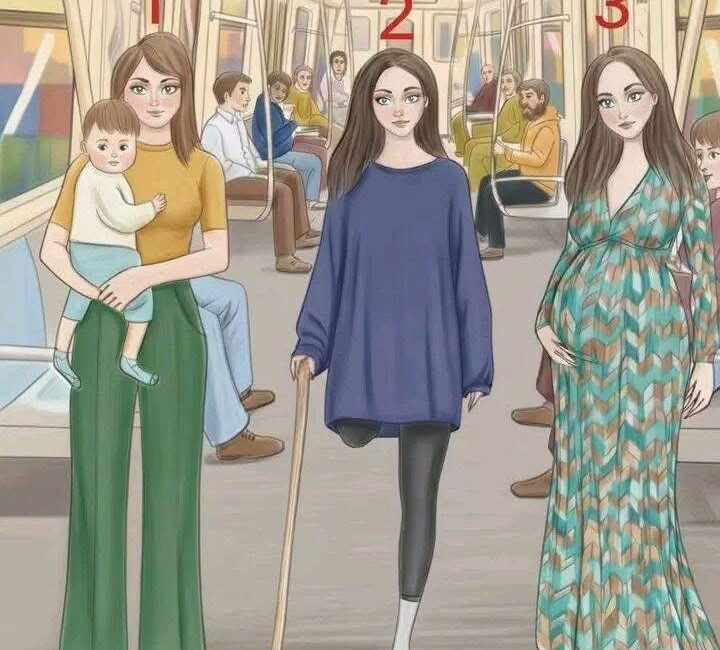
Imagine yourself sitting on a crowded metro during rush hour. The air feels heavy, the train sways unpredictably, and every person around you is carrying their own invisible story. Suddenly, three individuals stand in front of you, each silently asking for the same thing: your seat.
One is a mother holding a young child, her posture revealing exhaustion. Another is a blind young woman, gripping her cane, trying to maintain balance as the train jerks forward. The third is a visibly pregnant woman, her body bearing the weight of new life, her stability compromised with every movement of the carriage.
You are faced with a decision that seems simple—but is anything but. Who deserves your seat?
This scenario is not just about politeness or kindness. It is a powerful reflection of how we think, how we prioritize, and how we define fairness in society. It reveals our values, our biases, and even our emotional intelligence. More importantly, it challenges a deeper assumption: that only one person can be helped at a time.
In this article, we will explore this seemingly ordinary situation from multiple angles—ethical, psychological, social, and practical. You will not only understand who might need the seat the most, but also learn how to think beyond the question itself and become someone who creates solutions rather than dilemmas.
The Illusion of a Single Choice: Why the Question Is Designed to Divide
At first glance, the situation appears to force a binary decision. You have one seat and three people—so you must choose one, right?
This is where the psychological trap lies.
Human beings are naturally inclined to simplify complex situations into clear choices. Our brain prefers clarity over ambiguity. When presented with multiple needs, we instinctively try to rank them. Who needs it more? Who deserves it most?
But this framing is misleading.
The real issue is not about choosing one person. It is about how we respond to multiple needs in a shared environment. The metro is not just your space—it is a collective space. And the responsibility does not fall solely on you.
This question divides people because it encourages comparison rather than cooperation. It pushes individuals to justify why one person’s need is more valid than another’s, instead of exploring how everyone can be supported.
Understanding the Three Profiles: Beyond Surface-Level Judgments
To analyze the situation properly, we must go deeper than appearances. Each person represents a different type of need, and each requires a different kind of empathy.
The Blind Young Woman: The Urgency of Safety
The blind woman is not just tired—she is vulnerable.
Standing in a moving metro without full visual awareness significantly increases the risk of falling. A sudden brake, a sharp turn, or even a slight push from the crowd could lead to serious injury.
Her need is not only about comfort—it is about safety.
When evaluating priorities, safety often comes before comfort. This is a fundamental principle in both ethics and risk management. The consequences of not giving her a seat are potentially severe and immediate.
The Pregnant Woman: The Responsibility of Protection
Pregnancy is a state of physical vulnerability, even when everything appears normal. A pregnant woman’s center of gravity shifts, her balance is less stable, and her body is under constant physiological stress.
A fall or even a strong impact could have consequences not just for her, but also for the unborn child.
Her need is therefore both personal and protective. It involves two lives, not one.
From a societal perspective, protecting pregnancy is often seen as a priority because it represents the continuation of life. This is why many public systems include specific accommodations for pregnant individuals.
The Mother with a Child: The Weight of Endurance
The mother carrying a child is visibly exhausted, but her situation is different in nature.
She is managing responsibility rather than vulnerability. While fatigue is real and significant, it does not carry the same immediate risk as blindness or pregnancy.
However, her need should not be minimized. Carrying a child while standing in a crowded, unstable environment is physically demanding and can become dangerous over time.
Her strength lies in endurance—but endurance should not be exploited as a reason to ignore her need.
The Ethics of Priority: How Do We Decide Who Needs Help the Most?
When multiple people need help, how do we decide who to help first?
There are several ethical frameworks that can guide this decision.
1. The Principle of Urgency
This principle suggests that the person at the greatest immediate risk should be helped first.
In this case, the blind woman may be considered the highest priority because of the risk of falling and injury.
2. The Principle of Vulnerability
This focuses on who is least able to cope without assistance.
Both the blind woman and the pregnant woman fall into this category, as their conditions limit their ability to maintain balance and stability.
3. The Principle of Impact
This considers the consequences of not helping someone.
For the pregnant woman, the impact involves both her health and the health of the fetus. For the blind woman, it involves immediate physical danger.
4. The Principle of Fairness
This principle emphasizes equal respect and consideration for all individuals.
From this perspective, choosing one person over another becomes problematic, because all three have valid needs.
The Real Answer: Moving Beyond Competition Toward Collective Responsibility
The most important realization is this: you are not the only person responsible.
The metro is filled with people. Each one has the ability to act.
Instead of asking, “Who should I give my seat to?” the better question is:
“How can we, as a group, ensure that everyone who needs a seat gets one?”
This shift in thinking transforms the situation completely.
From Individual Action to Social Coordination
Click page 2 to continue