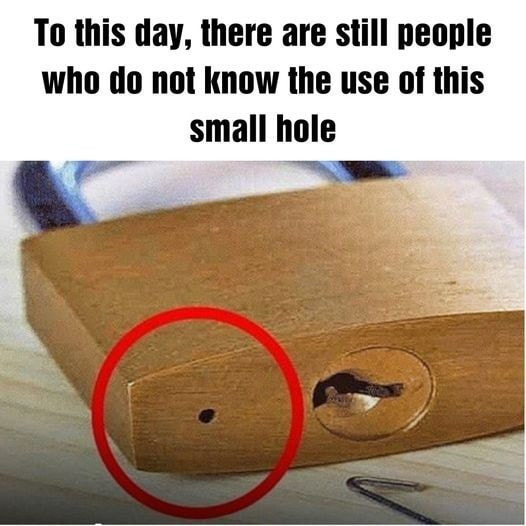
Everyday objects are full of hidden details we rarely question. The ridges on coins, the tiny dot next to your smartphone camera, the mysterious holes on airplane windows — all of them serve a purpose. But there’s one small feature that has puzzled countless people for generations: that tiny hole at the bottom of a padlock.
You’ve probably noticed it before — a small, inconspicuous opening near the base of the lock, usually right next to the keyhole or drainage area. Many assume it’s just a manufacturing mark, or perhaps an air vent. But that little hole is far from random. It’s one of the most important and functional design details in the entire lock.
Let’s dive deep into what it’s really for, how it works, and why ignoring it could mean the difference between a reliable lock and one that seizes up when you need it most.
The Hidden Genius Behind Everyday Design
Before revealing the secret of that tiny hole, let’s take a moment to appreciate how much thought goes into the things we use every day. Padlocks may look simple — a metal body, a shackle, a keyhole — but behind that simplicity lies centuries of design evolution.
Modern padlocks are small masterpieces of mechanical engineering. Inside that compact body are spring-loaded pins, locking cylinders, tumblers, and precision grooves that allow the shackle to move freely when the correct key is inserted. Every component has a purpose.
And that little hole? It’s not an accident of design. It’s the lock’s lifeline.
Purpose #1: Drainage Against Rain and Moisture
The most obvious reason for the small hole is drainage.
Padlocks are often used outdoors — on gates, sheds, chains, storage units, or fences — where they’re exposed to rain, snow, and fluctuating temperatures. When water seeps inside the lock body through the keyhole or shackle area, it can pool at the bottom.
If that water stays trapped, two bad things happen:
- Rust forms inside the mechanism.
Over time, this can corrode the springs, pins, and inner cylinder, making the lock stiff or impossible to open. - In freezing temperatures, the water can turn to ice.
When this happens, the internal components freeze in place, locking the mechanism shut — literally. You could have the right key and still be locked out because of frozen water.
The small hole allows that moisture to drain out naturally, preventing both rust and freezing. It’s a simple, gravity-powered solution to a problem that would otherwise ruin millions of padlocks.
That’s why you should never cover that hole with tape, paint, or glue — even if it looks like a dirt entry point. It’s meant to breathe.
Purpose #2: A Lubrication Access Point
The second — and equally important — purpose of that little hole is maintenance.
Padlocks, especially outdoor ones, need lubrication from time to time. Dust, debris, and oxidation can cause the pins inside to stick or the springs to weaken. But because most padlocks are sealed, you can’t easily reach the interior mechanisms.
That’s where the little hole comes in.
By applying a few drops of lock lubricant (like graphite powder or silicone spray) into the hole, you can coat the internal parts, freeing any jammed pins and restoring smooth movement.
In fact, lock manufacturers like Master Lock and ABUS specifically recommend using this hole for maintenance in their instruction manuals. It’s the direct route into the lock’s “heart.”
How to do it:
- Hold the lock upside down or on its side.
- Spray a small amount of lubricant into the hole.
- Insert and turn the key several times to distribute it evenly.
- Wipe off excess residue.
Doing this once or twice a year can extend the life of a padlock dramatically — especially if it’s exposed to the elements.
Purpose #3: Manufacturing and Assembly Support
Beyond drainage and lubrication, the hole also serves a mechanical function during production.
When padlocks are assembled in factories, they go through a process where springs, pins, and internal locking cylinders are inserted with precision. The small hole provides a secondary access point for:
- Aligning and testing internal parts.
- Releasing air pressure inside the lock body during assembly.
- Injecting lubricants or protective coatings during production.
This ensures that the lock seals properly without creating trapped air pockets — which could otherwise interfere with the mechanism or cause internal pressure buildup when exposed to temperature changes.
In simpler terms, it helps balance the internal atmosphere of the lock, keeping it consistent and reliable over time.
Purpose #4: Safety Valve for Pressure and Debris
In some heavy-duty or weatherproof padlocks, that hole also functions as a pressure relief valve.
When a lock is left outdoors in extreme heat or cold, the internal air expands and contracts. Without a vent, this could create a vacuum or pressure buildup that makes the lock harder to open. The hole allows the internal air to “breathe,” equalizing pressure naturally.
It also gives small dust particles or tiny debris an exit route, preventing buildup over time.
It’s a small detail, but in the world of engineering, small details are often what separate a cheap, unreliable lock from a long-lasting one.
Purpose #5: A Secret Access for Locksmiths
While not commonly known to the public, professional locksmiths can sometimes use the drainage hole for diagnostics or repairs.
When servicing or rekeying certain padlocks, the hole provides access to internal pins or springs without fully disassembling the lock. This makes it possible to clean, test, or reset internal components more efficiently.
In specialized locks — especially older brass ones — this tiny port was occasionally used to insert anti-corrosion fluids or solvents designed to break through old grime and oxidation.
So, yes — even professionals use that hole strategically.
Why It’s Not Always There
Click page 2 for more