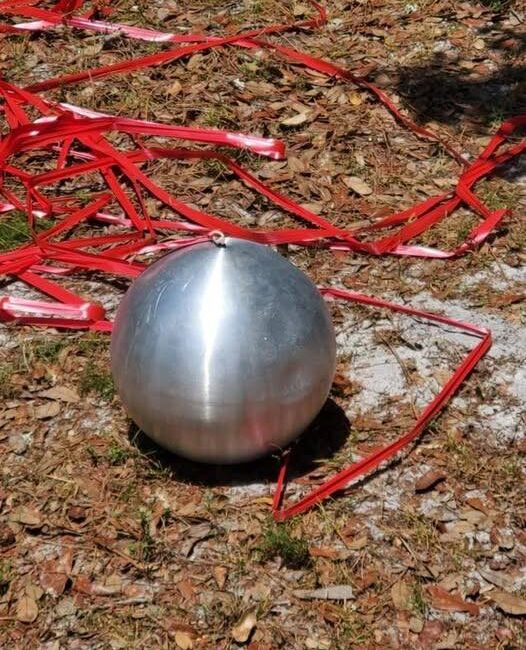
Imagine this: You’re out in your pasture, the golden sunlight bathing the fields, when suddenly your eye catches something unusual—a round, metallic object resting gently on the grass, accompanied by a parachute. It looks unlike anything you’ve seen before. What could it be? How did it get here? Is it safe? What is its purpose?
This scenario might sound like something out of a sci-fi story, but in reality, such mysterious objects do occasionally appear in rural areas, stirring curiosity and sometimes concern. This comprehensive article delves deep into the nature of these enigmatic round metallic objects that land with parachutes, the potential explanations, safety considerations, and even the science behind their design and use.
Unraveling the Mystery: Initial Impressions and Identification
When you first spot a round metallic object in your pasture accompanied by a parachute, your mind might immediately race through various possibilities:
- Could it be space debris?
- Is it some kind of military equipment?
- Might it be a scientific instrument or probe?
- Or perhaps, a commercial payload or experimental technology?
Understanding what the object might be requires breaking down its physical characteristics and contextual clues.
Physical Characteristics to Observe
- Shape and Size
The object is described as “round” and “metallic,” suggesting it might be a sphere, a capsule, or a disk-like shape. Sizes could vary dramatically—from something as small as a basketball to as large as a beach ball or bigger. - Surface Details
Does it have any markings, writing, or logos? Is the surface smooth, reflective, or matte? Are there any visible seams or hatches? These can provide vital clues. - Parachute Details
The parachute indicates controlled descent, hinting that the object is designed to return safely to Earth from altitude or space. Look for the type of fabric, cords, and deployment method. - Surrounding Area
Check for any additional debris, impact marks, or disturbed earth. Is there a smell, smoke, or unusual heat emanating from the object? Are animals nearby reacting oddly?
Common Origins of Round Metallic Objects With Parachutes
1. Space Capsule or Satellite Components
One of the most plausible explanations for a round metallic object with a parachute is that it is a returning space capsule or a component of a satellite. Many space missions employ capsules or instruments designed to return safely to Earth after completing their mission.
- Scientific Payload Returns: Satellites or research instruments deployed in the upper atmosphere or space sometimes send back collected data via capsules that re-enter the atmosphere and deploy parachutes for a soft landing.
- Space Debris: Pieces of satellites or spent rocket stages sometimes survive re-entry and land in remote areas. NASA and other space agencies track such debris but cannot always predict exact landing spots.
- Crewed Capsules: Spacecraft returning astronauts, like those used in historic or modern space missions, often use parachutes for atmospheric re-entry and landing. Though extremely rare to land in a pasture, test capsules or training units might accidentally stray.
2. Military or Defense Equipment
Military organizations around the world use specialized equipment that may be dropped from aircraft or rockets and designed to land safely with parachutes.
- Reconnaissance Devices: High-tech surveillance instruments or sensor packages may be dropped behind enemy lines or in designated test areas.
- Supply Drops: Parachute-supplied cargo containers for soldiers or remote outposts sometimes look like metallic spheres or capsules.
- Training Devices: Some training munitions or decoys use parachutes and metallic shells.
3. Scientific Research Instruments
Environmental, meteorological, and geological research programs often deploy instrument packages that descend via parachutes:
- Weather Balloons: These sometimes carry small capsules or data-logging instruments which return to Earth suspended by parachutes.
- Atmospheric Probes: Devices sent into the atmosphere to collect data on temperature, pressure, and chemical composition may descend slowly on parachutes.
- Geophysical Sensors: Used in earthquake zones or remote wilderness, these might be dropped from aircraft and recovered after mission completion.
4. Commercial and Experimental Technology
With the rise of private aerospace ventures and experimental tech, it’s not uncommon for test devices or prototypes to be dropped from drones or aircraft to test new delivery systems.
- Package Delivery Tests: Some companies experiment with dropping lightweight payloads via parachute for last-mile delivery.
- Aerial Photography or Mapping Devices: Spherical drones or sensors may descend by parachute after aerial data collection.
- Entertainment or Marketing Stunts: Novelty devices sometimes land with parachutes for dramatic effect.
Why Parachutes? The Science Behind Controlled Descent
Parachutes serve one fundamental purpose: to slow the descent of an object through the atmosphere, minimizing impact damage and increasing the likelihood of a safe landing.
The Physics of Parachuting Objects
Objects falling through the air accelerate due to gravity until air resistance counteracts this acceleration, reaching what’s called terminal velocity. Parachutes increase the surface area dramatically, increasing air resistance and reducing terminal velocity to safe levels.
This is especially crucial for delicate or expensive payloads that must survive re-entry from high altitudes or space, where speeds can exceed thousands of miles per hour.
Types of Parachutes
- Round Parachutes: Often used for cargo and simple payloads, these are hemispherical and provide stable but slower descents.
- Ram-Air Parachutes: These have wings that allow for controlled steering and gliding. Less common for payload recovery.
- Ribbon or Ring Parachutes: Designed for stability and rapid deployment in turbulent conditions.
The parachute attached to your mysterious metallic object likely fits one of these categories, hinting at its intended use and origin.
Safety Considerations: Is It Dangerous?
Discovering an unidentified metallic object in your pasture can be concerning. Here are key safety tips to follow:
1. Avoid Direct Contact
Metallic objects dropped from the sky may be hot, contain hazardous chemicals, or even have unexploded ordinance if military-related.
2. Do Not Attempt to Open
Unless you have expertise, opening the object could expose you to harmful substances, sharp edges, or trigger unknown mechanisms.
3. Observe and Document
Take photos, note the exact location, size, markings, and any other details. This information will be valuable to authorities.
4. Notify Local Authorities
Report the find to local law enforcement, environmental agencies, or even aerospace organizations. They will know the proper protocol.
5. Keep Pets and Children Away
Animals and kids may inadvertently injure themselves or damage the object.
Environmental and Legal Implications
Environmental Impact
Click page 2 for more