Weddings are supposed to be celebrations of love, commitment, family, and shared joy. They are emotional milestones where two people publicly begin a new chapter together surrounded by the people they care about most. Traditionally, guests attend weddings to witness a meaningful moment, offer support, and celebrate the union of two families.
But in recent years, something about weddings has started to shift.
What was once viewed primarily as a heartfelt ceremony has increasingly become entangled with luxury expectations, social media pressure, financial stress, and rising entitlement culture. Elaborate venues, destination ceremonies, designer outfits, curated aesthetics, and expensive receptions have transformed weddings into massive productions that often cost tens of thousands of dollars.
And with those rising costs comes a controversial question that is quietly creating tension inside families and friendships everywhere:
Do wedding guests owe the couple enough money to “cover their plate”?
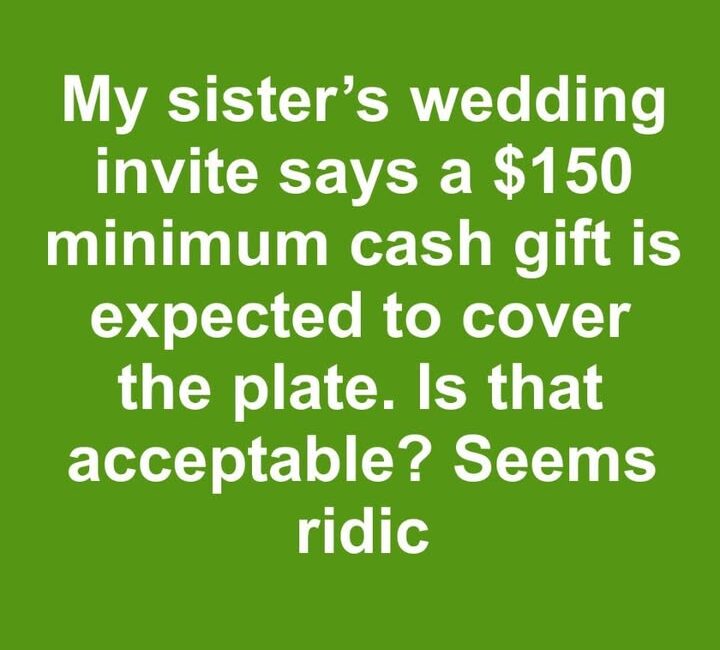
For many people, this debate became even more shocking after stories began circulating online about couples explicitly requesting minimum cash gifts directly on wedding invitations. In one particularly divisive example, a bride included a note stating that guests were expected to give at least $150 in cash to help cover the cost of their attendance at the reception.
The reaction was explosive.
Some people defended the request, arguing that weddings are extremely expensive and that cash gifts are practical. Others were horrified, claiming the request felt transactional, rude, entitled, and emotionally tone-deaf.
The debate quickly expanded into something much larger than wedding etiquette alone.
It opened conversations about:
- modern financial pressure,
- changing social expectations,
- class differences,
- emotional obligation,
- cultural traditions,
- family dynamics,
- and the growing commercialization of personal milestones.
At its core, the controversy forces people to confront a difficult emotional question:
When someone invites you to celebrate their love, are you a guest… or a financial contributor?
The answer is not nearly as simple as many people assume.
How Weddings Became So Expensive in Modern Society
To understand why some couples begin viewing guests as financial offsets, it is important to understand how dramatically wedding culture has changed.
Decades ago, weddings were often simpler community-centered gatherings. Families cooked food themselves, ceremonies took place in local churches or homes, and celebrations focused more on relationships than production value.
Today, weddings have evolved into highly curated events influenced heavily by:
- social media,
- luxury lifestyle culture,
- influencer aesthetics,
- destination trends,
- and consumer expectations.
Modern couples are often told that their wedding should be:
- unforgettable,
- visually perfect,
- emotionally cinematic,
- and socially impressive.
As a result, costs escalate rapidly.
Expenses now commonly include:
- luxury venues,
- professional photographers,
- videographers,
- custom floral installations,
- live entertainment,
- designer attire,
- beauty teams,
- elaborate catering,
- transportation,
- and curated décor experiences.
Many couples feel intense pressure to create a wedding that appears extraordinary not only for guests but also for online audiences.
This creates enormous financial strain.
The Financial Reality Behind Modern Weddings
Wedding costs can become overwhelming very quickly.
Many couples spend:
- years saving,
- taking loans,
- using credit cards,
- or relying on family contributions.
The emotional pressure surrounding weddings often leads people to overspend because they fear judgment or disappointment.
Some couples begin seeing guest gifts not as symbolic gestures but as partial reimbursement for the event itself.
This is where the “cover your plate” mentality emerges.
The logic sounds simple:
“If the meal and venue cost $150 per guest, then guests should at least contribute that amount.”
But emotionally and socially, this mindset changes the entire meaning of a wedding invitation.
The Problem With Treating Weddings Like Financial Transactions
At its heart, a wedding invitation is traditionally an offer of hospitality.
The couple chooses to host people because they want their presence during an important life moment.
Once attendance becomes tied to mandatory financial contribution, the emotional dynamic changes dramatically.
Guests may begin feeling:
- evaluated,
- financially measured,
- pressured,
- or emotionally manipulated.
Instead of feeling welcomed, they may feel invoiced.
This is precisely why explicit minimum gift requests create such strong reactions.
Many people feel that the spirit of generosity disappears when gifts become obligations.
Why Cash Gifts Became So Popular in the First Place
Cash gifts themselves are not inherently controversial.
In fact, they have become increasingly common for several practical reasons.
Modern couples often:
- already live together,
- already own household items,
- or prefer financial flexibility instead of traditional registry gifts.
Cash allows couples to:
- pay wedding expenses,
- save for a home,
- fund a honeymoon,
- build emergency savings,
- or invest in their future.
In many cases, guests also prefer giving cash because it feels practical and useful.
The controversy begins not with cash gifts themselves, but with the expectation and enforcement surrounding them.
Traditional Wedding Etiquette and What It Actually Says About Gifts
Historically, wedding gifts were always intended as voluntary gestures of support and celebration.
The purpose was symbolic rather than transactional.
Etiquette traditions generally emphasize:
- generosity without obligation,
- gratitude without expectation,
- and hospitality without conditions.
Guests give based on:
- their relationship with the couple,
- their financial ability,
- cultural norms,
- and personal choice.
The amount is traditionally private and discretionary.
That flexibility protects the emotional integrity of the celebration.
Why Mandatory Minimums Feel Emotionally Uncomfortable
One reason mandatory wedding gift expectations create such discomfort is because they introduce financial hierarchy into emotional relationships.
Not every guest has the same income, life circumstances, or financial freedom.
A $150 gift might feel manageable for one person and deeply stressful for another.
Guests may already face additional wedding-related expenses including:
- travel,
- hotels,
- clothing,
- transportation,
- childcare,
- beauty appointments,
- bachelor or bachelorette parties,
- and time off work.
For some attendees, attending the wedding itself already represents a major financial sacrifice.
Being told a minimum amount is expected can create embarrassment, shame, or resentment.
The “Cover Your Plate” Myth Explained
The idea that guests must “cover their plate” has become extremely widespread, but many etiquette experts argue it was never intended as a strict rule.
The concept likely emerged informally through social customs where guests tried to give generously relative to the scale of the event.
Over time, however, this evolved into something more transactional.
The problem with the “cover your plate” mindset is that it frames hospitality as conditional.
It subtly implies:
“If we spend money on you, you owe us reimbursement.”
But traditionally, hosting an event means voluntarily assuming the costs of that event.
Guests are invited because their presence matters emotionally — not because they are expected to subsidize expenses.
Cultural Differences Around Wedding Cash Gifts
It is important to recognize that wedding customs vary significantly across cultures.
In many cultures, cash gifting is deeply traditional and widely accepted.
For example:
- red envelopes in many Asian weddings,
- money dances in certain Latin traditions,
- or envelope gifting customs in Mediterranean and Middle Eastern communities.
In some cultural contexts, expected gift ranges may even be openly discussed socially.
However, even within cultures where cash gifts are normal, explicitly demanding minimum amounts on invitations often remains controversial.
The difference lies between:
- shared social understanding,
and - direct financial mandates.
That distinction matters emotionally.
How Social Media Changed Wedding Expectations Forever
One major force behind modern wedding pressure is social media.
Platforms filled with:
- luxury ceremonies,
- designer décor,
- viral wedding moments,
- and curated aesthetics
have transformed weddings into performances as much as personal celebrations.
Couples often feel pressure to compete visually.
This creates unrealistic standards that many people financially cannot sustain comfortably.
Instead of scaling weddings to fit budgets, some couples attempt to preserve expensive visions while relying emotionally or financially on guests to absorb part of the burden.
This contributes to growing tension around gift expectations.
The Emotional Fallout Guests Rarely Talk About
Mandatory gift expectations can create emotional consequences that couples sometimes underestimate.
Guests may feel:
- anxious,
- judged,
- financially inadequate,
- or emotionally distant from the celebration.
Some people quietly decline invitations because they cannot afford the expected costs.
Others attend while secretly resenting the pressure.
In extreme cases, friendships and family relationships become strained over wedding finances.
The emotional irony is painful:
a celebration meant to unite people can sometimes create division instead.
Weddings and the Rise of Entitlement Culture
The controversy surrounding mandatory wedding gifts also reflects broader societal shifts.
Modern culture increasingly emphasizes:
- personalization,
- luxury experiences,
- and individual validation.
Some people begin viewing weddings less as communal celebrations and more as highly customized productions centered entirely around the couple’s desires.
This can unintentionally create entitlement dynamics where guests are expected to:
- spend heavily,
- travel extensively,
- follow strict aesthetic rules,
- and contribute financially.
Critics argue this transforms weddings from celebrations into emotionally expensive obligations.
Why Financial Experts Warn Against Overspending on Weddings
Financial advisors frequently caution couples against beginning married life with excessive wedding debt.
A single day of celebration should not create years of financial stress.
Experts often recommend:
- prioritizing long-term financial stability,
- setting realistic budgets,
- and avoiding emotional overspending driven by comparison culture.
Importantly, they also warn against relying on guest gifts as financial planning strategies.
Wedding gifts are unpredictable.
Building a wedding budget around expected reimbursement can create emotional disappointment and financial instability.
Polite Ways Couples Can Communicate Gift Preferences
Click page 2 to continue