Many viral illusion posts intentionally use emotionally loaded language.
Examples include:
- “Only geniuses can find all animals.”
- “What you see first reveals your dark side.”
- “Psychologists say this exposes narcissism.”
- “Only highly intelligent people notice the hidden animal.”
These headlines are designed to trigger emotional urgency.
They exploit:
- Insecurity
- Curiosity
- Fear
- Ego
- Desire for uniqueness
This is not accidental.
It is strategic psychological engagement.
Why People Secretly Want These Tests to Be True
Ironically, many people know these tests are not scientifically reliable.
Yet they still participate enthusiastically.
Why?
Because humans crave meaning.
We want random experiences to reveal something deeper about ourselves.
Even vague personality interpretations can feel strangely personal because the human mind naturally searches for self-relevance.
This phenomenon explains why horoscope descriptions often feel accurate even when generalized.
The brain unconsciously fills gaps and creates emotional connections.
What Your Approach to the Image Actually Reveals
The most interesting insight is not how many animals you see.
It is how you engage with the image.
Do you:
- Rush quickly?
- Study carefully?
- Become competitive?
- Feel frustrated?
- Stay curious?
- Seek hidden meaning?
- Lose interest immediately?
These reactions reflect cognitive and emotional tendencies more than the animal count itself.
The Relationship Between Attention Span and Perception
Modern digital life has transformed human attention dramatically.
Constant scrolling conditions the brain for rapid stimulation rather than sustained observation.
This affects perception.
Many people overlook hidden details simply because they no longer examine things deeply.
Their attention jumps instantly to the next stimulus.
Optical illusions briefly interrupt that pattern.
They force the viewer to pause.
And that pause feels unusual in today’s fast-moving digital world.
The Fascinating Link Between Visual Perception and Personality
While optical illusions cannot diagnose narcissism, perception styles can reflect certain personality tendencies.
For example:
Big-Picture Thinkers
Some individuals naturally focus on broader structures first.
They may excel in:
- Leadership
- Strategic thinking
- Long-term planning
Detail-Oriented Thinkers
Others notice subtle patterns immediately.
They may excel in:
- Analysis
- Art
- Investigation
- Design
- Observation-based work
Neither style is better.
Both are valuable cognitive strengths.
Why Hidden Animal Images Feel So Personal
There is something uniquely intimate about discovering hidden images.
The experience feels personal because perception itself feels personal.
When someone else sees an animal you missed, it creates surprise and sometimes insecurity.
You begin questioning your own awareness.
This emotional reaction increases engagement dramatically.
The Human Desire to Feel Unique
One reason people love sharing their results is because individuality feels valuable.
Saying:
“I saw seven animals immediately”
creates identity.
It subtly communicates:
- Observation skills
- Intelligence
- Creativity
- Awareness
Social media amplifies this because identity performance is constant online.
People are always presenting versions of themselves.
Why Curiosity Is One of the Most Powerful Human Traits
At its core, this entire phenomenon revolves around curiosity.
Curiosity drives:
- Science
- Discovery
- Creativity
- Innovation
- Learning
- Exploration
People who continue searching the image beyond the obvious often display strong exploratory instincts.
And those instincts shape life outcomes more than simplistic labels ever could.
The Bigger Philosophical Question Hidden Inside the Illusion
These images unintentionally raise a profound philosophical question:
How much of reality do we fail to notice every day?
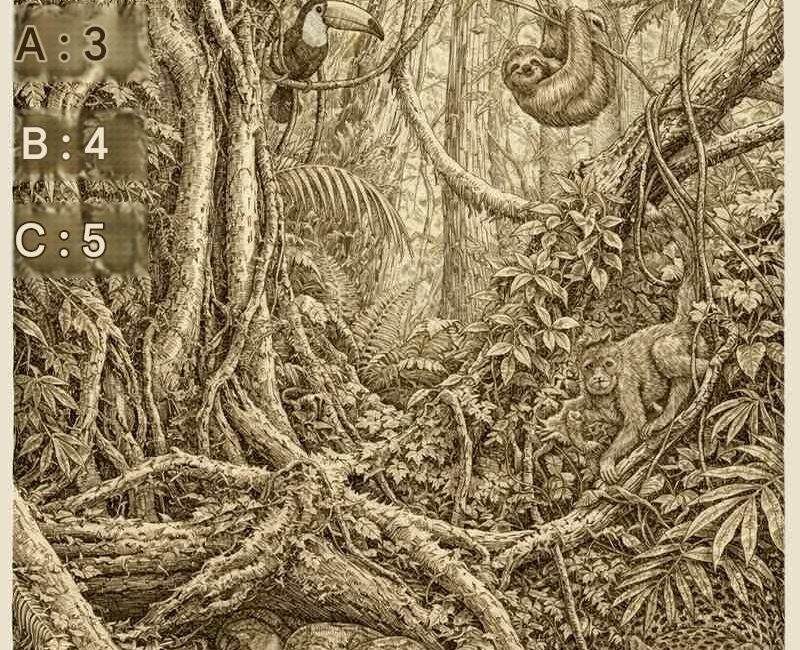
The jungle illusion becomes symbolic.
Some people stop after seeing what is obvious.
Others continue searching deeper layers.
That pattern applies to life itself.
Some individuals:
- Accept surface explanations
- Avoid ambiguity
- Seek quick conclusions
Others:
- Explore complexity
- Question appearances
- Look beneath the surface
- Stay intellectually curious
This difference influences relationships, careers, emotional intelligence, and worldview.
Why the Internet Loves Simplified Psychology
Modern online culture rewards simplicity.
Complex truths spread slowly.
Simple emotional statements spread instantly.
Saying:
“Optical illusions reveal selective attention patterns”
is accurate but less emotionally gripping than:
“This image reveals whether you are narcissistic.”
The internet prioritizes emotional reaction over nuance.
That is why oversimplified psychology dominates viral content.
The Real Psychological Insight Hidden in the Image
The true value of these illusions is not diagnosis.
It is awareness.
They remind us that:
- Perception is selective
- Attention shapes reality
- Curiosity changes outcomes
- The brain constantly filters information
Most importantly, they reveal how easily human beings search for identity in external experiences.
Final Reflection: The Number of Animals Does Not Define You
In the end, the number of animals you see does not determine whether you are narcissistic, intelligent, empathetic, shallow, creative, or emotionally evolved.
Human personality is far too complex to be reduced to a jungle drawing.
But the way you approach the image may reveal something meaningful.
Do you stop at the obvious?
Or do you continue exploring?
Do you seek certainty instantly?
Or tolerate ambiguity long enough to discover deeper patterns?
Do you rush for answers?
Or stay curious?
Those questions matter far more than the animal count itself.
Because the real story was never hidden inside the jungle.
It was hidden inside the way your mind chose to look at it.