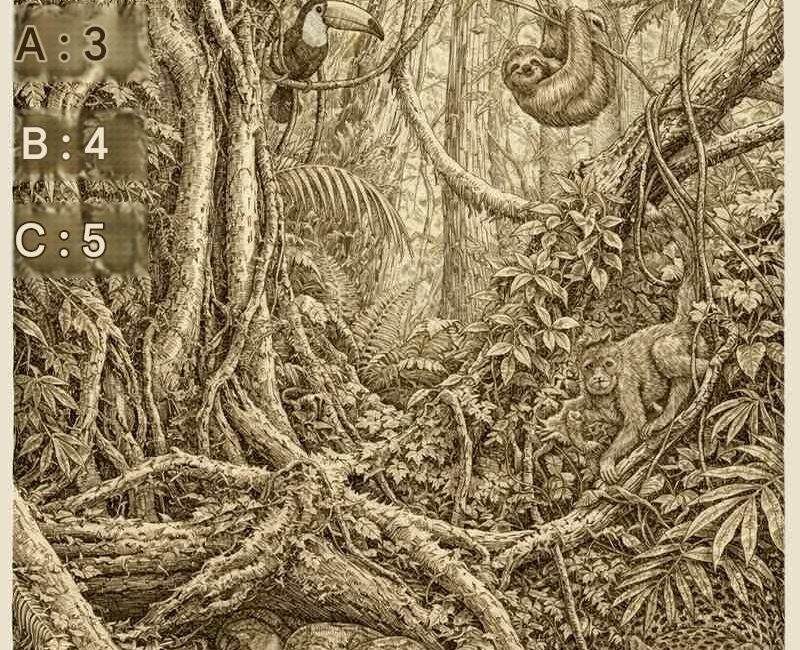
A Simple Jungle Drawing… or a Psychological Trap?
At first glance, it looks harmless.
Just another jungle illustration drifting through social media feeds at lightning speed. Tangled roots. Heavy shadows. Thick leaves layered over twisted branches. The kind of image your brain registers in seconds before moving on.
But then something strange happens.
You notice an animal.
Then another.
Then another hidden deeper inside the image.
A monkey watching from the darkness.
A snake coiled beneath the roots.
A bird balancing silently on a branch.
A sloth hanging almost invisibly above the scene.
And perhaps, hidden in the shadows, the eyes of a large feline staring directly at you.
Suddenly, the image changes completely.
It is no longer just a drawing.
It becomes a test.
“How many animals do you see?”
And then comes the hook that makes people stop scrolling instantly:
“The number of animals you see may reveal whether you are narcissistic.”
It is provocative.
Slightly unsettling.
Almost impossible to ignore.
Because no one wants to discover something negative about themselves accidentally while scrolling online.
Yet millions of people continue sharing these visual puzzles every single day. They compare answers, debate interpretations, and wonder whether seeing three animals instead of five says something profound about their personality, intelligence, or emotional awareness.
But does it really?
Or is something much more fascinating happening beneath the surface?
The truth is that these viral optical illusions reveal far more about human psychology, attention, curiosity, cognition, and digital behavior than they do about narcissism itself.
And that is exactly why they spread so fast.
Why the Human Brain Is Obsessed With Hidden Images
Human beings are naturally drawn to mystery.
The brain loves incomplete information because incomplete information creates tension. Psychologists sometimes describe this as a “cognitive itch” — the uncomfortable feeling that pushes people to search for closure.
An image that contains hidden animals triggers this instinct perfectly.
Your brain immediately begins asking questions:
- What am I missing?
- Why do other people see more than I do?
- Did I overlook something obvious?
- What does this say about me?
This creates engagement at an almost automatic level.
The image becomes interactive without requiring movement, sound, or technology.
It transforms passive viewing into active participation.
And once participation begins, emotional investment follows.
The Dangerous Power of Personality Labels
The real genius behind these viral illusions is not the hidden animals.
It is the emotional trigger attached to them.
Words like:
- Narcissistic
- Toxic
- Genius
- Empath
- Introvert
- Psychopath
- Emotionally intelligent
instantly create emotional tension.
Why?
Because human beings are deeply concerned with identity.
We constantly wonder:
- Who am I really?
- How do others perceive me?
- Am I normal?
- Am I flawed?
- Am I intelligent?
- Am I selfish?
A headline suggesting that a simple image can reveal hidden truths about your personality taps directly into those insecurities.
Especially the word “narcissistic.”
That word carries emotional weight because narcissism is associated with selfishness, manipulation, arrogance, emotional coldness, and lack of empathy. Most people fear being perceived that way.
So when an image hints:
“The number of animals you see may reveal narcissistic tendencies,”
the brain immediately pays attention.
Not because people fully believe it.
But because they need to know.
What Is Narcissism, Really?
One of the biggest problems with viral psychology content is that it dramatically oversimplifies complex mental concepts.
True narcissism is not determined by optical illusions.
It is a deeply complex psychological pattern involving:
- Grandiosity
- Excessive need for admiration
- Lack of empathy
- Fragile self-esteem hidden beneath superiority
- Emotional manipulation
- Entitlement
Clinical narcissistic personality disorder is even more complicated and requires professional evaluation.
You cannot diagnose narcissism based on:
- Which animal someone notices first
- How many animals they count
- Whether they focus on details or large shapes
Human psychology simply does not work that way.
Yet people continue believing these tests hold hidden truths because they offer something irresistible:
A fast explanation for identity.
Why Different People See Different Numbers of Animals
This is where the topic becomes genuinely fascinating.
People do not see different animals because of narcissism.
They see different animals because human perception is selective.
Your brain does not process every visual detail equally.
Instead, it filters information constantly.
The Science of Selective Attention
At every moment, your brain receives enormous amounts of sensory input.
If your mind attempted to consciously process everything simultaneously, you would become overwhelmed instantly.
So the brain prioritizes.
It asks:
- What matters most?
- What stands out?
- What should I ignore?
- What deserves focus?
This process is called selective attention.
In jungle illusion images, selective attention determines:
- Which shapes appear first
- Which details remain invisible
- Which animals stand out immediately
- Which require deeper inspection
Some individuals naturally focus on broader structures first.
Others instinctively notice tiny irregularities and hidden patterns.
Neither approach is inherently superior.
They are simply different cognitive tendencies.
Why Some People Immediately Notice Hidden Details
People who identify more hidden animals often display stronger pattern-recognition tendencies.
Pattern recognition is one of the brain’s most powerful cognitive functions.
It allows humans to:
- Recognize faces
- Detect danger
- Read emotions
- Interpret symbols
- Predict outcomes
- Solve problems
In visual illusions, pattern recognition becomes hyperactive.
The brain begins connecting shadows, curves, and shapes into meaningful forms.
This is why one person may instantly see a snake hidden in roots while another sees nothing unusual at all.
The Role of Curiosity in Perception
Curiosity dramatically changes what people notice.
Someone who quickly glances at the image may only see three animals.
Another person who studies it carefully for several minutes may discover six or seven.
This difference says less about intelligence and more about cognitive persistence.
Some individuals are satisfied with initial answers.
Others continue searching deeper.
That behavioral difference extends far beyond optical illusions.
It affects:
- Learning styles
- Career choices
- Creativity
- Problem-solving
- Emotional understanding
- Relationships
Optical Illusions Reveal How the Brain Constructs Reality
One of the most extraordinary truths about perception is this:
Human beings do not see reality objectively.
The brain constantly interprets reality rather than merely recording it.
This means perception is partially constructed.
Optical illusions expose this beautifully.
The animals already exist within the image.
Yet some people cannot see them immediately.
Why?
Because seeing is not purely visual.
It is cognitive.
The brain must organize visual information into recognizable meaning.
Why Viral Illusions Spread Faster Than Ordinary Content
These illusion tests dominate social media because they combine several powerful psychological triggers simultaneously.
1. Curiosity
The brain wants to solve the puzzle.
2. Identity
People want insight into themselves.
3. Competition
Viewers compare results with others.
4. Social Validation
People share answers publicly for reactions.
5. Emotional Tension
No one wants a negative label.
6. Instant Participation
No effort is required beyond looking.
This combination creates the perfect formula for viral engagement.
The Hidden Addiction of Self-Analysis
Modern culture is obsessed with self-analysis.
People constantly seek explanations for:
- Their emotions
- Their relationships
- Their behavior
- Their insecurities
- Their personality traits
This explains the explosive popularity of:
- Personality tests
- Zodiac signs
- Attachment styles
- Psychology quizzes
- Body language analysis
- Behavioral labels
Optical illusion personality tests fit perfectly into this ecosystem.
They provide instant psychological storytelling.
Even when scientifically inaccurate, they feel emotionally satisfying.
The Emotional Manipulation Behind Viral Headlines
Click page 2 to continue