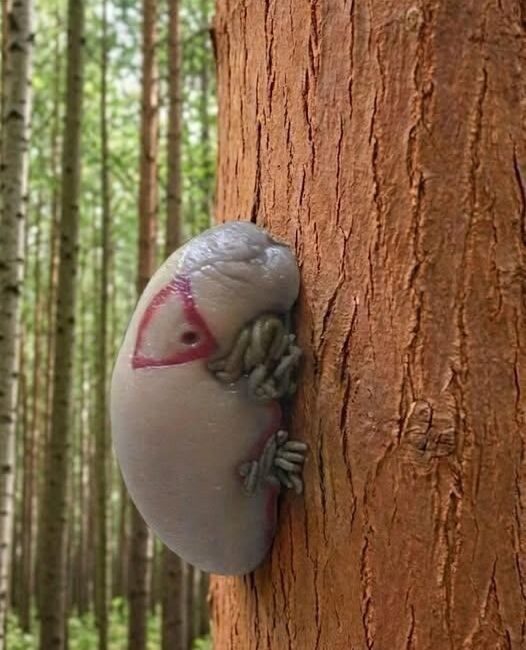
The reaction to encountering a Red Triangle Slug is not just about biology; it is also about psychology. Humans are naturally cautious around unfamiliar shapes, colors, and movements. This instinct has evolutionary roots, helping our ancestors avoid potential threats.
However, in modern contexts, this instinct can sometimes lead to unnecessary fear or misunderstanding. The bright red marking of the slug may trigger associations with danger, even though the animal itself is harmless.
This highlights an important concept: perception is not always accurate. What we see and how we interpret it are influenced by prior experiences, cultural beliefs, and instinctive responses.
Learning about the Red Triangle Slug provides an opportunity to challenge these assumptions. It encourages a shift from reactive thinking to informed understanding. Instead of asking, “Is this dangerous?”, we begin to ask, “What is this, and what role does it play?”
This shift is not just useful in nature—it is a valuable mindset in everyday life.
Biodiversity and Balance: The Importance of Every Species
The Red Triangle Slug is just one example of the incredible diversity found in natural ecosystems. Each species, no matter how small or seemingly insignificant, contributes to the overall balance of its environment.
Biodiversity refers to the variety of life within a given area. High biodiversity is often associated with healthy ecosystems, as it indicates a wide range of interactions and processes. Each organism plays a role, whether as a producer, consumer, or decomposer.
Removing even a single species can have ripple effects. If decomposers like the Red Triangle Slug were to disappear, the breakdown of organic matter would slow, affecting soil quality and plant growth. This, in turn, could impact herbivores and predators, creating a chain reaction.
This interconnectedness is one of the most important concepts in ecology. It teaches that everything is linked, and that even the smallest components matter.
Gardens, Forests, and Human Spaces: Coexisting with Nature
Encounters with the Red Triangle Slug often occur in gardens or semi-natural spaces. For many people, the presence of slugs can be associated with damage to plants or unwanted pests. However, not all slugs have the same impact.
The Red Triangle Slug primarily feeds on decaying material rather than living plants, making it less likely to harm gardens. In fact, its presence can be beneficial, as it contributes to soil health and nutrient cycling.
This raises an important point about coexistence. Not every organism in our environment is a threat or a nuisance. Some are neutral, and others are actively beneficial. Learning to distinguish between them allows for more balanced interactions with nature.
Instead of immediately removing or fearing unfamiliar creatures, taking a moment to observe and understand them can lead to more informed decisions. This approach supports both environmental health and personal awareness.
From Fear to Fascination: A Shift in Perspective
The journey from first encounter to understanding is a powerful one. It begins with uncertainty, moves through curiosity, and ends with appreciation. The Red Triangle Slug serves as a perfect example of how perspective can change when knowledge is introduced.
What once seemed strange or even alarming becomes interesting, even beautiful, when viewed through a different lens. The bold red triangle is no longer a warning sign but a unique characteristic. The slow movement is no longer unsettling but calming.
This transformation is not just about one species. It reflects a broader truth about how we interact with the world. Many things that seem intimidating or confusing at first can become meaningful when we take the time to learn about them.
Lessons from the Red Triangle Slug: Slowness, Balance, and Awareness
Beyond its biological and ecological significance, the Red Triangle Slug offers subtle lessons that extend into everyday life.
Its slow, deliberate movement reminds us that speed is not always necessary. In a world that often prioritizes productivity and urgency, there is value in taking things slowly, observing carefully, and moving with intention.
Its role in decomposition highlights the importance of unseen processes. Not all valuable work is visible or immediately recognized. Some of the most important contributions happen quietly, behind the scenes.
Its ability to thrive in specific conditions teaches adaptability. Success is not about fitting into every environment but about finding the right one and functioning effectively within it.
These lessons are not abstract; they are practical. They can influence how we approach work, relationships, and personal growth.
A Deeper Connection to the Natural World
Encounters with creatures like the Red Triangle Slug can serve as entry points into a deeper appreciation of nature. They remind us that the world is full of complexity, diversity, and subtle beauty.
Taking the time to observe, research, and understand even a single species can change how we see our surroundings. It encourages mindfulness, curiosity, and respect for the environment.
This connection is increasingly important in modern life, where many people are disconnected from natural processes. Rebuilding this connection can improve not only environmental awareness but also personal well-being.
Conclusion: The Power of Curiosity and Understanding
The story of the Red Triangle Slug is not just about a single species. It is about the journey from uncertainty to knowledge, from instinctive reaction to informed appreciation.
What begins as a moment of confusion—a bright red shape in an unfamiliar setting—becomes an opportunity for learning. Through observation and understanding, fear is replaced by curiosity, and curiosity leads to insight.
This process is valuable in all areas of life. It teaches that first impressions are not always accurate, that knowledge can transform perception, and that even the smallest elements of the natural world have meaning and purpose.
The Red Triangle Slug, with its distinctive marking and quiet role in the ecosystem, stands as a reminder that the world is richer and more intricate than it may first appear. And sometimes, all it takes is a closer look to see it.