A Moment of Uncertainty: When the Unknown Captures Attention
It begins quietly, almost insignificantly. A flash of deep, vivid red appears against the muted tones of soil, bark, and fallen leaves. At first glance, it feels out of place—too bright, too defined, too deliberate to be ignored. The mind reacts instinctively: What is that? Is it dangerous? Should I stay away?
This initial reaction is deeply human. When confronted with something unfamiliar, especially in nature, our brains are wired to assess risk before curiosity. The contrast of color alone—red against earthy browns and greens—can trigger caution, as many organisms in the natural world use bright coloration as a warning signal. Yet, not everything that appears bold or unusual is harmful.
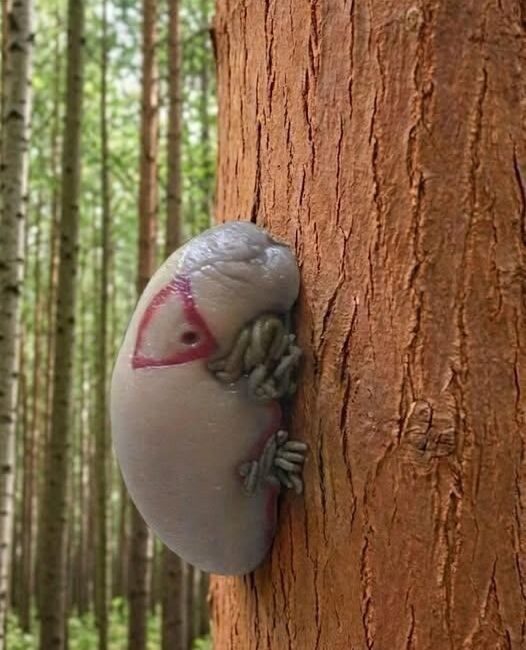
As the observer lingers, leaning closer, the object begins to take shape. It is not sharp or rigid, not fast or aggressive. Instead, it moves slowly—almost gracefully—across the surface. Its body glistens slightly, leaving behind a faint, reflective trail. The striking red triangle on its back becomes clearer, almost like a symbol intentionally placed there.
This is the moment when uncertainty transforms into curiosity. The question shifts from fear to fascination. And that shift is the beginning of understanding.
Introducing the Red Triangle Slug: A Misunderstood Marvel
The creature in question is known as the Red Triangle Slug, a species native to the eastern coastal regions of Australia. Its name comes directly from its most defining feature: a bold, triangular marking that sits prominently on its back, often in shades of red or orange. This geometric marking is rare in the animal kingdom, especially among soft-bodied invertebrates, which contributes to its striking and memorable appearance.
Unlike many animals that rely on speed or strength for survival, this slug depends on subtlety and adaptation. Its body is elongated, smooth, and flexible, allowing it to navigate through tight spaces, beneath logs, and within dense layers of leaf litter. The coloration varies slightly depending on the environment, but the red triangle remains a consistent signature.
Despite its unusual look, the Red Triangle Slug is entirely harmless to humans. It does not bite, sting, or produce toxins that pose any threat. In fact, its presence is often a sign of a healthy, balanced ecosystem.
Understanding this creature requires moving beyond surface impressions. What seems strange at first is often simply unfamiliar—and unfamiliarity is not the same as danger.
Habitat and Lifestyle: Life in the Shadows
The Red Triangle Slug thrives in environments that many people rarely explore closely. It prefers damp, shaded habitats where moisture is abundant and direct sunlight is limited. Forest floors, gardens with dense vegetation, and areas rich in decomposing organic matter provide the perfect conditions for its survival.
Moisture is essential. Like all slugs, this species relies on a thin layer of mucus to move and to protect its body from drying out. Without sufficient humidity, it becomes vulnerable to dehydration, which can be fatal. As a result, the Red Triangle Slug is most active during cooler, wetter periods—often at night, early morning, or after rainfall.
During the day, it remains hidden. Beneath logs, under rocks, or within layers of decaying leaves, it conserves moisture and avoids predators. This hidden lifestyle contributes to its mystery; many people encounter it only by chance.
Its movement is slow but efficient. The mucus it produces serves multiple purposes. It reduces friction, allowing the slug to glide smoothly over rough surfaces. It also creates a protective barrier against environmental hazards. Additionally, the trail it leaves behind can serve as a form of communication with other slugs, guiding them toward food sources or suitable habitats.
This quiet, deliberate way of life is a reminder that not all forms of existence are fast or visible. Some of the most important processes in nature happen slowly, out of sight.
The Science of Slowness: Movement and Adaptation
To truly understand the Red Triangle Slug, it is worth examining the mechanics of its movement. Unlike animals with limbs, slugs rely on muscular contractions along the underside of their bodies. These wave-like motions push the body forward, while the mucus layer reduces resistance.
This method of locomotion may seem inefficient compared to walking or running, but it is perfectly suited to the slug’s environment. It allows for precise control, enabling the slug to navigate uneven terrain, climb vertical surfaces, and even move upside down beneath objects.
The mucus itself is a remarkable substance. It is both adhesive and lubricating, capable of sticking to surfaces while still allowing movement. This dual property is an example of biological engineering at its finest. Scientists have studied similar substances for potential applications in medicine and materials science, highlighting how even the simplest organisms can inspire innovation.
Adaptation is not always about speed or strength. Sometimes, it is about efficiency, resilience, and the ability to function within specific environmental constraints. The Red Triangle Slug embodies this principle perfectly.
Diet and Ecological Role: Nature’s Quiet Recycler
One of the most important aspects of the Red Triangle Slug’s existence is its role in the ecosystem. It feeds primarily on decaying plant material—fallen leaves, rotting wood, and other organic debris. While this may not seem impressive at first glance, it is a critical function in maintaining ecological balance.
Decomposition is the process by which organic matter is broken down and returned to the soil. Without decomposers like slugs, fungi, and microorganisms, dead plant material would accumulate, and nutrients would remain locked away, unavailable for new growth.
By consuming and breaking down this material, the Red Triangle Slug helps release essential nutrients back into the soil. These nutrients support plant growth, which in turn sustains entire ecosystems. In this way, the slug plays a small but vital role in the cycle of life.
This process can be compared to recycling in human systems. Just as recycling reduces waste and conserves resources, decomposition ensures that nothing in nature is truly wasted. Every fallen leaf becomes part of something new.
Understanding this role shifts perspective once again. What might initially be seen as insignificant—or even undesirable—becomes essential when viewed within the larger system.
The Psychology of Perception: Why We Fear the Unfamiliar
Click page 2 to continue