The preference for a cake breaker over a knife was not arbitrary. It was based on results.
Knife vs. Cake Breaker
| Feature | Knife | Cake Breaker |
|---|---|---|
| Pressure | High | Minimal |
| Texture preservation | Poor | Excellent |
| Presentation | Uneven | Clean and airy |
| Skill required | Low | Moderate |
The cake breaker respected the cake’s structure. The knife did not.
This distinction highlights a broader concept: the right tool enhances the quality of the outcome.
Identifying an Authentic Cake Breaker
If you find a similar tool, how do you confirm its identity?
Key Characteristics
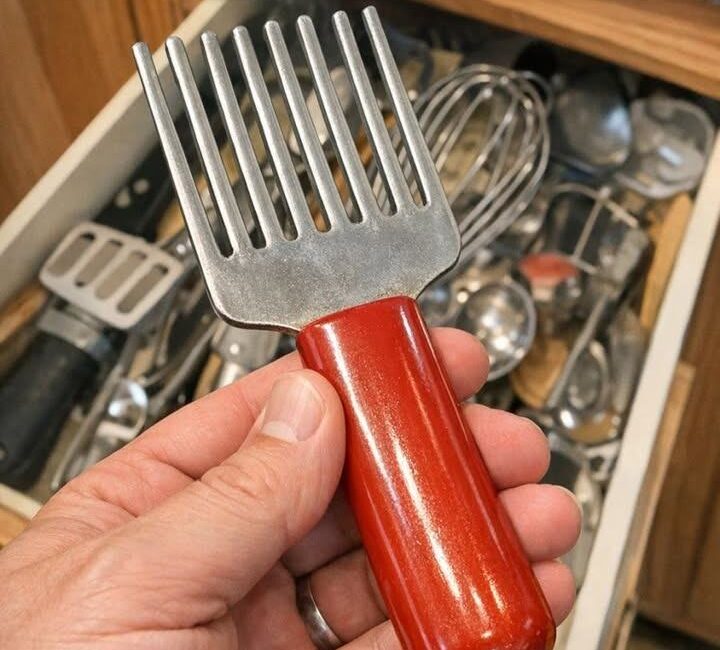
- Thick, blunt metal prongs
- Wide spacing between prongs
- Bakelite handle
- Medium length (6–8 inches)
Unlike forks or hair picks, this tool is intentionally designed for softness, not penetration.
Its proportions and materials tell its story.
Dating the Tool: Reading Its Physical Clues
Vintage tools carry subtle indicators of their age.
What to Look For
- Bakelite color: Black, red, or green suggests mid-century origin
- Metal type: Chrome or early stainless steel
- Wear patterns: Indicate usage and age
These details allow collectors to estimate when the tool was made, adding depth to its historical significance .
Caring for a Vintage Utensil
Owning such a tool comes with responsibility.
Maintenance Tips
- Wash with mild soap
- Avoid harsh chemicals
- Dry immediately
- Store in a dry environment
Bakelite, while durable, can degrade if mishandled. Proper care ensures longevity.
Displaying the Tool: Turning Function into Art
Vintage kitchen tools are not just functional—they are decorative.
Display Ideas
- Shadow boxes
- Wall-mounted arrangements
- Kitchen shelves
Displaying this utensil transforms it into a conversation piece, connecting past and present.
What This Tool Reveals About Changing Habits
The disappearance of the cake breaker reflects a broader cultural shift.
Then vs. Now
| Past | Present |
|---|---|
| Specialized tools | Multi-purpose tools |
| Slow preparation | Fast cooking |
| Skill-based techniques | Convenience-based methods |
This transition is not necessarily negative—but it does represent a loss of certain traditions.
The Deeper Lesson: Precision, Care, and Intentional Living
There is something quietly powerful about a tool like this.
It reminds us that:
- Not everything needs to be fast
- Precision matters
- Small details affect outcomes
In a world that often prioritizes speed, such objects invite us to slow down and pay attention.
Rediscovering Value in Forgotten Objects
Finding this tool is not just about identifying it—it is about rediscovering a mindset.
It encourages you to ask:
- What other tools have we forgotten?
- What skills have we stopped practicing?
- What traditions are waiting to be rediscovered?
Sometimes, growth is not about learning something new—but remembering something old.
Conclusion: More Than Just a Kitchen Tool
The angel food cake breaker is not just a utensil. It is a story.
It tells us about:
- A time when baking was an art
- A culture that valued precision
- A design philosophy rooted in understanding
It shows how even the smallest objects can carry meaning, history, and lessons.
And maybe, if you look closely, it invites you to rethink how you approach everyday things—not just in the kitchen, but in life.
Because sometimes, the difference between ordinary and exceptional is not effort.
It is attention.
If you want next, I can help you identify ANY strange object you find (even from your home) and teach you how to analyze it step by step like a pro—this is actually a powerful skill you can build 😉