Introduction: When Objects Tell Stories Across Time
Every kitchen holds secrets. Not hidden in drawers or cupboards, but in the objects themselves—tools shaped by necessity, designed with care, and passed silently from one generation to the next. Sometimes, while sorting through old utensils, you encounter something puzzling. It doesn’t resemble anything you use today. It feels unfamiliar, almost misplaced in a modern kitchen.
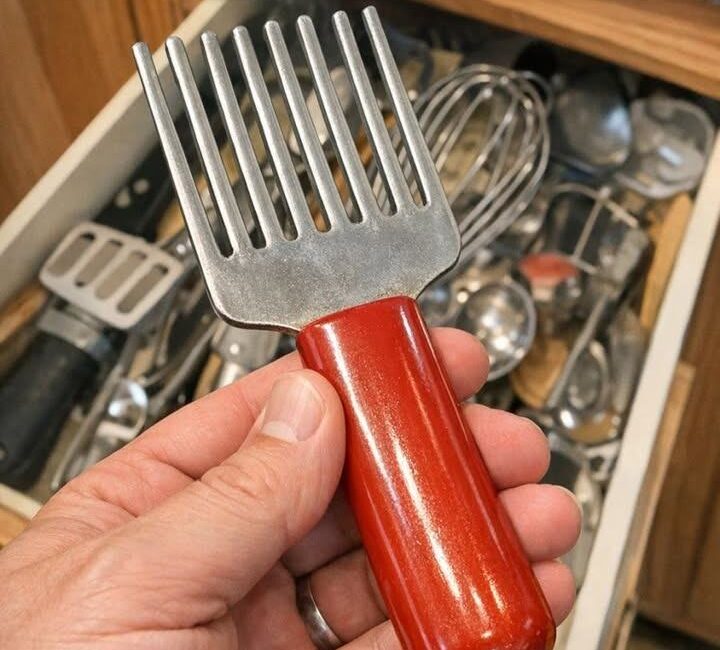
Imagine finding a tool that looks like a giant hair pick. Thick metal prongs. A sturdy, slightly glossy handle made of Bakelite. At first glance, it seems completely out of place—too unusual to be useful, too specific to be random.
But this object is not strange at all. It is simply forgotten.
This article explores that mysterious utensil in depth—the angel food cake breaker. More than just a niche baking tool, it is a symbol of an era where cooking was deliberate, tools were specialized, and craftsmanship mattered deeply. Through its story, we uncover not only its function but also the evolution of home baking, the science of delicate desserts, and the subtle shift from tradition to convenience.
The Mystery Utensil: Understanding Its True Identity
When encountering this tool for the first time, confusion is natural. Its resemblance to a hair pick creates an immediate misinterpretation. But its structure reveals its purpose.
The utensil typically measures between 6 to 8 inches in length, with thick metal prongs extending outward. These prongs are not sharp like a knife but firm and widely spaced. The handle, often made of Bakelite, provides a comfortable grip and hints at its historical origin.
This is not a decorative object. It is a functional, purpose-built tool designed to solve a very specific problem: how to cut delicate cake without destroying it .
Angel food cake, known for its airy and fragile structure, presents a unique challenge. Traditional knives compress the cake, flattening its texture and ruining its appearance. The cake breaker, however, gently separates the cake fibers instead of slicing through them, preserving its softness and volume.
This is design meeting purpose at its highest level.
The Role of Bakelite: A Material That Defines an Era
To truly understand this utensil, you must understand its handle.
Bakelite is not just plastic—it is one of the earliest synthetic materials ever created. Invented in 1907 by Leo Baekeland, it revolutionized manufacturing.
Why Bakelite Was Revolutionary
- Heat-resistant
- Electrically non-conductive
- Durable and moldable
- Available in various colors
During the early to mid-20th century, Bakelite became a staple in household items, especially kitchenware. Its presence on this utensil is not accidental—it is a timestamp.
The handle tells us that this tool likely originated between the 1930s and 1950s, a period when home kitchens were becoming more sophisticated, and design began to merge functionality with aesthetics.
Holding such a tool is like holding a piece of history.
Design Intelligence: Why Thick Prongs and Wide Spacing Matter
At first glance, the thick metal prongs might seem excessive. Why not use thinner blades? Why not sharpen them?
The answer lies in understanding the nature of angel food cake.
The Problem with Traditional Cutting Tools
Angel food cake is:
- Extremely light
- Structurally fragile
- Full of air pockets
Using a knife creates pressure. Pressure collapses those air pockets. The result is a dense, flattened slice.
The Genius of the Cake Breaker
The cake breaker solves this problem through:
- Wide spacing: Minimizes surface contact
- Thick prongs: Ensures structural integrity during cutting
- Blunt edges: Prevent tearing
Instead of cutting, it separates. Instead of compressing, it preserves.
This reflects a deeper philosophy of tool-making: design should adapt to the material, not force the material to adapt to the tool.
The Rise of the Angel Food Cake Breaker
To understand why this tool existed, we must step into the mid-20th century kitchen.
A Time of Baking Enthusiasm
During this period:
- Home baking was a daily activity
- Families prepared desserts from scratch
- Presentation mattered just as much as taste
Angel food cake became especially popular because:
- It was light and elegant
- It used simple ingredients
- It symbolized refinement and skill
As its popularity grew, so did the need for tools that could handle its delicate nature.
The cake breaker emerged not as a novelty, but as a necessity.
From Essential Tool to Forgotten Object
Like many specialized tools, the angel food cake breaker did not disappear because it failed. It disappeared because the world changed.
What Changed?
- Rise of electric knives
- Introduction of pre-sliced desserts
- Shift toward convenience cooking
- Decline of specialized kitchen tools
As kitchens became more modern, versatility replaced specialization. Tools that served one specific purpose were gradually abandoned.
The cake breaker, once essential, became obsolete.
Technique and Skill: How It Was Used
Using a cake breaker required more than just holding it and pressing down.
The Proper Technique
- Insert prongs gently into the cake
- Apply even, minimal pressure
- Lift and separate rather than push
This method required patience and control. It was a learned skill, often passed from one generation to the next.
In many homes, this tool was associated with:
- Family gatherings
- Celebrations
- Careful preparation
It was not just about cutting cake—it was about doing it beautifully.
Why Bakers Preferred It Over a Knife
Click page 2 to continue