It started like something out of a suspense story.
You flipped the mattress — just a simple cleaning routine. Sunlight angled across the bed frame. Sheets were half folded. Everything felt ordinary.
Until it wasn’t.
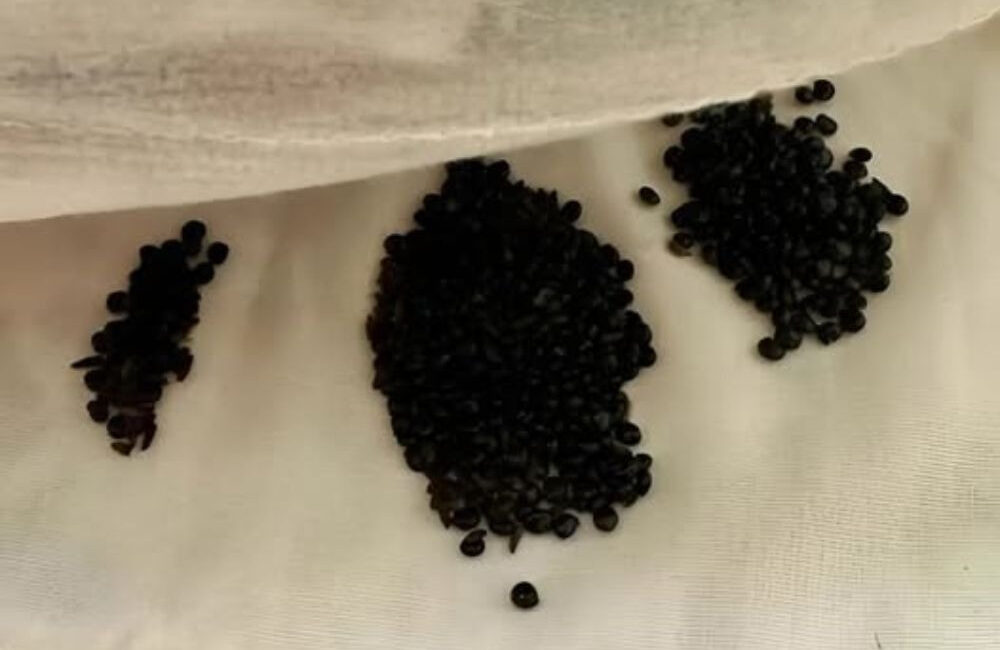
In the corner, tucked almost invisibly into the seam where mattress met wood, was a small cluster of tiny black grains.
Not dust.
Not dirt.
Not fabric debris.
They were dull but faintly glossy, like miniature fragments of charcoal. Compact. Uniform. Intentional.
Your stomach tightened.
The brain is fast at pattern recognition — sometimes too fast. Tiny black grains under a mattress? The most immediate, ancient alarm goes off: infestation.
Roaches.
Beetles.
Egg sacs.
Your skin reacts before logic does.
You scoop a few onto paper. They are hard. Dry. Lifeless.
Not moving.
So what are they?
Then comes the twist.
Not insect eggs.
Not droppings.
Not decay.
Kalonji.
Black cumin seeds.
And suddenly the narrative shifts from horror to heritage.
But this moment — this pivot from fear to revelation — is more fascinating than it first appears.
Because beneath it lies something profound: the intersection of biology, symbolism, tradition, psychology, and the way humans quietly try to protect the people they love.
Let’s unpack what really happened.
First: What Kalonji Actually Is
Kalonji is the common name for the seeds of Nigella sativa, sometimes called black cumin, black seed, or black caraway.
They are:
- Small
- Angular
- Matte black
- Slightly glossy
- Roughly 2–3 millimeters long
They are widely used in:
- South Asian cuisine
- Middle Eastern cooking
- North African dishes
- Traditional medicine systems
If you’ve ever eaten naan sprinkled with tiny black seeds, or certain Moroccan breads, you’ve likely tasted kalonji.
They are aromatic, slightly bitter, with a peppery and onion-like undertone.
But their cultural role goes far beyond seasoning.
Why Your Brain Jumped to “Insect Eggs”
Before we go into folklore, let’s pause at the psychological reaction.
You saw:
Tiny black grains
Hidden under mattress
Clustered
Your brain immediately ran a threat analysis.
Humans evolved to detect patterns associated with contamination or parasites quickly. It’s an adaptive survival mechanism.
Anything small, clustered, and unexpected in sleeping areas triggers:
- Disgust reflex
- Parasite detection bias
- Threat anticipation
This happens before conscious reasoning.
The amygdala — the brain’s threat detector — activates in milliseconds.
Even if the seeds were harmless, your nervous system reacted first.
Fear is faster than curiosity.
But curiosity won.
That’s important.
Kalonji in Traditional Healing: Protection and Blessings
When your friend said, “Those are kalonji — someone placed them intentionally,” the story shifted from infestation to intention.
Across many cultures, kalonji has held symbolic power.
In Islamic tradition, black seed is referenced in prophetic medicine as a remedy “for every disease except death.”
In South Asian households, kalonji is used for:
- Digestive support
- Cold remedies
- Immune boosting
- Anti-inflammatory purposes
But beyond medicine, it has also been used symbolically.
In various folk practices, black seeds were placed:
- Under mattresses
- Near door thresholds
- In pillows
- Sewn into clothing
Not as magic in the theatrical sense.
But as quiet protection.
A physical symbol of:
Blessing
Safeguarding
Intention
Care
Your grandmother didn’t place random seeds.
She placed meaning.
The Anthropology of Hidden Charms
Across cultures, humans have always hidden protective objects in sleeping spaces.
Why the bed?
Because sleep is vulnerability.
When you sleep:
- You cannot defend yourself
- Your awareness drops
- Your body repairs itself
- Your subconscious becomes active
Beds are symbolic spaces of:
Rest
Healing
Dreaming
Safety
People have historically placed:
- Garlic (against illness or evil)
- Salt (for purification)
- Lavender (for calm sleep)
- Bay leaves (for protection)
- Black seeds (for warding negativity)
Whether or not one believes in “evil energy,” the act itself carries psychological weight.
It says:
“I care about your safety.”
That matters.
The Science of Black Cumin: Beyond Symbolism
Here’s where things get interesting.
Kalonji isn’t just symbolic.
Modern research has examined Nigella sativa for its active compound:
Thymoquinone.
Studies suggest potential properties including:
- Anti-inflammatory effects
- Antioxidant activity
- Antimicrobial potential
- Mild immune modulation
It has been explored in research related to:
- Asthma
- Diabetes
- Hypertension
- Skin conditions
Now, placing seeds under a mattress does not activate these biological properties in any measurable way.
But the plant itself does have scientifically studied effects.
Which means the line between folklore and pharmacology is not entirely imaginary.
Many traditional practices originated from empirical observation long before lab science existed.
Why Your Grandmother Did It
When she chuckled and said:
“Ah, you found it? May it keep you safe.”
That wasn’t superstition.
That was love expressed through tradition.
Older generations often practice what anthropologists call “protective rituals.”
These rituals:
- Reduce anxiety for the giver
- Express care nonverbally
- Maintain cultural continuity
- Provide symbolic comfort
She noticed you were restless.
Instead of lecturing you.
Instead of dramatic intervention.
She quietly placed seeds.
Not to control.
Not to manipulate.
But to bless.
It was an act of intention.
The Psychology of Ritual
Click page 2 to continue