Introduction: A Simple Challenge That Tests More Than Your Eyes
At first glance, the challenge sounds playful, almost effortless:
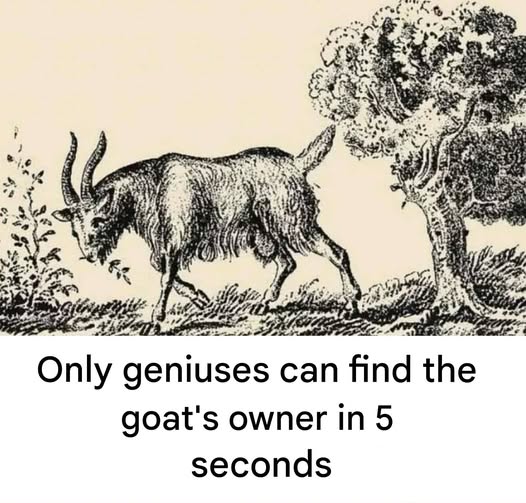
“Find the goat’s owner in 5 seconds.”
You imagine a quick scan, a fast answer, and perhaps a sense of satisfaction. After all, how difficult could it be? A goat, a setting, and somewhere nearby—its owner.
But then you look more carefully.
The image is not as straightforward as expected. Details blur together. Shapes overlap. The obvious becomes uncertain. Seconds pass, and suddenly, what seemed simple becomes complex.
This is not just a visual puzzle.
It is a carefully designed cognitive challenge that tests:
- Your attention span
- Your visual processing speed
- Your ability to filter distractions
- Your pattern recognition skills
- Your capacity for rapid decision-making
The claim that “only geniuses can solve it in 5 seconds” is not a scientific statement, but it serves a purpose: it increases pressure, sharpens focus, and activates competitive curiosity.
In this article, we will explore this puzzle far beyond its surface. You will learn:
- Why such illusions are harder than they appear
- How your brain processes visual information under time pressure
- What makes someone a “fast observer”
- How attention and perception shape your success
- How to train your brain to improve these skills
Because the real challenge is not about finding the goat’s owner.
It is about understanding how you see.
The Nature of Optical Illusions: Why Your Brain Gets Tricked
Optical illusions are not mistakes in your vision—they are shortcuts in your brain.
Your brain is constantly trying to:
- Simplify information
- Recognize familiar patterns
- Make quick decisions
To do this, it relies on assumptions.
Concept to Learn: Cognitive Shortcuts (Heuristics)
Heuristics are mental shortcuts that help you process information quickly. They allow you to:
- Recognize faces instantly
- Navigate environments efficiently
- Make rapid judgments
But they come with a cost:
👉 They can lead to errors when the situation is complex or deceptive.
In puzzles like this one, the illusion is designed to exploit these shortcuts.
Why the Puzzle Feels Difficult: Hidden Complexity
When you are asked to find the goat’s owner, your brain immediately creates expectations:
- The owner will be clearly visible
- The owner will stand near the goat
- The relationship will be obvious
But the image challenges these expectations.
The owner may be:
- Blended into the background
- Camouflaged within shapes
- Positioned in a way that defies your assumptions
This creates confusion.
Concept to Learn: Visual Camouflage
Visual camouflage occurs when:
- Objects blend into their surroundings
- Edges are not clearly defined
- Patterns overlap in misleading ways
Your brain struggles because it cannot easily separate figure from background.
The Role of Time Pressure: Why “5 Seconds” Matters
The instruction to solve the puzzle in 5 seconds is not random.
It introduces:
- Urgency
- Stress
- Cognitive load
Concept to Learn: Time-Constrained Cognition
When you are under time pressure:
- Your brain relies more on intuition
- You scan faster but less deeply
- You may miss subtle details
This is why many people fail—not because they lack intelligence, but because the brain prioritizes speed over accuracy.
How the Brain Searches: The Science of Visual Scanning
When you look at an image, your eyes do not move randomly.
They follow patterns:
- Initial scan (broad overview)
- Focus on high-contrast areas
- Search for familiar shapes
- Refine attention to smaller details
In this puzzle, the challenge is that:
👉 The owner is likely hidden in a way that avoids all these natural scanning patterns.
The Hint: “Look Around the Tree” — Why It Matters
Hints are designed to redirect attention.
Without a hint, your brain may:
- Focus on the goat
- Ignore the surroundings
- Miss contextual clues
The mention of a tree changes your focus.
Concept to Learn: Guided Attention
Guided attention means:
👉 Your focus can be directed externally, not just internally.
This is why hints can dramatically improve performance.
What Makes Someone a “Fast Observer”?
The idea of a “genius” solving the puzzle quickly is not about IQ alone.
It is about specific cognitive skills:
1. Selective Attention
The ability to ignore irrelevant information and focus only on what matters.
2. Pattern Recognition Speed
The ability to quickly identify shapes and relationships.
3. Cognitive Flexibility
The ability to shift perspective when the first interpretation fails.
4. Visual Memory
The ability to remember patterns and compare them instantly.
Concept to Learn: Observation vs Intelligence
Observation is a skill—not a fixed trait.
It can be trained and improved over time.
Common Mistakes People Make in This Puzzle
1. Focusing Only on the Goat
People assume the answer is near the most obvious object.
2. Ignoring Background Details
The owner is often hidden in less noticeable areas.
3. Rushing Without Processing
Click page 2 to continue