Speed without focus leads to missed information.
4. Sticking to One Perspective
Many fail because they do not change how they look at the image.
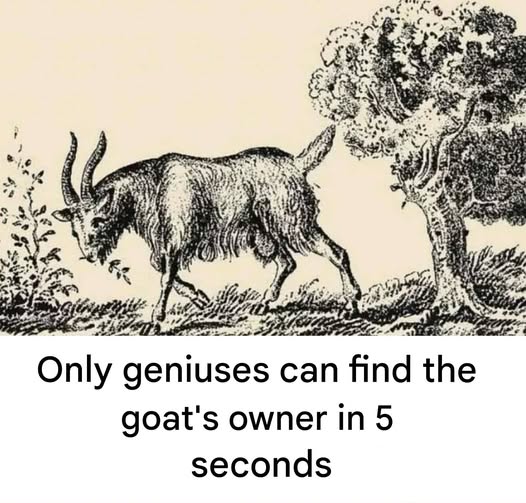
The Hidden Owner: How Illusions Conceal Information
In many puzzles like this, the “owner” is not visible as a full figure.
Instead, it may appear as:
- A face formed by shadows
- A silhouette created by shapes
- A hidden outline within the tree
Concept to Learn: Gestalt Perception
Gestalt psychology explains how we perceive whole forms rather than separate parts.
Your brain tries to:
- Group elements
- Create meaning
- Recognize patterns
But when patterns are disguised, recognition becomes difficult.
Training Your Brain: How to Improve Observation Skills
You can significantly improve your ability to solve such puzzles.
1. Slow Down Your First Look
Instead of rushing, take one second to observe the entire image.
2. Divide the Image into Sections
Scan systematically:
- Top to bottom
- Left to right
3. Look for Unusual Shapes
Focus on:
- Irregular patterns
- Distorted lines
- Unexpected symmetry
4. Change Your Perspective
Try:
- Looking from a distance
- Tilting your head
- Squinting your eyes
5. Practice Regularly
Repeated exposure improves:
- Speed
- Accuracy
- Confidence
The Psychological Appeal: Why These Challenges Go Viral
These puzzles are popular because they combine:
- Curiosity
- Competition
- Self-evaluation
When you see:
“Only geniuses can solve this”
Your brain reacts with:
👉 A desire to prove capability
The Truth About “Genius” in These Tests
The word “genius” is often used as a marketing trigger.
In reality, success depends on:
- Focus
- Strategy
- Practice
Not innate intelligence alone.
Beyond the Puzzle: Real-Life Applications of Observation Skills
The skills used here apply to many areas:
1. Work and Productivity
- Noticing details others miss
- Identifying problems early
2. Social Awareness
- Reading body language
- Understanding subtle cues
3. Decision-Making
- Evaluating situations quickly
- Avoiding obvious mistakes
The Deeper Lesson: Seeing vs Observing
There is a difference between:
- Seeing → passive
- Observing → active
This puzzle trains you to move from one to the other.
Why Some People Solve It Instantly
People who solve it quickly often:
- Have trained visual attention
- Stay calm under pressure
- Avoid overthinking
They do not just look—they scan with intention.
Conclusion: The Real Meaning of the Challenge
The goat puzzle is not just a game.
It is a test of:
- Awareness
- Focus
- Perception
It teaches that:
- What you see depends on how you look
- Speed comes from clarity, not pressure
- Observation is a skill you can develop
So whether you found the owner in 5 seconds or needed more time, the real achievement is not the answer.
It is understanding the process behind your search.
Because once you learn how to observe deeply, you begin to see the world differently.
And that is far more valuable than solving any puzzle.