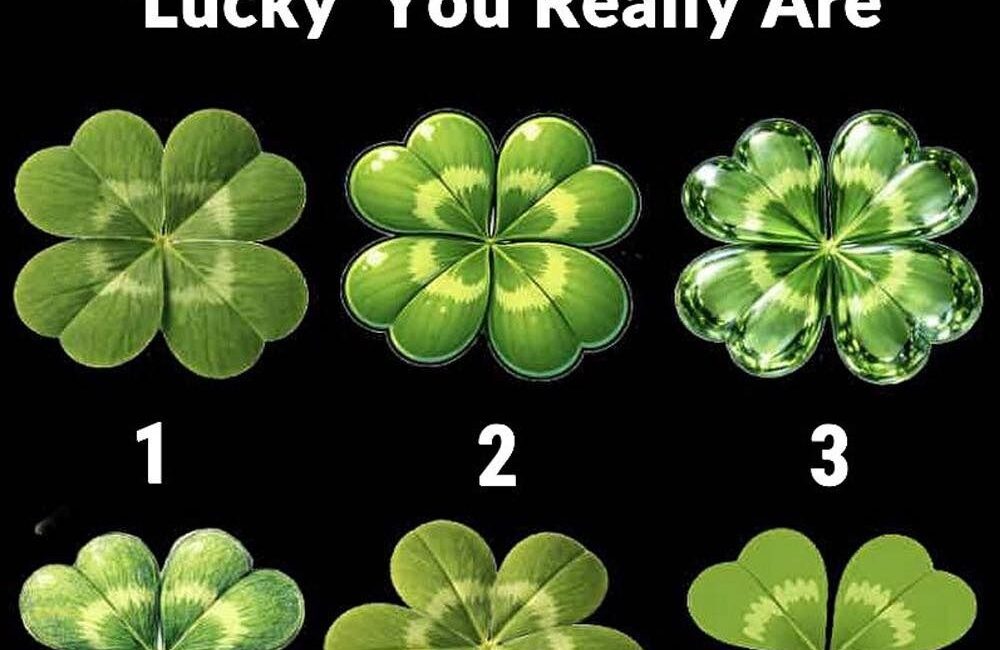
Introduction: A Simple Game That Isn’t So Simple
At first glance, the challenge seems almost childlike in its simplicity. You are presented with six clovers—each one subtly different—and asked to do one thing:
Pick the odd one out.
It feels like a quick visual puzzle, the kind you might scroll past or share casually. But then something interesting happens. You hesitate. You look again. You compare shapes, shades, textures. Suddenly, what seemed obvious becomes uncertain.
And then comes the intriguing twist:
Your choice is said to reveal how “lucky” you are.
But here is the deeper truth—this is not about luck at all.
This kind of visual test taps into something far more powerful:
- How you perceive patterns
- How your brain filters information
- How you make decisions under uncertainty
- How you interpret the world around you
In this article, we will go far beyond the surface of this puzzle. You will explore the psychology behind it, understand what your choice may reflect about your thinking style, and uncover the real meaning of “luck” from a cognitive and behavioral perspective.
Because in reality, this is not a game about clovers.
It is a mirror of the mind.
The Nature of Visual Puzzles: Why They Fascinate Us
Human beings are naturally drawn to puzzles that challenge perception. These exercises activate multiple cognitive systems at once, including:
- Visual processing
- Pattern recognition
- Memory comparison
- Decision-making
When you are asked to find the “odd one out,” your brain immediately begins scanning for differences. It searches for:
- Variations in color
- Changes in shape
- Irregularities in symmetry
- Differences in texture
This process happens rapidly, often within seconds.
Concept to Learn: Pattern Recognition
Pattern recognition is one of the brain’s most essential functions. It allows you to:
- Identify faces
- Understand language
- Detect danger
- Make quick decisions
However, this ability also has a limitation:
👉 Your brain sees patterns based on what it expects, not just what is actually there.
This is why different people can look at the same image and choose completely different answers.
Why There May Be No Single Correct Answer
Traditional puzzles usually have one correct solution. But this type of visual test operates differently.
Each clover appears “normal” in its own way, yet also slightly unique. This creates ambiguity.
And ambiguity is the key.
Concept to Learn: Cognitive Ambiguity
Cognitive ambiguity occurs when:
- Multiple interpretations are possible
- No single answer is definitively correct
- Perception depends on personal focus
In such situations, your choice becomes less about correctness and more about:
👉 What your brain prioritizes.
How the Brain Chooses: The Invisible Process Behind Your Decision
When faced with multiple options, your brain does not analyze everything equally. Instead, it follows a hierarchy:
- Immediate attention (what stands out first)
- Pattern comparison (what feels different)
- Emotional or intuitive response
- Final decision based on internal confidence
This entire process can happen in seconds.
Concept to Learn: Cognitive Filtering
Your brain filters information based on:
- Past experiences
- Personal preferences
- Emotional tendencies
- Cognitive habits
This means your choice reflects not just what you see—but how you think.
Interpreting Each Choice: What Your Selection Suggests About Your Thinking Style
While this test is not scientifically diagnostic, it offers meaningful insights into cognitive tendencies.
If You Chose #1: The Grounded Observer
You are drawn to what appears natural and authentic.
This suggests:
- Strong attention to realism
- Preference for clarity over complexity
- Focus on what feels “true” rather than what stands out
You likely approach life with a practical mindset, valuing stability and reliability.
If You Chose #2: The Balanced Analyst
You noticed subtle differences and sought harmony.
This indicates:
- Analytical thinking
- Ability to compare details carefully
- Preference for measured decisions
You tend to evaluate options before acting, avoiding impulsive choices.
If You Chose #3: The Bold Differentiator
You were attracted to something that looked striking or unusual.
This reflects:
- Appreciation for uniqueness
- Attraction to contrast and boldness
- Willingness to challenge norms
You may be more open to risk and innovation.
If You Chose #4: The Creative Perceiver
You noticed texture, layers, or complexity.
This suggests:
- High visual sensitivity
- Imaginative thinking
- Ability to see beyond the obvious
You often perceive depth where others see simplicity.
If You Chose #5: The Intuitive Thinker
Your choice may not be easy to explain logically.
This indicates:
- Strong reliance on instinct
- Emotional intelligence
- Quick, subconscious decision-making
You trust your “feeling” more than structured analysis.
If You Chose #6: The Practical Decision-Maker
You preferred clarity and simplicity.
This reflects:
- Efficiency in thinking
- Preference for straightforward solutions
- Focus on function over form
You are likely decisive and action-oriented.
The Illusion of Luck: What This Test Really Reveals
Click page 2 to continue