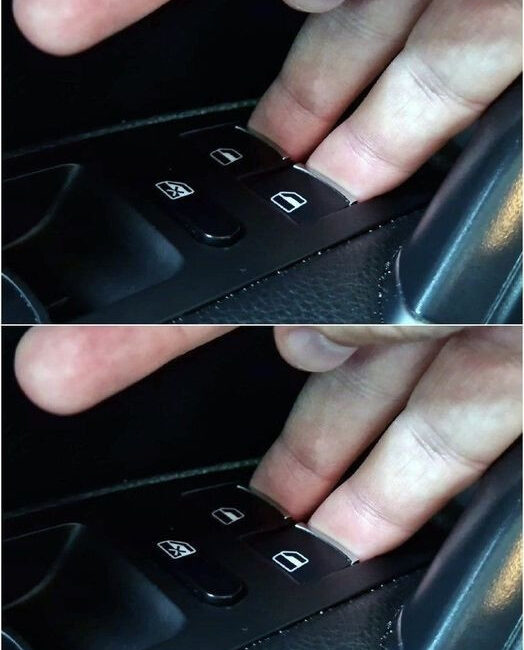
If you’ve ever sat in a car and noticed a driver briefly pressing two power window buttons at once, you may have assumed it was a nervous habit, a mistake, or simple impatience. It looks oddly specific—too deliberate to be accidental—yet most people never explain why they do it.
What’s surprising is this:
in many vehicles, this is not a random gesture at all.
It’s a quiet workaround, a learned behavior, or a way of accessing hidden or semi-hidden window functions that manufacturers rarely explain clearly.
Let’s slow down and unpack what’s really happening—because this small action reveals a lot about how modern cars are designed, and how drivers adapt to those designs.
First: There Is No Universal “Secret Button”… but There Is a Pattern
Before myths take over, one important clarification:
There is no single, universal secret function that works in every car when you press two window buttons at the same time.
However, across many brands and models, pressing two window buttons simultaneously can:
- Override safety lock behavior
- Reset window calibration
- Bypass faulty auto-up / auto-down logic
- Synchronize window movement
- Regain manual control when electronics misbehave
In other words, it’s not magic—it’s human problem-solving in response to digital systems.
1. Overriding a Child Safety or Window Lock Logic
Many modern cars have a window lock designed to prevent rear passengers (especially children) from operating their windows.
In some models:
- The lock doesn’t fully disable input
- The system still “listens” to multiple signals
Pressing two window buttons at once—especially the driver’s window plus a rear window—can momentarily override the logic, allowing the driver to regain control when:
- A rear window gets stuck halfway
- The system refuses a single-button command
- The lock logic glitches
Drivers who’ve experienced this once often remember it forever and repeat it instinctively.
2. Resetting Auto-Up / Auto-Down When It Stops Working
This is one of the most common real reasons drivers do this.
Power windows with one-touch auto-up and auto-down rely on calibration. The car needs to know:
- Where “fully closed” is
- Where “fully open” is
- How much resistance is normal
If the battery is disconnected, voltage drops, or the motor strains, the system can lose this calibration.
Symptoms include:
- Window stops halfway
- Auto-up no longer works
- Window reverses direction unexpectedly
Pressing two window buttons—often holding one up while tapping or holding another—can:
- Force the motor to relearn limits
- Re-engage manual control mode
- Stabilize the control module
Some drivers learn this from mechanics. Others discover it accidentally during frustration.
3. Forcing Manual Control When Auto Mode Is Too Sensitive
Modern windows are designed to stop or reverse if they sense resistance (to avoid injuries).
But this sensitivity can backfire:
- Cold weather stiffens seals
- Dust increases friction
- Slight misalignment triggers safety reversal
When this happens, auto-up refuses to close the window.
Pressing two buttons at once can:
- Disable auto mode temporarily
- Force continuous motor movement
- Allow the window to close fully
It’s not officially advertised—but drivers notice it works.
4. Synchronizing Front and Rear Windows (Airflow Control)
Some drivers press two window buttons intentionally to:
- Lower two windows at the same speed
- Control airflow without opening windows unevenly
- Reduce wind buffeting (that low-frequency “booming” sound)
Opening diagonally opposite windows—or front + rear—changes cabin pressure dramatically.
Pressing two buttons at once allows:
- Faster pressure equalization
- Less noise
- Better ventilation
This is especially common among drivers who spend a lot of time on highways.
5. Compensating for Worn or Inconsistent Switches
Power window switches wear out long before motors do.
Aging switches can:
- Miss inputs
- Send partial signals
- Respond inconsistently
Pressing two buttons simultaneously increases the chance that:
- One signal gets through
- The control module responds
- The window moves
This is not a design feature—it’s a workaround born from experience.
6. Muscle Memory From Older Cars and Fleet Vehicles
Click page 2 for more