Drivers who’ve used:
- Taxis
- Company cars
- Older vehicles
- Mixed-brand fleets
often develop habits that don’t apply everywhere but work often enough to be retained.
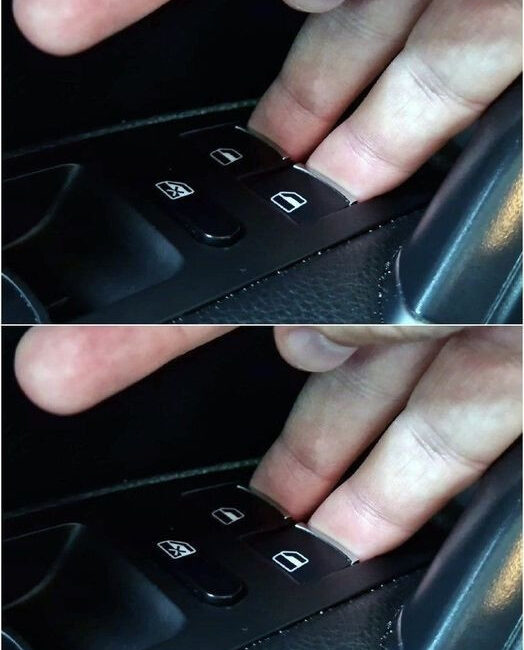
Pressing two buttons becomes:
- A reflex during window issues
- A stress response
- A learned “fix” that worked once
Human brains are excellent at remembering what solved a problem under pressure, even if the logic isn’t fully understood.
7. Why Manufacturers Don’t Talk About This
Car manufacturers avoid advertising behaviors like this because:
- It’s inconsistent across models
- It can confuse users
- It’s not guaranteed
- It complicates liability and safety explanations
Instead, manuals describe ideal conditions, not real-world quirks.
Drivers, meanwhile, live in the real world.
The Bigger Picture: What This Behavior Really Reveals
This small habit reveals something important:
Modern cars are software-driven machines, but humans still expect mechanical certainty.
When digital logic fails—or feels unpredictable—drivers instinctively:
- Combine inputs
- Try overrides
- Search for “control”
Pressing two window buttons is not about a secret feature.
It’s about regaining authority over a system that feels too clever for its own good.
Final Thought
When you see a driver pressing two power window buttons at the same time, you’re not witnessing superstition or impatience.
You’re seeing:
- Experience
- Adaptation
- A quiet negotiation between human intuition and automated systems
It’s a reminder that even in highly engineered machines, real functionality often lives in the gray area between design and use.
And sometimes, the most effective “hidden feature” is simply knowing how the system behaves when it doesn’t behave as expected.