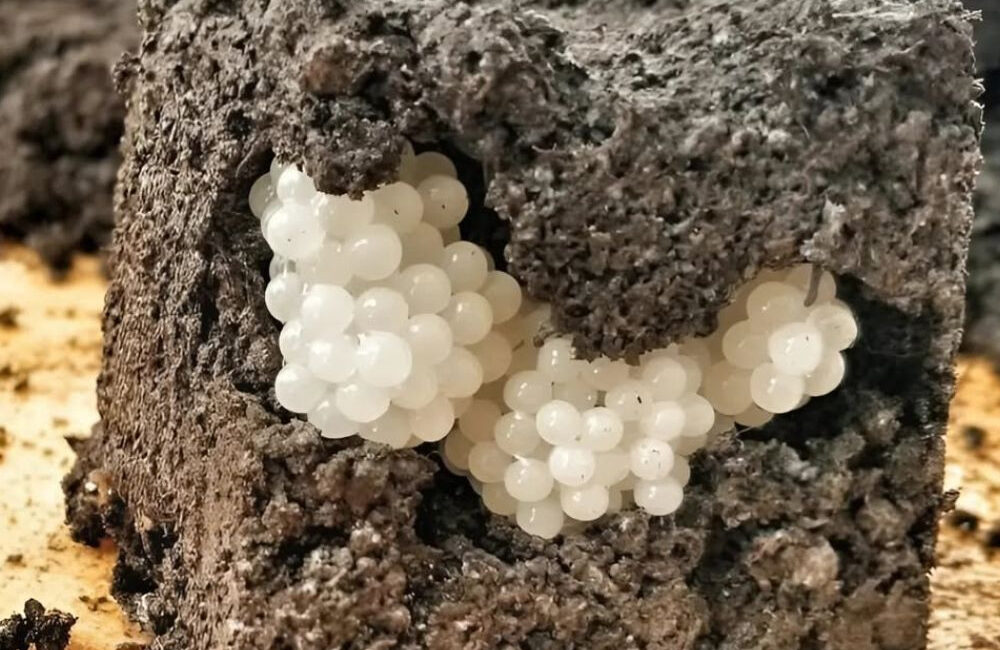
It started innocently enough—a late afternoon stroll through the backyard, the kind you take without thinking, just to enjoy the air and the sound of your own footsteps on the soil. But that day, something caught my eye. A patch of earth near the corner of the garden looked… odd. The texture was different, as if someone had sprinkled something across it. I bent closer, squinting, and saw dozens of tiny, white, round balls half-buried in the dirt.
At first, I thought it was litter—maybe styrofoam pellets from an old packaging box, or beads from a child’s toy. But the closer I looked, the less artificial they seemed. Each one was perfectly smooth, slightly translucent, and eerily uniform, like pearls that had fallen from a broken necklace.
I reached out to touch one—but hesitated. There was something alive about them, something fragile and secretive. My instincts buzzed with unease.
Still, curiosity won. I went inside, put on gloves, and came back with a small trowel. The soil around the strange patch was loose, almost freshly turned. I pressed the blade into the earth and began to lift them out gently.
They were soft—springy, like jelly—and cool to the touch. The texture made me shudder. These weren’t stones or seeds. They were organic.
That’s when it hit me: eggs.
But eggs of what?
The Uneasy Mystery of the White Balls
I gathered a few and placed them on a flat tray, bringing them closer to the house where the light was better. Holding one up to the sunlight, I saw something that made my stomach tighten—a faint dark shadow inside, suspended in the translucent gel. Some of the spheres even had tiny veins running through them, so faint I could have missed them if I wasn’t looking closely.
It didn’t take long for my mind to spiral. Were they frog eggs? Snake eggs? Or something worse—insect larvae about to hatch?
I remembered seeing a few tiny flies hovering around that corner of the garden earlier that week. But no—these were too large for insect eggs. Too perfect.
I leaned in closer, turning one over with a gloved finger. The surface was glistening and moist, and when I pressed lightly, it yielded under pressure but didn’t burst. A faint earthy smell rose from the cluster.
Something inside me whispered that I shouldn’t have touched them.
Searching for Answers
I did what any modern human would do when faced with a mystery that walks the line between science and horror—I went straight to the Internet.
I typed the words “white jelly balls in soil,” then “small white eggs in garden,” and what appeared made my skin crawl.
Possibility one: slug or snail eggs.
That’s right. What I had found might be a nest of snail eggs—a cluster laid just beneath the soil, protected from sunlight. They’re small, round, and translucent, with a soft, gel-like consistency. Depending on humidity, they can appear pearly white or faintly opaque.
The dark spot I saw inside some of them? That was the embryo developing—a baby snail curled inside its delicate shell-to-be.
It sounded harmless enough. Snails are slow, quiet creatures, hardly terrifying. But the thought of hundreds of them hatching under my garden soil, creeping unseen through roots and leaves, made my stomach twist.
Then I kept reading.
When the Internet Makes It Worse
In some forums, people posted pictures that looked exactly like what I’d found—but the explanations varied wildly.
Some said they were spider egg sacs that had burst open. Others claimed they were frog spawn washed ashore after rain. One person insisted they were fungal growths—a rare kind called slime molds, which can move and pulse slowly as if alive.
And then came the horror stories:
Clusters of parasitic fly larvae, hatched from eggs buried by their mothers under damp soil.
Fungal spheres that, when touched, release spores capable of triggering allergic reactions.
Even cases where homeowners discovered snake eggs, leathery and soft, hidden near compost piles or under old boards.
Each possibility seemed worse than the last.
I went back to the window, looking at the tray of eggs on my kitchen counter. Under the warm light, they seemed to shimmer faintly, as if breathing.
That’s when I realized I had made a mistake bringing them inside.
Understanding What They Really Are
After several tense minutes of reading and comparing images, I finally found the most probable answer—and thankfully, it wasn’t something deadly.
What I had discovered was almost certainly a cluster of snail eggs, most likely from garden snails (Cornu aspersum or Helix aspersa).
They lay eggs in small holes in damp soil, usually between 30 and 120 eggs at a time, depending on the species. The eggs are small—about 3 to 4 millimeters—and perfectly round, with a pearly appearance.
Click page 2 for more