Introduction: When a Simple Symbol Holds a Life Story
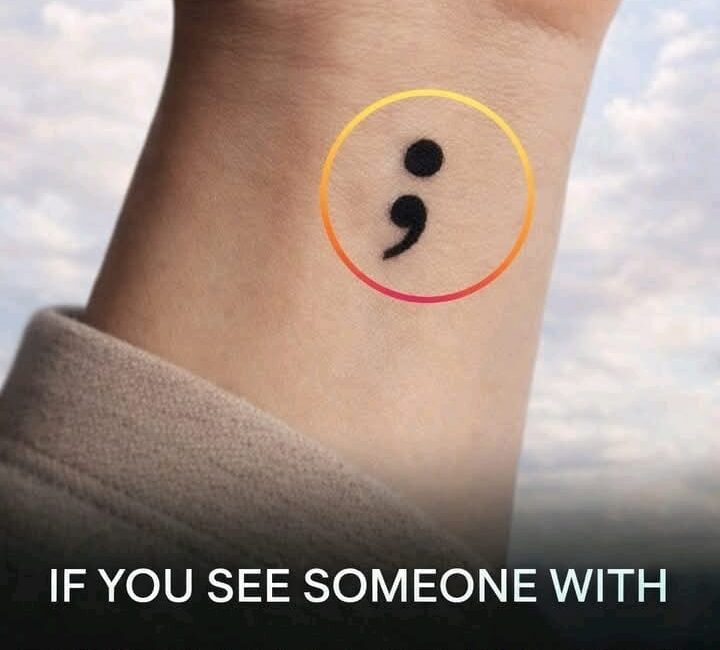
At first glance, it is almost invisible. A tiny mark inked delicately onto the skin—often on the wrist, behind the ear, or along the finger. It is not elaborate. It does not demand attention. It does not immediately reveal its meaning to everyone who sees it. And yet, for those who understand, it speaks volumes.
The semicolon tattoo is one of the most powerful examples of how minimal design can carry immense emotional depth. What appears to be a simple punctuation mark has evolved into a global symbol of resilience, survival, and the quiet strength required to continue life in the face of overwhelming challenges.
This is not just a tattoo. It is a statement. A decision. A moment captured permanently.
For many, it represents a turning point—a choice made during a period of darkness to keep going rather than stop. It is a mark of survival that does not erase pain but acknowledges it, integrates it, and transforms it into something meaningful.
In this article, you will explore the semicolon tattoo far beyond its surface. You will understand its psychological, emotional, and cultural significance. You will learn how such a small symbol can represent identity, healing, and personal transformation. And most importantly, you will gain insight into the deeper human need to express struggle, resilience, and hope in a way that words often cannot fully capture.
The Origins of the Semicolon as a Symbol: From Grammar to Meaning
What a Semicolon Means in Language
In writing, a semicolon is used to connect two closely related ideas. It represents a pause—not a full stop. It signals that while a sentence could have ended, the writer chose to continue.
This grammatical function is simple, but its metaphorical power is extraordinary.
A semicolon says:
- This could have ended here
- But it didn’t
This idea, when applied to life, becomes deeply emotional.
The Transformation Into a Life Symbol
The semicolon transitioned from punctuation to symbolism when people began to interpret it as a reflection of human experience.
Life, like writing, contains moments where the story could end—moments of pain, despair, confusion, or emotional overwhelm. The semicolon represents the decision to continue writing that story.
It becomes a declaration:
- My story is not over
- I am still here
- I chose to continue
This shift from grammar to meaning is what gives the semicolon its unique emotional power.
The Rise of the Semicolon Tattoo: A Cultural Movement
The Birth of a Global Symbol
The semicolon tattoo gained widespread recognition through a mental health awareness initiative that encouraged people to use the symbol as a way to express solidarity, survival, and support.
What made this movement powerful was its simplicity. There was no need for long explanations or complex imagery. A single symbol could communicate an entire emotional journey.
Why It Spread So Quickly
The semicolon resonated globally because it fulfilled several emotional needs:
- Visibility without exposure: People could express their story without having to explain it publicly
- Connection without words: Others who recognized the symbol instantly understood its meaning
- Strength without noise: It was subtle, yet deeply powerful
In a world where mental health struggles are often hidden, the semicolon became a quiet but visible signal of understanding.
The Psychology Behind the Semicolon Tattoo
Why Humans Use Symbols to Express Emotion
Humans have always used symbols to communicate complex ideas and emotions. From ancient carvings to modern tattoos, symbols allow us to express what words cannot fully capture.
The semicolon works because it:
- Simplifies a complex experience
- Creates a shared meaning
- Allows personal interpretation
The Role of Identity
Getting a tattoo is not just an aesthetic decision—it is an identity statement.
When someone chooses a semicolon tattoo, they are saying:
- This experience is part of who I am
- I acknowledge my journey
- I accept my story
This reinforces identity in a powerful way.
Emotional Anchoring
A tattoo acts as a physical anchor for emotional meaning.
Every time the person sees the semicolon, it reminds them:
- Of what they went through
- Of their strength
- Of their decision to continue
This can be especially important during difficult moments.
The Emotional Meaning: Resilience, Survival, and Continuation
Resilience: The Ability to Keep Going
Resilience is not about avoiding hardship. It is about continuing despite it.
The semicolon represents:
- Strength in vulnerability
- Persistence through difficulty
- Growth after struggle
It acknowledges that life is not perfect—but it is still worth continuing.
Survival: A Quiet Victory
For many, the semicolon tattoo marks survival.
Not in a dramatic or visible way—but in a deeply personal one.
It says:
- I faced something difficult
- I am still here
This is a powerful statement, even if it is never spoken aloud.
Continuation: The Core Message
At its heart, the semicolon represents continuation.
Life is not a straight line. It is full of pauses, interruptions, and unexpected turns.
The semicolon reminds us:
- A pause is not the end
- A difficult chapter is not the whole story
- There is always the possibility of what comes next
Why Minimalism Makes It More Powerful
The Strength of Simplicity
Click page 2 to continue