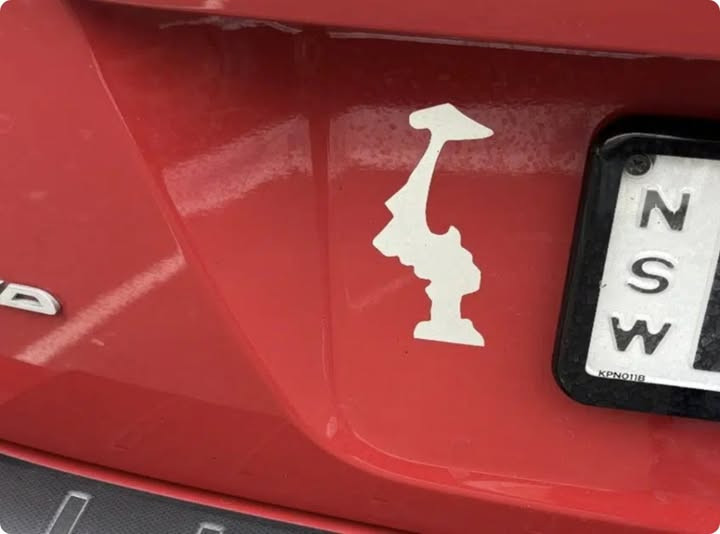
The sticker becomes a social filter — invisible to most, meaningful to a few.
REBELLION WITHOUT AGGRESSION
There is also a subtle rebellious quality to the upside-down sticker.
It rejects convention without attacking it. It breaks a rule that no one explicitly stated, yet everyone assumed. It refuses to display identity in the expected orientation.
This kind of rebellion appeals strongly to people drawn to alternative lifestyles — van lifers, climbers, hikers, artists, and travelers who prioritize experience over structure.
It aligns with the Pacific Northwest ethos: independent, understated, skeptical of authority, quietly confident.
WHY IT APPEARS SO OFTEN ON CERTAIN VEHICLES
There’s a reason these stickers frequently show up on Subarus, Jeeps, camper vans, and overland rigs.
These vehicles represent mobility, adaptability, and connection to the outdoors — all values deeply associated with Washington State culture. The upside-down sticker complements that identity.
It suggests movement. Transition. A life in motion rather than rooted in one place.
The car becomes not just transportation, but a narrative device.
A GLOBAL FOOTPRINT OF A LOCAL SYMBOL
What’s fascinating is how far this symbol has traveled.
You’ll find upside-down Washington stickers far beyond the Pacific Northwest. They appear in national parks, foreign cities, surf towns, and mountain villages around the world.
Each one marks the presence of someone who carried a piece of Washington with them — flipped, but intact.
It’s a form of cultural breadcrumbing. A way of saying: someone from there passed through here.
WHY IT ENDURES WHEN OTHER TRENDS FADE
Most visual trends burn bright and disappear quickly. This one hasn’t.
The upside-down Washington sticker persists because it is flexible. It doesn’t lock itself into one meaning. It adapts to the person using it.
It can mean humor.
It can mean loss.
It can mean freedom.
It can mean nostalgia.
Sometimes it means nothing more than personal aesthetic preference. And that’s enough.
WHAT IT SAYS ABOUT MODERN IDENTITY
At its core, the upside-down sticker reflects a broader shift in how people relate to place.
Identity is no longer fixed. People move more. They live in multiple places. Home becomes layered rather than singular.
Flipping the sticker acknowledges that complexity. It refuses the idea that belonging must be static, upright, and easily labeled.
It embraces contradiction: pride without rigidity, attachment without permanence.
A FINAL LOOK
The next time you see a Washington State sticker turned upside down, pause before assuming error.
Someone chose that orientation.
Someone thought about it.
Someone decided that was the right way to represent where they’re from — or where they’re not anymore.
It’s not a mistake.
It’s a quiet declaration that home can be loved, missed, questioned, redefined, and carried — even when everything else feels inverted.
And sometimes, the most honest way to say “this matters to me” is to turn it upside down and let others wonder why.