A Viral “Mind Test” That Says More About Perception Than Personality
At first glance, the image looks almost laughably simple.
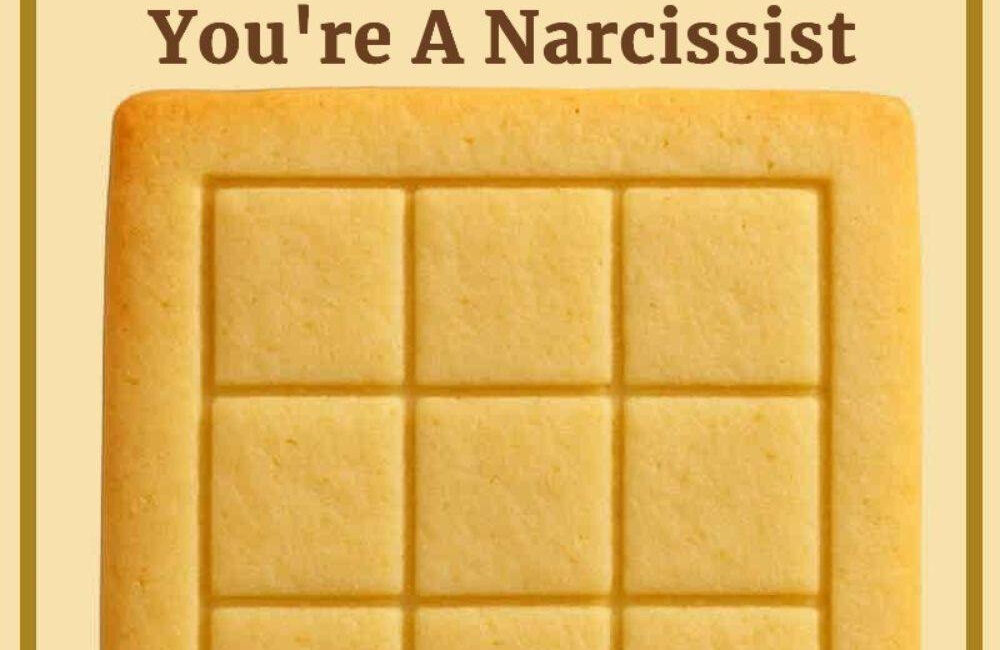
A soft, cookie-like square.
A neat grid carved into its surface.
Clean lines. Symmetry. Order.
Nothing threatening. Nothing complicated.
And yet, the sentence above it instantly hooks the mind:
“The number of squares you see determines if you’re a narcissist.”
Suddenly, you’re no longer just looking at a picture.
You’re evaluating yourself.
Questioning your perception.
Wondering what your answer might “say” about you.
That’s exactly why this image went viral.
Not because it diagnoses anything — but because it quietly exposes how the human mind works when curiosity, ego, and pattern recognition collide.
Let’s slow down and unpack what’s really happening here.
Step One: Counting the Squares (And Why It’s Harder Than It Looks)
Most people see the same thing at first:
Nine small squares.
Three across.
Three down.
Simple.
That’s the automatic response — the brain’s fast mode, designed to recognize obvious structure and move on.
But if you keep looking, something interesting happens.
Your eyes start combining shapes.
- Two small squares form a larger one
- Four small squares merge into a new square
- Horizontal and vertical groupings appear
- Eventually, the entire cookie becomes one final square
Suddenly, the image isn’t static anymore. It’s layered.
And that’s the key.
The Full Count (If You See Everything)
Let’s break it down carefully:
- 9 small squares (the most obvious ones)
- 4 medium squares (each formed by combining four small squares)
- 1 large square (the outer boundary holding everything)
That gives us a total of:
👉 14 squares
If you reached that number, congratulations — not because you’re “special,” but because you allowed your brain to slow down, reframe, and explore multiple levels of structure.
Why This Puzzle Feels Psychological (Even Though It Isn’t)
The trick isn’t math.
It’s attention style.
This image taps into two very common ways the brain processes information:
1. Global Thinkers
These people:
- See the overall picture first
- Register the obvious structure
- Don’t feel the need to analyze further
They’re efficient, practical, and comfortable moving on once something “makes sense.”
2. Detail-Oriented Thinkers
These people:
- Notice patterns within patterns
- Question whether they’ve missed something
- Enjoy squeezing extra meaning out of simple things
They don’t stop at the first answer — they keep digging.
Neither style is better.
They’re just different.
So Where Did the “Narcissist” Label Come From?
Here’s the honest answer:
👉 Clickbait and humor.
Online “pop psychology” loves exaggeration. Calling the most observant people “narcissists” is meant to be provocative, not accurate.
The joke plays on a stereotype:
- If you see everything, maybe you overanalyze
- If you overanalyze, maybe you’re self-focused
- If you’re self-focused… cue the dramatic label
But in real psychology, narcissism has nothing to do with visual puzzles or pattern recognition.
True narcissism involves:
- Lack of empathy
- Need for admiration
- Difficulty accepting criticism
- Manipulative behavior
Not counting squares.
What This Puzzle Really Reveals About You
Instead of asking, “Am I a narcissist?”
A better question is:
How does my mind approach information?
Your reaction to the puzzle is more telling than your final count.
- Did you feel satisfied quickly and move on?
- Did you feel compelled to double-check?
- Did you feel annoyed when others saw more (or less)?
- Did you feel proud of spotting all 14?
- Or did you laugh and enjoy the process?
Those reactions reveal:
- Comfort with ambiguity
- Relationship with control
- Curiosity levels
- Emotional flexibility
That’s far more interesting than any fake label.
Why These Puzzles Spread So Easily Online
This image succeeds because it combines:
- Simplicity (anyone can understand it)
- Challenge (most people miss some squares)
- Identity hook (“What does this say about me?”)
- Low stakes (no real consequences)
- Shareability (“How many did YOU see?”)
It invites conversation, comparison, and playful debate — which is exactly what social media thrives on.
The Deeper, Quieter Lesson
There’s something unexpectedly poetic about this square puzzle.
Some people see:
- Parts
Some see:
- Wholes
Some see:
- Connections between parts and wholes
All of those perspectives are valid.
In life, the same thing happens.
Some people focus on:
- Daily tasks
Others on:
- Long-term goals
Others on:
- How everything fits together
The danger isn’t in seeing too much or too little.
The danger is believing your way of seeing is the only correct one.
Ironically, that mindset is much closer to narcissism than counting 14 squares.
So… Are You a Narcissist?
Almost certainly not.
But you are human.
And curious.
And wired to find patterns.
And that’s a good thing.
This image isn’t a diagnosis.
It’s a mirror — one that briefly reflects how your mind organizes the world.
So enjoy the puzzle.
Enjoy the debate.
Enjoy the moment of “Ohhh, I see it now.”
And the next time a viral image tries to label you in one sentence?
Smile, scroll a little slower…
and count the squares anyway. 👀🧠