Introduction: When What You See Is Not What Exists
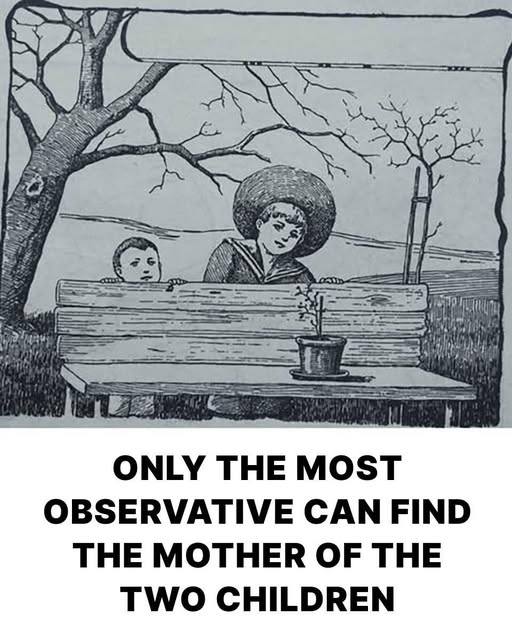
At first glance, the image appears peaceful, even ordinary. Two children sit quietly on a bench in what seems to be a cold, wintry setting. The atmosphere feels calm. Nothing is chaotic. Nothing seems suspicious. Your eyes move across the scene, registering familiar elements: the bench, the figures, the background.
And yet, something is wrong.
Not dramatically wrong. Not immediately obvious. But deeply, subtly wrong.
You are told there is a hidden presence in the image—a mother, right in front of you. Not behind the children. Not far away. Not concealed by shadows. She is there, visible, yet unseen.
This creates a strange tension. You begin to look again. You focus harder. You question your perception.
And suddenly, the image transforms from a simple scene into a mental challenge.
This is the power of optical illusion.
This article will guide you far beyond the surface of this visual puzzle. You will not only understand how the hidden mother is concealed, but also discover the deeper principles behind perception, attention, and how your brain processes reality. You will learn why your mind misses what is clearly present, how illusions exploit your thinking patterns, and how you can train yourself to see more clearly—not just in images, but in life.
Because the real lesson here is not about finding the mother.
It is about understanding how often you fail to see what is already in front of you.
The Setup: A Scene Designed to Deceive
Let’s reconstruct the image mentally.
You see:
- Two children sitting on a bench
- A quiet, winter-like environment
- No obvious movement or complexity
Everything appears structured and familiar.
This is intentional.
The illusion works because it presents a recognizable situation. Your brain immediately categorizes it:
- “Children” → safe, simple, emotional
- “Bench” → ordinary object
- “Winter scene” → calm environment
Once your brain labels the scene as “normal,” it stops searching deeply.
And that is exactly when it gets tricked.
The Hidden Mother: Where Is She?
The mother is not hidden behind an object.
She is not invisible.
She is part of the image itself.
In most versions of this illusion, the mother’s face is formed through negative space and visual composition—often hidden within:
- The shapes of the children’s clothing
- The contours of the bench
- The shadows or background
Your brain fails to recognize her because it is not looking for a face in those areas.
It is looking for:
- A body
- A clear figure
- A separate person
But the illusion breaks that expectation.
Why Your Brain Fails to See the Obvious
To understand why this illusion works, you need to understand how your brain processes visual information.
1. Top-Down Processing: You See What You Expect
Your brain does not analyze every detail equally.
Instead, it uses past experience to interpret what it sees.
This is called top-down processing.
It means:
- Your expectations shape your perception
- Your brain fills in missing information
- You see what you think should be there
In this image, your brain expects:
- Two children
- A simple scene
So it stops searching for anything else.
2. Pattern Recognition: The Brain’s Shortcut System
Humans are extremely good at recognizing patterns—especially faces.
But this ability has limits.
When a face is presented in an unusual way (like hidden in shapes), your brain may fail to detect it.
Why?
Because it looks for:
- Eyes in expected positions
- Symmetry
- Clear outlines
When these are distorted, recognition breaks down.
3. Selective Attention: You Only See What You Focus On
Your brain cannot process everything at once.
So it chooses what to focus on.
In this image, your attention is drawn to:
- The children
- Their expressions
- The central elements
Everything else becomes background noise.
The hidden mother exists in that “ignored” area.
4. Cognitive Bias: Trusting First Impressions
Once your brain decides:
👉 “This is a simple image”
It stops questioning.
This is called cognitive bias.
It saves energy—but reduces accuracy.
The Science Behind Optical Illusions
Optical illusions are not just tricks. They are tools.
They reveal how perception works.
Types of Illusions Involved Here
This image uses multiple illusion principles:
Figure-Ground Illusion
Your brain separates objects (figures) from background.
But sometimes, the background contains hidden figures.
Ambiguous Images
The same image can be interpreted in different ways.
Gestalt Principles
Your brain organizes visual elements into meaningful patterns.
But it can organize them incorrectly.
Why These Illusions Were Used Historically
Images like this were not created just for entertainment.
They were used to test:
- Attention to detail
- Cognitive flexibility
- Perceptual awareness
In earlier times, they were even used in:
- Psychological evaluations
- Educational tools
- Intelligence assessments
They helped measure how well someone could:
- Go beyond the obvious
- Question initial perception
- Adapt their thinking
The Deeper Meaning: This Is Not Just About Vision
Click page 2 to continue