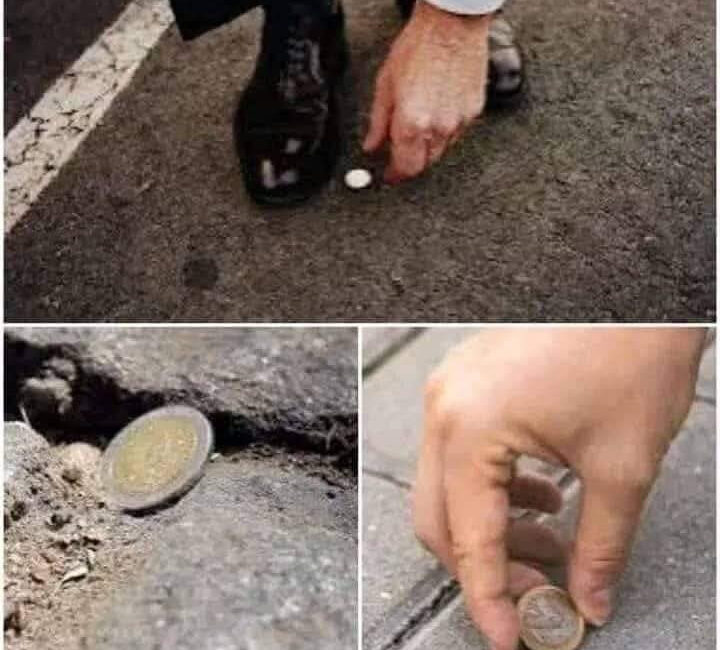
A coin lying on the ground seems like one of the most ordinary sights in daily life. People pass by it on sidewalks, in parking lots, near bus stops, or on quiet streets. Sometimes it glints briefly in the sunlight. Sometimes it lies dull and forgotten among dust and gravel. Most people walk past it without stopping. Others pick it up out of habit. A few pause for a moment and wonder whether such a small object might carry a deeper meaning.
Across many cultures, finding a coin has long been associated with luck, prosperity, or a symbolic message from the universe. The idea appears in folklore, spiritual traditions, and everyday sayings. People sometimes whisper phrases like “find a penny, pick it up, and all day long you’ll have good luck.” For others, the experience feels strangely personal, as if the tiny metal object appeared exactly when they needed a reminder of something.
At first glance, these beliefs might seem purely superstitious. Yet the story is more interesting than that. Human beings are natural meaning-makers. When something unusual catches our attention—especially something shiny, unexpected, or symbolic—we instinctively look for patterns and messages.
Finding a coin becomes more than a financial discovery. It becomes a moment of reflection.
This article explores the many interpretations surrounding coins found on the street. We will examine cultural beliefs, psychological explanations, spiritual symbolism, and the fascinating role coins have played in human history. Along the way, we will discover that the meaning of a small coin may not lie in magic itself, but in the way humans connect everyday experiences to deeper ideas about luck, gratitude, and opportunity.
The Long History of Coins and Human Civilization
To understand why coins carry symbolic meaning, it helps to understand how important they have been throughout history.
Coins are among the oldest surviving artifacts of human economic systems. The first widely recognized metal coins appeared around the 7th century BCE in the ancient kingdom of Lydia, located in what is now western Turkey. These early coins were made from electrum, a naturally occurring alloy of gold and silver.
Before coins existed, trade often relied on barter systems. People exchanged goods directly: grain for tools, livestock for clothing, pottery for spices. While barter could work in small communities, it was inefficient for large or complex economies.
Coins solved that problem by introducing standardized value.
Each coin represented a certain weight of precious metal and therefore a predictable amount of purchasing power. This innovation allowed trade to expand across regions and civilizations.
Soon, coins spread across the ancient world. Greek city-states minted coins bearing images of gods and symbols of civic identity. The Roman Empire used coins not only for trade but also for propaganda, stamping the faces of emperors onto currency that circulated across vast territories.
For thousands of years, coins carried both economic and symbolic significance.
A coin was not merely money. It was also a piece of art, a marker of political authority, and a tangible representation of value.
Because coins have always been connected to wealth, survival, and exchange, it is not surprising that they became linked to ideas of fortune and luck.
Why Humans Notice Coins on the Ground
One fascinating aspect of finding coins is that they catch our attention more than many other objects.
Imagine walking down a street. The ground may be scattered with small stones, leaves, bottle caps, or bits of paper. Yet a coin often draws the eye instantly.
Several psychological factors explain this effect.
First, coins reflect light. The metallic surface creates a glimmer that contrasts with the surrounding environment. Human vision evolved to detect contrast and shine because these cues helped early humans notice water sources, tools, or edible objects.
Second, coins have recognizable shapes. A round, flat disk is easy for the brain to identify quickly.
Third, coins represent value. Even small amounts of money trigger a sense of reward in the brain. Behavioral economists have shown that humans respond strongly to even tiny financial gains.
This means that when a coin appears unexpectedly, it activates a mixture of curiosity and satisfaction.
In other words, the moment feels special.
That emotional response may help explain why people attach symbolic meaning to the experience.
Cultural Beliefs About Finding Coins
Across cultures, coins have been associated with luck, prosperity, and divine favor.
Many traditional sayings reflect this belief.
In English-speaking countries, a popular rhyme states:
“Find a penny, pick it up, and all day long you’ll have good luck.”
The rhyme encourages people to pick up coins rather than ignore them.
In some European traditions, finding money on the ground was believed to be a blessing from fate or fortune. The unexpected discovery symbolized that prosperity could arrive in surprising ways.
Other cultures linked coins to spiritual protection.
In certain traditions, coins were placed in shoes, buried under foundations of homes, or sewn into clothing to attract wealth and ward off misfortune.
These practices show that coins were never seen as ordinary metal objects. They represented abundance and security.
When someone discovered a coin unexpectedly, it felt like a small confirmation that the world could still offer opportunities.
Coins as Messages From Loved Ones
One of the most emotional interpretations of finding coins involves the belief that they may represent messages from loved ones who have passed away.
This idea appears in various spiritual traditions and personal experiences.
Some people report noticing coins shortly after thinking about someone they lost. Others describe finding coins in unusual places during moments of sadness or reflection.
In these interpretations, the coin becomes a symbolic reminder that the bond with the departed person still exists.
The reasoning often follows a simple emotional logic.
If someone you loved wanted to send a sign that they were still present in spirit, they would choose something small but noticeable. A coin fits this role perfectly. It is simple, portable, and easy to place in unexpected locations.
Of course, from a scientific perspective, there is no evidence that coins appear through supernatural means.
However, psychology offers an interesting explanation.
Humans naturally search for connections between events and emotions. When we miss someone deeply, we become more aware of objects or events that remind us of them.
The coin becomes a symbol through which memory and emotion express themselves.
Even if the event is coincidental, the meaning it creates can be powerful and comforting.
The Meaning of Heads and Tails
Click page 2 to continue