Growing onions is one of the most rewarding experiences in gardening. Few vegetables match their versatility in the kitchen or their reliability in the garden. Yet many gardeners struggle with spacing, weeds, and uneven growth when planting onion sets. Rows become messy, weeds compete with fragile seedlings, and bulbs end up crowded or undersized.
A surprisingly simple solution exists—one that transforms ordinary garden beds into organized, efficient planting systems. It involves something most households discard without a second thought: paper egg carton trays.
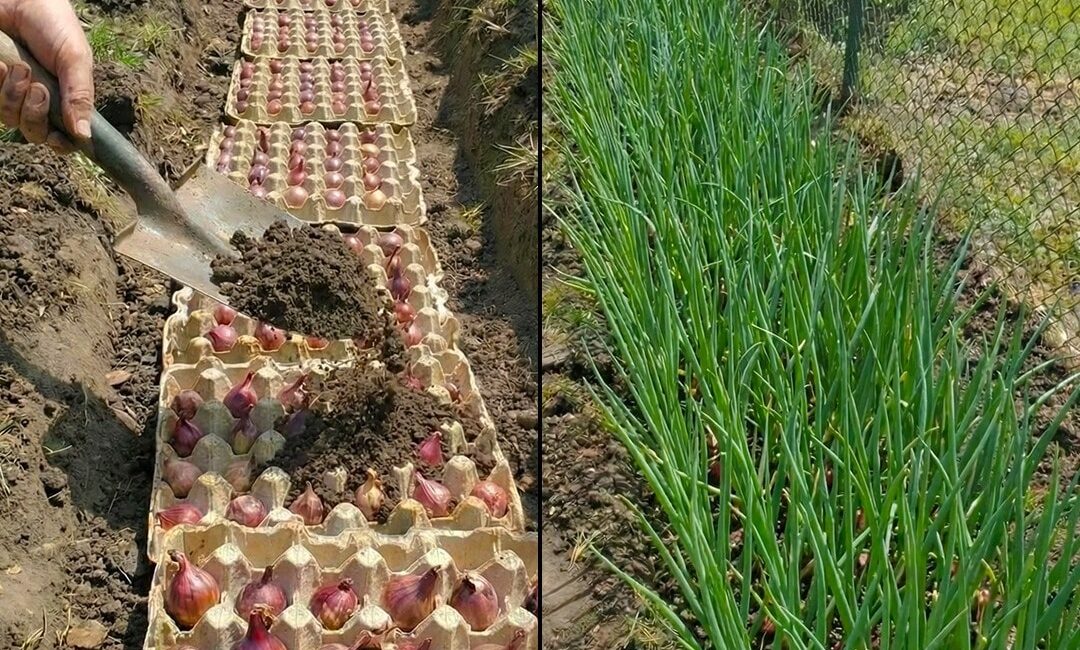
Using egg cartons as a planting grid is an ingenious method that combines spacing guide, biodegradable mulch, and weed barrier all in one. The cups naturally create evenly spaced holes for planting onion sets, while the cardboard structure suppresses weeds and gradually decomposes into the soil as the plants grow.
This technique is elegant because of its simplicity. There are no complicated tools, no plastic templates, and no specialized equipment. Gardeners simply place paper trays on prepared soil, insert onion sets into the cups, and lightly cover them with soil. The trays break down over time, leaving a tidy and productive onion bed behind.
However, despite the simplicity, success still depends on understanding several important details. Onion varieties respond to daylight length. Soil preparation strongly influences bulb size. Watering patterns affect flavor and storage quality. Fertilization timing determines whether onions produce thick bulbs or weak leafy tops.
This guide explores the egg carton grid method in depth—covering materials, preparation, planting techniques, growth stages, common problems, and harvesting strategies. It also explains the biological reasons behind each step so that gardeners understand why the method works, not just how to perform it.
By the end, you will understand how a humble egg carton can become a powerful tool for growing healthy, evenly spaced onions in even the smallest garden spaces.
Why Onion Spacing Matters More Than Most Gardeners Realize
To understand why egg carton trays work so well, it helps to understand how onions grow. Unlike many vegetables, onions produce bulbs that expand outward beneath the soil surface. Each onion bulb forms from layers of modified leaves that thicken around the base of the plant.
Every green leaf that emerges above ground eventually becomes one ring inside the onion bulb. The more leaves an onion plant produces, the more rings—and therefore the larger the bulb.
This means onions require both space and resources to reach their full potential. If planted too closely together, the plants compete for nutrients, sunlight, and moisture. Instead of forming large bulbs, they remain small and slender.
Traditional onion planting methods usually rely on estimating spacing by eye or measuring with a ruler or string line. This approach often leads to irregular distances between plants. Some onions end up crowded, while others have too much empty space around them.
Egg carton trays solve this issue elegantly. Each cup becomes a precise planting location. The gardener no longer has to guess where to place the next onion set. The grid ensures uniform spacing across the entire bed.
Even spacing leads to several important benefits:
- Uniform bulb size
- Better airflow around plants
- Easier weed control
- Efficient use of garden space
In small gardens, especially urban beds or narrow strips along fences, this organization can make the difference between mediocre harvests and impressive yields.
The Hidden Advantage of Biodegradable Garden Tools
Paper egg cartons are made from compressed pulp fibers, usually recycled paper. When exposed to moisture and soil microorganisms, these fibers begin to break down slowly.
This natural decomposition is exactly what makes them so useful in the garden.
Instead of removing the trays after planting, gardeners simply leave them in place. As the season progresses, soil organisms such as bacteria, fungi, and earthworms gradually digest the material.
The cartons eventually become part of the soil itself.
During the early weeks after planting, however, the trays serve several valuable functions:
Weed suppression:
The cardboard blocks sunlight from reaching weed seeds in the soil, reducing germination.
Moisture regulation:
The pulp material absorbs and releases water gradually, helping maintain stable moisture levels around the plants.
Soil protection:
The trays reduce soil crusting after rainfall or watering.
Root guidance:
Roots grow downward through the softened carton material into the soil below.
Because the trays degrade naturally, they do not interfere with bulb expansion later in the season.
This concept reflects an important ecological principle: using materials that work with natural processes rather than against them.
Choosing the Right Onion Type for Your Climate
Before planting onions, gardeners must consider one crucial factor: day length.
Onions form bulbs in response to the number of daylight hours they receive. This biological trigger determines when the plant shifts energy from leaf growth into bulb formation.
There are three major onion categories:
Long-Day Onions
Long-day onions begin forming bulbs when daylight reaches about 14–16 hours per day. These varieties thrive in northern regions where summer days are long.
They produce large bulbs when grown in climates with extended daylight periods.
Short-Day Onions
Short-day onions start bulbing when daylight reaches 10–12 hours. They are ideal for warmer southern climates where winter and early spring provide the appropriate day length.
In these regions, short-day onions are often planted in autumn and harvested in spring.
Day-Neutral (Intermediate) Onions
Day-neutral onions, sometimes called intermediate onions, form bulbs with 12–14 hours of daylight. These varieties are adaptable and work well across many climates.
For gardeners unsure about which type to choose, day-neutral onions are often the safest option.
Selecting the correct type ensures the plant forms bulbs at the proper time. If the wrong variety is grown, the onions may produce leaves but fail to develop proper bulbs.
Onion Sets vs Seeds vs Transplants
The egg carton grid method works best with onion sets, though it can also accommodate small transplants.
Understanding the differences between onion planting materials helps explain why.
Onion Sets
Onion sets are small dormant bulbs that were grown from seed during the previous season and harvested early. They resemble miniature onions.
Advantages include:
- Fast establishment
- Reduced risk of disease
- Earlier harvests
Because they are already partially developed bulbs, sets grow quickly once planted.
Onion Seeds
Growing onions from seed offers a wider selection of varieties but requires more time and patience. Seeds are typically started indoors weeks before planting outdoors.
This method works but requires careful transplanting.
Onion Transplants
Transplants are young onion seedlings grown in nurseries or greenhouse trays.
They provide a middle ground between seeds and sets but are slightly more delicate during planting.
For beginners and for the egg carton method, onion sets are the easiest and most reliable option.
Preparing the Soil: The Real Foundation of Success
Even the most clever planting method cannot compensate for poor soil. Onions are shallow-rooted plants, meaning their roots remain near the surface.
Because of this shallow root system, they depend heavily on soil quality in the top six to eight inches.
The ideal onion soil has three key characteristics:
Loose texture:
Roots must penetrate easily without resistance.
Good drainage:
Standing water causes bulb rot.
Rich organic matter:
Nutrients must be readily available for rapid leaf growth.
Preparing the bed properly involves several steps.
First, remove all weeds and grass from the planting area. Competition early in the season can severely stunt onion growth.
Next, loosen the soil using a shovel, hoe, or garden fork. Breaking up compacted soil allows air and water to circulate freely.
Then incorporate compost or well-aged manure into the top layer. Compost improves both fertility and soil structure.
Finally, rake the surface smooth and level so the egg cartons sit flat against the soil.
This preparation stage is arguably the most important part of the entire process.
Preparing Egg Carton Trays for Planting
Not all egg cartons are suitable for garden use. Only plain paper or pulp cartons should be used.
Plastic or foam cartons do not decompose and can harm soil health.
Paper trays, especially the larger 30-egg commercial flats, work particularly well because they cover more surface area.
Before placing them in the garden, a few simple adjustments can improve performance.
If the trays feel stiff or dry, lightly wet them with water. Moist pulp becomes flexible and molds to the soil surface more easily.
Some gardeners also tear small holes in the bottom of each cup. These holes allow roots to penetrate the soil faster.
Once prepared, the trays are laid directly onto the garden bed in rows. The cups naturally create a grid pattern that marks planting positions.
If wind is a concern, sprinkling a small amount of soil over the edges helps anchor the trays.
Planting Onion Sets in the Egg Carton Grid
Each cup of the egg carton becomes an individual planting station.
The onion set is placed into the cup with the pointed tip facing upward. The pointed end is where the leaves will emerge.
Proper orientation ensures that the plant grows vertically without unnecessary stress.
Spacing can be adjusted depending on the desired harvest.
For large bulb onions, plants typically need four to six inches of space between them. If the egg tray cups are closer together, gardeners can simply skip every other cup.
For green onions or scallions, closer spacing of two to three inches is acceptable.
This flexibility allows the same tray system to be used for different onion types.
After placing the sets into the cups, a thin layer of soil is spread across the tray.
The soil should lightly cover the sets while still allowing the top portion to remain near the surface.