There is something deeply evocative about inheriting a box of old utensils.
You open the lid expecting the ordinary: tarnished spoons, heavy forks, knives dulled by decades of sharpening. Perhaps a ladle with a wooden handle darkened by years of steam. These objects carry a quiet intimacy. They fed people you love. They stirred soups on winter evenings. They clinked against plates during family gatherings you may barely remember.
And then — there it is.
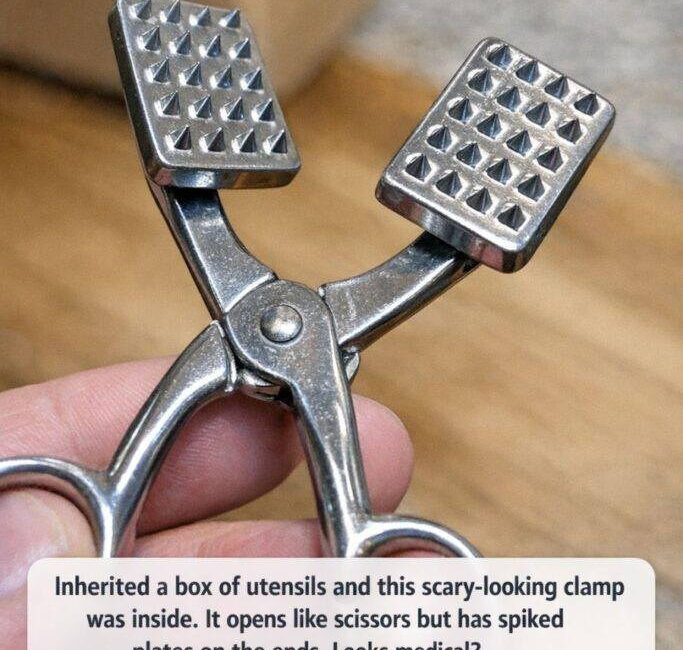
A strange metal clamp.
It opens like scissors. The handles are long. The ends are flat and round — but covered in sharp-looking spikes or teeth. It feels industrial. Aggressive. Slightly alarming.
Your first instinct may be unsettling:
Is this medical?
Is it surgical?
Was it used for something disturbing?
Before your imagination runs too far, let’s ground this mystery in history and practicality.
What you likely found is not a medical instrument at all.
It is almost certainly an antique ice crusher or ice tongs — sometimes called a hand ice breaker — a common household tool before refrigerators became standard in every home.
The spikes were not designed for flesh.
They were designed for ice.
And understanding that single fact opens a fascinating window into daily life before modern appliances.
A Closer Look: What This “Scary Clamp” Actually Is
The tool you described — scissor-like handles with spiked, flat plates at the ends — matches the design of a manual ice crusher or ice tongs used in the late 19th and early 20th centuries.
Here’s how it worked:
- The user placed a chunk of ice between the spiked plates.
- The handles were squeezed together.
- The spikes dug into the ice, gripping or cracking it.
- The pressure fractured the ice into smaller pieces.
It was a mechanical solution to a very real problem: ice used to arrive in large, solid blocks.
And people needed smaller pieces for drinks, food preservation, and dessert preparation.
That clamp was a household convenience — not a surgical device.
But why does it look so intense?
Because ice is surprisingly hard.
Life Before Refrigerators: The Icebox Era
To understand this tool, we need to step into a kitchen from 1900.
There is no electric refrigerator humming in the corner.
Instead, there is an icebox — a heavily insulated wooden cabinet lined with tin or zinc. A large block of ice is placed in a top compartment. As it slowly melts, the cold air circulates downward, keeping food fresh.
The ice does not come from your freezer.
It is delivered.
In many cities, an “ice man” brought blocks of ice to homes weekly. These blocks were cut from frozen lakes in winter or produced in early ice plants.
The ice block might weigh 25, 50, even 100 pounds.
That means every household needed tools to:
- Lift the ice block
- Break it into smaller pieces
- Handle it without slipping
And that is where your mysterious clamp comes in.
Why the Spikes Look So Aggressive
Ice, especially when frozen in large blocks, is extremely dense.
Smooth metal surfaces would simply slide off.
The spikes served three critical purposes:
- Grip — They penetrated the surface to prevent slipping.
- Stability — They allowed precise pressure application.
- Force concentration — The sharp points focused mechanical pressure into small areas, causing controlled cracking.
This is basic physics.
Pressure equals force divided by area. By reducing the contact area (using spikes), you increase pressure dramatically with the same squeezing force.
It is the same principle behind:
- Ice picks
- Meat tenderizers
- Crampons used for climbing ice
The tool looks intimidating because it is designed to overcome resistance efficiently.
But its purpose was purely culinary and practical.
Could It Be Medical?
The short answer: almost certainly not.
Medical clamps and surgical forceps have very different characteristics:
- They are typically smooth or finely serrated, not heavily spiked.
- They often include locking ratchets near the handles.
- They are designed for precision, not brute force.
- They are smaller and more delicate in structure.
The large, flat, spiked plates on your inherited clamp are not designed for tissue. They are designed for rigid material.
It feels medical because industrial design from the early 1900s was unapologetically utilitarian. Form followed function. If spikes were necessary, spikes were added — aesthetics were secondary.
Old tools often look harsher than modern ones.
We are used to soft plastic handles and rounded edges. Our ancestors were not.
Variations of Ice Handling Tools
Your clamp may belong to one of several related categories:
Ice Tongs
Large versions used to carry full blocks of ice. These had curved, spiked ends that dug into the block when lifted.
Hand Ice Breakers
Smaller scissor-style clamps used to crack chunks into usable sizes.
Ice Picks
Sharp, single-point tools used to chip or sculpt ice.
Manual Ice Crushers
Devices that crushed ice into fine pieces for drinks.
Your inherited clamp most closely resembles the hand ice breaker category.
These were common in households that entertained guests, served chilled drinks, or preserved perishables.
The Cultural Role of Ice in Daily Life
It may surprise you how central ice once was to domestic life.
Ice was luxury.
Before mechanical refrigeration became widespread in the 1920s and 1930s, ice represented:
- Food safety
- Social hospitality
- Economic status
- Urban infrastructure
Cities developed entire industries around ice harvesting and distribution.
In colder regions, workers cut massive ice blocks from frozen lakes in winter, stored them in insulated ice houses packed with sawdust, and delivered them year-round.
Later, artificial ice plants expanded distribution to warmer climates.
Owning proper ice tools meant you participated in modern living.
That clamp in your box once symbolized convenience and advancement.
Why It Ended Up in a Utensil Box
Click page 2 to continue