Most people do not bend down to pick up a penny.
It is the smallest unit of American currency. It jingles at the bottom of pockets. It disappears into couch cushions. It gathers dust in jars labeled “spare change.” Many people do not even consider it worth the effort to carry.
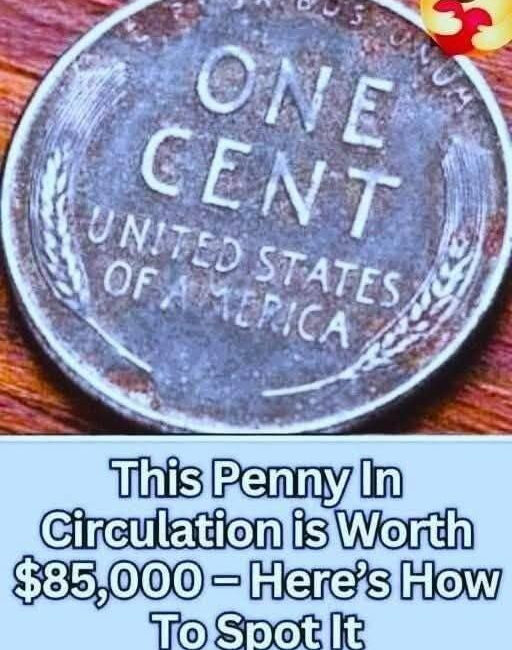
And yet, hidden among billions of ordinary one-cent coins are a few extraordinary outliers — pennies that have sold for $10,000, $50,000, even $85,000 or more.
That is not exaggeration. It is documented fact in the world of numismatics — the study and collection of coins.
The most fascinating part? Some of these coins still circulate. They look almost identical to the pennies you handle every day.
This article will take you deep into the world of rare pennies — how they were accidentally created, why collectors value them so highly, how to identify key characteristics, and what specific coins have reached astonishing prices. You will learn what makes a penny valuable, what mistakes to look for, how weight and metal composition matter, and how to avoid common misconceptions.
Because sometimes, fortune is not hidden in a vault.
Sometimes, it is hiding in your pocket.
Why Some Pennies Become Valuable
To understand why a penny can be worth $85,000, you must first understand what gives coins value beyond their face amount.
There are four primary drivers of coin value:
- Rarity
- Condition
- Historical significance
- Minting errors
When these factors overlap, prices can skyrocket.
Most pennies are produced in the billions. They are designed to be common, durable, and replaceable. But occasionally, something goes wrong in the minting process — and that mistake becomes incredibly valuable decades later.
Coins are struck at facilities operated by the United States Mint. Each coin is made using metal blanks called planchets, which are stamped with dies that imprint the design.
If the wrong planchet is used, if the die is misaligned, if the metal composition is incorrect, or if experimental materials are accidentally released, those coins become anomalies.
And collectors love anomalies.
The Legendary 1943 Copper Penny
No rare penny discussion is complete without the famous 1943 copper Lincoln cent.
During World War II, copper was needed for ammunition and military equipment. To conserve resources, the U.S. Mint switched penny production in 1943 from copper to zinc-coated steel.
Steel pennies look silvery and are magnetic.
However, a few copper planchets from 1942 remained in the machinery by accident. A tiny number of 1943 pennies were struck in copper instead of steel.
Those coins were never supposed to exist.
Today, fewer than 20 verified 1943 copper pennies are known.
One example sold for more than $200,000. Others have sold for amounts exceeding $85,000 depending on condition.
Here is what makes them special:
- They are dated 1943.
- They are made of copper (reddish-brown).
- They are not magnetic.
- They weigh about 3.11 grams (steel pennies weigh about 2.7 grams).
Imagine checking your change and finding a 1943 penny. If it sticks to a magnet, it is common steel. If it does not — and weighs correctly — you might be holding a six-figure coin.
This is not fantasy. It has happened.
The Reverse Error: 1944 Steel Pennies
Now here is where it gets interesting.
In 1944, the Mint switched back to copper production. But just as copper planchets accidentally slipped into 1943 production, a few steel planchets from 1943 were accidentally used in 1944.
That means some 1944 pennies were struck in steel — a material no longer intended for use.
These coins are even rarer than the 1943 copper errors.
Fewer than 30 are believed to exist.
One example has sold for over $100,000.
To identify a 1944 steel penny:
- The coin is dated 1944.
- It appears silver or gray.
- It sticks to a magnet.
- It weighs about 2.7 grams.
These are the kinds of details that separate a normal coin from a fortune.
The 1955 Doubled Die Penny
Not all valuable pennies involve the wrong metal. Some involve dramatic visual errors.
One of the most famous examples is the 1955 doubled die Lincoln cent.
During minting, the die used to strike the coin was improperly manufactured, resulting in doubled lettering. The words “LIBERTY” and “IN GOD WE TRUST” appear visibly doubled to the naked eye.
This is not subtle. The doubling is bold and dramatic.
Thousands entered circulation before the mistake was corrected.
Today, high-quality examples sell for tens of thousands of dollars.
Why?
Because the error is obvious, famous, and historically important.
Collectors prize coins that clearly display the human element in manufacturing — proof that even industrial systems can produce beautiful mistakes.
The 1969-S Doubled Die Penny
Another legendary doubled die penny comes from 1969.
The 1969-S doubled die Lincoln cent features strong doubling on the date and lettering.
It was so unusual that early discoverers were accused of counterfeiting. The Secret Service initially investigated the coin before confirming it was genuine.
Today, authenticated examples have sold for over $35,000 to $75,000 depending on condition.
To identify this coin:
- It must have the “S” mint mark (San Francisco).
- The doubling must be part of the die itself — not machine doubling.
- The doubling should be visible on “LIBERTY” and the date.
Subtle mechanical errors are common and worth little. True doubled dies are rare and valuable.
Knowing the difference is essential.
Why Weight and Metal Matter
One of the easiest tools for identifying rare pennies is a simple digital scale.
Weight reveals composition.
Standard copper pennies minted before 1982 weigh approximately 3.11 grams.
Zinc pennies minted after 1982 weigh approximately 2.5 grams.
If you find a coin from the wrong year with the wrong weight, that is a red flag.
For example:
- A 1982 penny weighing 3.11 grams might be copper (rare transitional error).
- A 1943 penny weighing 3.11 grams might be copper instead of steel.
Transitional years — when the Mint changed metal composition — are prime territory for rare errors.
In 1982, the U.S. Mint shifted from mostly copper pennies to copper-plated zinc pennies due to rising copper costs.
That year alone has multiple varieties.
Some rare 1982 copper transitional errors have sold for thousands of dollars.
All because someone bothered to weigh a penny.
Missing Mint Marks and Why They Matter
Mint marks indicate where a coin was produced:
- “D” = Denver
- “S” = San Francisco
- No mint mark (on many older coins) = Philadelphia
Occasionally, mint marks are missing when they should be present — or appear when they should not.
In 1922, for example, only the Denver Mint produced pennies. Yet some 1922 pennies appear without a mint mark due to die wear.
These “1922 No D” pennies are rare and valuable.
Small details like this are easy to overlook.
But in coin collecting, small details are everything.
Condition: The Multiplier of Value
Rarity alone does not guarantee extreme value.
Condition multiplies price.
Coins are graded on a scale from Poor (heavily worn) to Mint State (uncirculated, flawless).
A rare penny in poor condition might sell for $10,000.
The same coin in near-perfect condition could sell for $85,000 or more.
Collectors pay for preservation.
That is why handling matters. Cleaning a coin — even gently — can destroy value. Scratches, polishing, or chemical treatment lower grade dramatically.
If you suspect you have something rare, do not clean it.
Preserve it exactly as found.
Experimental and Pattern Coins
Some pennies were never meant for circulation at all.
Pattern coins are prototypes created to test new designs or metals. Occasionally, they escape into the public.
Because they were not mass-produced, they can be extraordinarily rare.
These coins represent moments of experimentation in Mint history — forks in the road that were never taken.
Collectors treat them as historical artifacts.
And history commands a price.
Why Some Rare Pennies Are Still “In Circulation”
Click page 2 to continue