The Curious Case of the Mysterious Brown Piles — And What It Teaches Us About Fear, Parenting, and the Science of the Unknown
Picture this.
It’s 10 p.m. The house is quiet. The dishes are done. You’re half-awake, half-scrolling through a parenting group, your thumb drifting lazily down the screen. Then suddenly — you stop.
A photo.
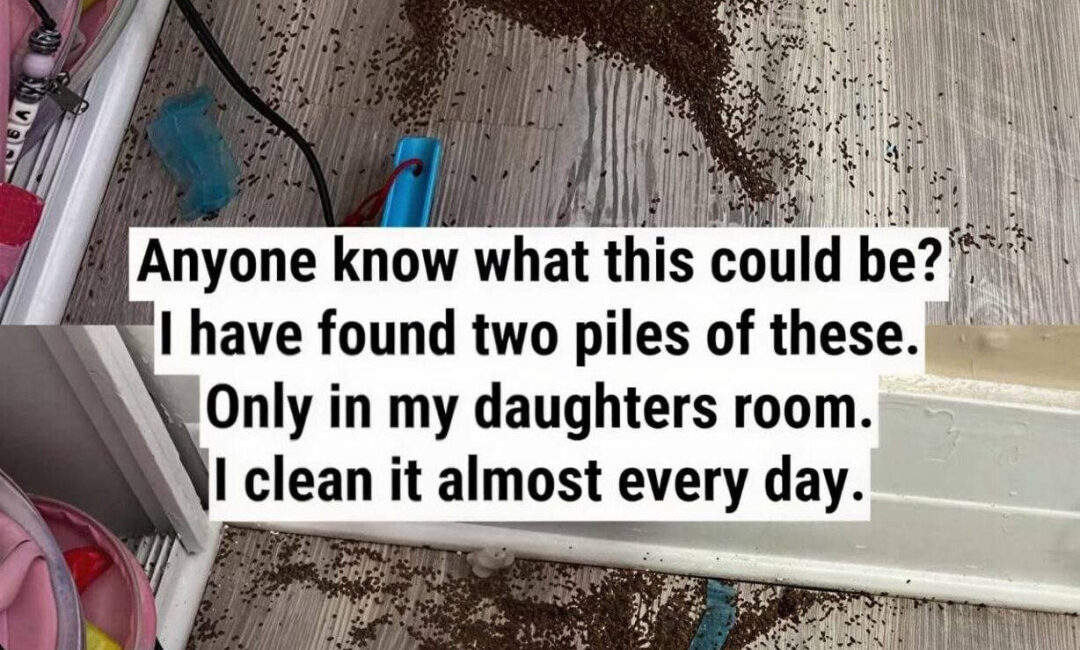
Two small piles of something brown and granular sitting on a bedroom floor.
Not quite coffee grounds.
Not quite dirt.
Not quite… anything comforting.
The caption reads:
“Anyone know what this could be? I found two piles of these in my daughter’s room.”
And instantly, your nervous system wakes up.
Because if there is one universal parental truth, it is this:
Mysterious substances in your child’s bedroom are never neutral.
They are either:
- A pest problem.
- A mold problem.
- A structural problem.
- Or something your brain invents at 200% anxiety speed.
What followed in this now-famous online moment was a perfect snapshot of modern fear, collective imagination, and ultimately, relief. But beneath the humor lies something deeper — a fascinating look at how humans interpret the unknown, why we jump to worst-case scenarios, and what this says about the age we live in.
Let’s unpack it slowly.
The Scene of the “Crime”: Brown, Granular, Silent
The original poster, Kelli Tarin, was renting a home with her family. She discovered two small piles of brown, gritty material on her daughter’s bedroom floor. No smell. No movement. No visible source.
Just piles.
And that detail matters.
Because piles imply intention.
Piles imply activity.
Piles imply something happened.
The human brain is exceptionally sensitive to patterns. When something looks organized — even slightly — we assume agency. We assume something made it.
And when that something is unknown?
Our imagination takes over.
The Internet Reacts: A Masterclass in Escalation
Within hours, the post exploded.
Over 150,000 reactions.
More than 7,000 comments.
Thousands of amateur detectives.
The theories rolled in:
🐜 “Ant frass!”
🐭 “Mouse droppings!”
🦇 “Bat guano!”
🪳 “Roach casings!”
🪵 “Termite droppings!”
🥣 “Granola?”
Notice something?
Every early theory involved infestation.
This is not random. This is evolutionary psychology at work.
Why Our Brains Jump to Infestation First
From a survival standpoint, contamination threats have always been high priority.
Parasites, rodents, insects — historically, they meant:
- Disease.
- Food loss.
- Structural collapse.
- Infection.
Our brains evolved to detect potential contamination quickly. This system is part of what psychologists call the behavioral immune system — a cognitive mechanism that triggers disgust and avoidance when something might pose biological risk.
So when we see:
- Unidentified granular material.
- In a child’s bedroom.
- Appearing overnight.
Our threat detection system lights up.
It is not logical yet.
It is protective.
And online, protection amplifies.
Collective Anxiety in the Age of Social Media
In earlier eras, a parent might have:
- Asked a neighbor.
- Called a local handyman.
- Investigated quietly.
Today, we post.
And when you post uncertainty online, you do not get calm.
You get volume.
Thousands of people project their own fears into the mystery.
And something interesting happens.
Each comment adds possibility.
Each possibility raises stakes.
Each raised stake increases anxiety.
This is a phenomenon known in psychology as catastrophic amplification — when a group magnifies a potential threat beyond its statistical likelihood.
The more comments suggested termites, bats, mice, or hidden infestations, the more real those possibilities felt.
Even though no one had evidence.
Fear spreads faster than certainty.
Enter the Professionals — And the Plot Thickens
Two pest control companies were called.
They inspected the room.
And both left confused.
When professionals cannot immediately identify something, the human brain does something dangerous:
It assumes novelty equals danger.
“Huh, that’s new.”
Those four words from an expert can spike anxiety more than confirmation of a known issue.
Because if it’s new…
It could be anything.
The Turning Point: Comment #437
Then came the internet hero.
One commenter wrote:
“That looks exactly like the stuffing from my kid’s lavender bear.”
And suddenly, the mystery shifted.
Because now, there was a non-threatening explanation.
Kelli examined the room.
There it was.
A beloved stuffed bear.
Slightly deflated.
A small seam split open.
Inside: dried lavender buds and fiberfill.
When spilled and pooled on the floor, they looked disturbingly like insect debris.
Mystery solved.
No pests.
No infestation.
No structural decay.
Just a tired teddy bear who gave a little too much of itself.
Why This Story Resonates So Deeply
This story went viral not because of pests.
But because it perfectly mirrors how modern anxiety works.
Let’s examine the layers.
1. The Brain Hates Ambiguity
Uncertainty is cognitively uncomfortable.
Research shows that humans prefer a bad known outcome over an unknown one.
Ambiguity activates stress circuits in the brain — particularly the amygdala, which processes fear.
When we cannot categorize something, our brain often defaults to worst-case scenarios.
Because worst-case scenarios demand action.
And action feels safer than waiting.
2. Parenting Heightens Threat Sensitivity
When children are involved, the threat detection system intensifies.
Parents are neurologically wired for hypervigilance.
A mysterious substance in your own room? Concerning.
In your child’s room? Alarm bells.
Parental anxiety is not weakness. It is biological.
The cost of ignoring a threat historically outweighed the cost of false alarms.
Better safe than sorry.
3. The Power of Pattern Recognition
The piles looked like something.
They resembled:
- Termite frass.
- Rodent droppings.
- Insect shells.
The brain works by comparison. It searches its internal database for matches.
But resemblance is not identity.
The lavender stuffing mimicked the texture and color of pest debris.
Our visual system often jumps from similarity to conclusion.
4. The Internet as a Fear Multiplier
Online communities are powerful.
They provide support, knowledge, humor.
But they also amplify.
When thousands speculate simultaneously, the emotional tone escalates.
One person says “termites.”
Another adds “structural damage.”
Another adds “expensive repairs.”
Another adds “health hazard.”
Suddenly, a torn teddy bear becomes a housing crisis.
5. The Antidote: Curiosity Over Panic
The resolution of this mystery did not require:
- Exterminators.
- Evacuation.
- Burning the house down (as one commenter half-joked).
It required:
- Observation.
- Patience.
- Re-examining the environment.
The solution was not dramatic.
It was ordinary.
And that ordinariness is the lesson.
The Science of False Alarms
Humans operate on a bias toward false positives.
In evolutionary biology, this is called error management theory.
If you hear rustling in bushes:
- Assuming it’s a predator (false positive) costs little.
- Assuming it’s wind when it’s a predator (false negative) costs everything.
So we evolved to over-detect threats.
Modern life has fewer predators.
But the detection system remains active.
Now it activates for:
- Mysterious piles.
- Strange smells.
- Unfamiliar sounds.
- Google search symptoms.
The system is ancient.
The context is modern.
Lavender Bear vs. Termites: A Cognitive Contrast
Termites represent:
- Structural damage.
- Financial stress.
- Hidden decay.
A lavender bear represents:
- Comfort.
- Childhood.
- Safety.
The same brown pile supported two completely different narratives.
Click page 2 to continue