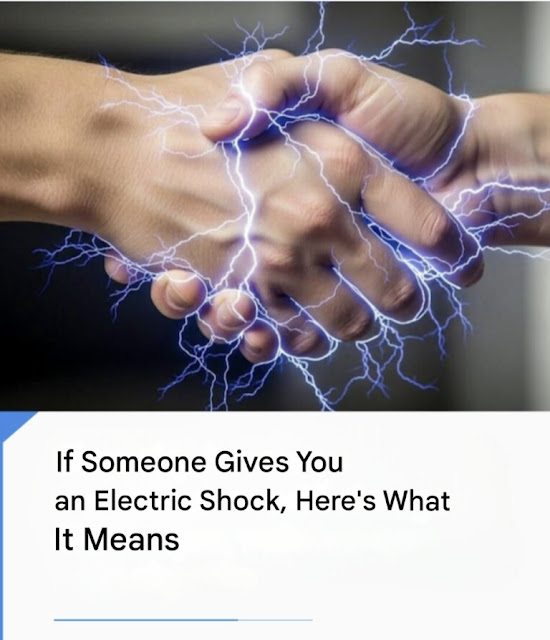
The Real Science Behind That Tiny Zap Between Two People
You reach for a doorknob.
Zap.
You brush someone’s hand.
Snap.
A small spark jumps between you.
You both laugh. Or flinch. Or say, “Wow, that was strong!”
For centuries, humans might have called that moment mystical. A sign of chemistry. Energy. Fate.
But science has a different — and surprisingly elegant — explanation.
That tiny electric shock when you touch someone is not emotional energy.
It’s physics.
And it reveals something fascinating about how your body interacts with the environment.
Let’s go deep into what’s actually happening — electrically, biologically, and physically — when you feel that little shock.
⚡ The Short Answer: Static Electricity
The sensation you feel is caused by static electricity discharge.
More specifically:
It is the rapid equalization of electrical charge between two objects (or people) with different electric potentials.
In simple terms:
One of you built up extra electrical charge.
The other didn’t.
When you touched, the imbalance corrected instantly.
That correction is the spark.
🧲 What Is Static Electricity?
Electricity is the movement of electrons.
Electrons are negatively charged particles that orbit atoms.
Normally, your body is electrically neutral:
Equal numbers of positive and negative charges.
But friction can disturb this balance.
When two materials rub against each other:
Electrons can transfer from one surface to another.
This process is called:
The triboelectric effect
It’s the same phenomenon that lets you:
- Rub a balloon on your hair and stick it to a wall
- Shuffle across carpet and shock a metal door
- See tiny sparks when removing a sweater
Your body becomes temporarily charged.
👟 How You Build Up Charge Without Realizing It
Throughout the day, you accumulate charge through:
- Walking on carpets
- Wearing synthetic fabrics
- Sitting on certain chairs
- Driving in your car
- Pulling off sweaters
- Sliding across couch fabric
Each time friction occurs, electrons transfer.
Some materials hold onto extra electrons easily.
Others give them up.
If you accumulate excess electrons, you become negatively charged.
If you lose electrons, you become positively charged.
The key is:
That imbalance can persist until discharge occurs.
🤝 Why It Happens When You Touch Someone
When two people approach each other, each may carry:
- Different levels of electrical charge
- Different potentials (voltage)
The moment skin comes close enough:
The electric field between you strengthens.
If the difference is large enough:
Electrons jump through the air gap.
That jump is the spark.
The shock you feel is the rapid movement of electrons equalizing the imbalance.
💡 Why Does It Hurt?
The shock is tiny.
Usually only a few thousand volts.
Wait — that sounds high.
But here’s the catch:
The voltage is high.
The current is extremely low.
Pain is caused not by voltage alone — but by current flow and nerve stimulation.
The discharge happens in microseconds.
But it stimulates nerve endings in your skin.
Your nervous system interprets that stimulation as:
A sharp sting.
It’s harmless — just startling.
❄️ Why It Happens More in Winter
Ever notice this happens more during cold months?
That’s because:
Cold air is dry.
Dry air allows static charge to build up easily.
Humidity acts like a conductor — it helps charges dissipate gradually.
In dry air:
Charge stays trapped on your skin and clothing.
Until you touch something conductive.
Then — zap.
🧬 What Role Does Your Body Play?
Your body is mostly water.
Water conducts electricity.
When charged, your body behaves like a capacitor — storing electrical energy.
But here’s something fascinating:
Your nervous system itself uses electrical signals.
Every thought.
Every movement.
Every heartbeat.
Your body is already an electrical system.
But the static shock is not your biological electricity.
It’s surface charge accumulation from friction.
🔍 Why Some People Shock More Than Others
You may have noticed:
Some people seem to cause more shocks.
Why?
Several factors influence static buildup:
Clothing Material
Synthetic fibers (polyester, nylon) generate more static than cotton.
Shoes
Rubber soles insulate charge.
Leather allows discharge.
Flooring
Carpet increases friction.
Tile reduces buildup.
Humidity
Dry climates increase static.
Skin Moisture
Dry skin holds charge better.
Moist skin dissipates charge more easily.
So if you’re:
Wearing synthetic clothes,
Walking on carpet,
In a dry room,
With dry skin—
You are a walking battery.
⚛️ What Happens in the Exact Moment of Shock?
Let’s slow it down scientifically.
- You approach another person.
- A potential difference exists.
- The electric field strengthens.
- Air (normally an insulator) breaks down.
- Electrons leap across.
- Current flows for microseconds.
- Charges equalize.
- The spark disappears.
The crack sound?
That’s rapid air expansion from ionization.
The light?
Tiny plasma channel formed during discharge.
Yes — it’s a microscopic lightning bolt.
Between two humans.
🌩️ It’s Basically Mini Lightning
Lightning works the same way.
Cloud builds charge.
Ground builds opposite charge.
Difference increases.
Air ionizes.
Massive discharge occurs.
The only difference is scale.
Lightning:
Millions of volts.