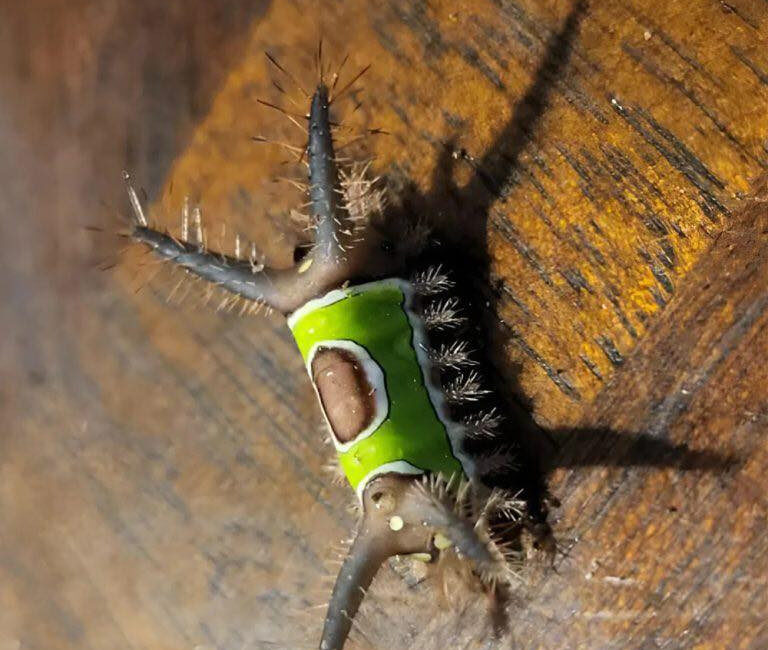
The Terrifying Reality Behind the Saddleback Caterpillar and Why You Should Never Touch Unknown “Objects” Indoors
At first, nothing about it suggested danger.
It lay there on the floor of my house, completely still, as if it didn’t belong to the animal world at all. Bright green. Smooth. Almost artificial. It looked like a torn piece of a houseplant, maybe part of a vine that had broken off and fallen. For a moment, I even thought it might be a child’s toy—something plastic, harmless, forgotten.
I stood over it, confused, trying to place it in a mental category that felt safe. Plant. Decoration. Toy. Anything but alive.
What made it unsettling, even then, was how wrong it felt. The color was too vivid. The shape too perfect. On its sides were strange protrusions—little “horns” that didn’t make sense for a leaf or a toy. They looked molded, almost synthetic.
Then I leaned closer.
That was the moment everything changed.
When Something That Looks Dead Suddenly Isn’t
The “thing” trembled.
Not dramatically. Not violently. Just enough to register in my brain as movement. I froze instantly, the way people do when their instincts take over before logic can intervene.
Then it began to crawl.
Slowly. Deliberately. As if it had been waiting for me to get close.
A wave of fear rushed through me so fast I barely had time to process it. I almost screamed. What I was looking at felt unreal—like a creature designed by a science fiction artist, something that had slipped out of an alien movie and into my home.
As it moved, dark spines rose from its body. Long. Thin. Sharp-looking. They didn’t just look defensive; they looked like a warning written in nature’s harshest language:
Don’t touch me.
And the terrifying truth is this: if I had followed my first instinct—if I had picked it up—I could have been in serious trouble.
The Horrifying Discovery: What It Really Was
Later, after the adrenaline faded and curiosity took over, I learned what I had encountered.
It was a saddleback caterpillar—one of the most deceptively dangerous caterpillars found in North America and increasingly reported in unexpected places, including homes.
The name sounds harmless. Almost cute.
The reality is anything but.
This caterpillar is famous for its striking appearance: a bright green body with a darker, saddle-shaped marking on its back, and prominent horn-like structures covered in venomous spines. Those spines are not decoration. They are delivery systems.
Each spine contains venom, and the slightest contact can inject it directly into human skin.
Why the Saddleback Caterpillar Is So Dangerous
The danger lies in how easy it is to get stung.
You don’t need to squeeze it.
You don’t need to provoke it.
You don’t even need to realize what it is.
A light brush of the skin is enough.
Once the venom enters the body, people commonly experience:
- Immediate, intense burning pain
- Redness and rapid swelling
- Blisters or raised welts
- Tingling or numbness spreading from the contact site
In more severe cases, symptoms can escalate to:
- Dizziness
- Nausea
- Headaches
- Muscle weakness
- Radiating pain that feels disproportionate to the size of the insect
Many people end up in the hospital—not because the venom is fatal, but because the pain is so severe and alarming that medical intervention becomes necessary.
Reading about it afterward sent a chill through me. I sat there imagining the alternate version of that moment: my hand reaching down, fingers closing around what I thought was a harmless object… and the immediate, overwhelming pain that would have followed.
One wrong move.
Why These Encounters Are Becoming More Common
One of the most unsettling aspects of this experience is that it didn’t happen outdoors. It happened inside my home.
Saddleback caterpillars typically live on trees and shrubs, feeding on leaves. But they can fall from plants, hitch rides on clothing, or wander indoors through open windows and doors. Their bright coloring, meant to warn predators, ironically makes them easier for humans to mistake as toys or plant matter.
As people bring more greenery into homes, spend more time gardening, or leave windows open during warmer months, these encounters are becoming less rare.
And because the caterpillar looks unnatural—almost fake—it doesn’t immediately trigger caution.
What To Do If You Accidentally Touch One
If someone is stung by a saddleback caterpillar, quick and calm action matters.
The recommended steps are simple but important:
First, do not rub the area. Rubbing can drive spines deeper into the skin.
Next, use adhesive tape to gently lift and remove any spines stuck in the skin. Press lightly, lift, and repeat with fresh tape until no spines remain.
Then, wash the area with soap and water to reduce the risk of infection.
Apply ice or a cold compress to help with pain and swelling.
If symptoms worsen—severe pain, spreading numbness, dizziness, or nausea—seek medical attention immediately. An antihistamine may help with allergic reactions, but a doctor should always be consulted if there’s any concern.
How I Removed It Safely (And Why I Didn’t Kill It)
Once I understood what I was dealing with, I kept my distance.
I used a broom to carefully sweep the caterpillar into a glass jar, making sure I never came close to touching it. Then I carried it outside and released it far from the house, into the garden where it belonged.
It wasn’t acting aggressively. It wasn’t chasing anyone. It was simply existing—dangerous not by intention, but by design.
I let it live. Just not in my house.
The Bigger Lesson: Nature Doesn’t Always Look Dangerous
This experience left a lasting impression on me.
We are taught, subconsciously, that danger looks obvious: sharp teeth, fast movement, threatening sounds. But nature often hides its most effective defenses in beauty, stillness, and deception.
The saddleback caterpillar doesn’t look like a threat.
That’s the point.
Its brightness is a warning to animals that know the code. Humans, disconnected from those signals, are the ones most likely to misinterpret it.
Why You Should Always Think Twice Before Touching “Strange” Objects
Since that day, I’ve changed a habit I didn’t even realize I had.
If I see something strange on the floor—something out of place, oddly colored, unfamiliar—I stop. I observe. I keep my hands back.
Because not everything that looks harmless is.
Sometimes, what looks like a toy is a warning.
Sometimes, what looks like a leaf is a defense system.
Sometimes, danger doesn’t move until you do.
And sometimes, being cautious for just a few extra seconds can spare you hours—or days—of pain.
That lesson stayed with me far longer than the fear itself.