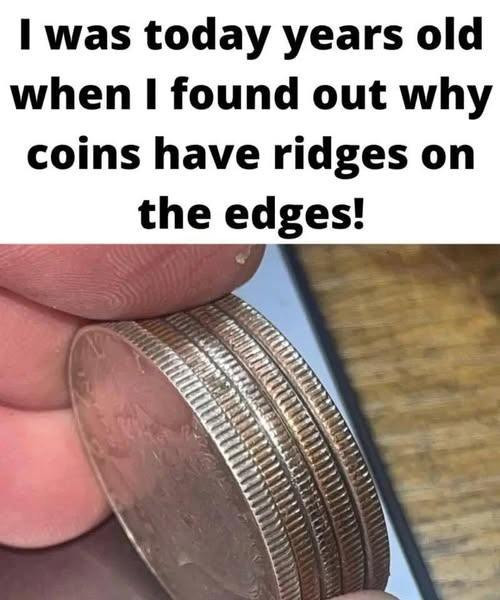
Most people touch coins every day without ever really seeing them. We notice the face, the number, maybe the shine or lack of it—but the edge? The edge is almost invisible to thought. And yet, that thin ring of metal carries one of the most important design decisions in economic history.
Those tiny ridges—precise, repetitive, easy to feel but rarely noticed—exist for reasons that stretch across centuries of human behavior, crime, trust, technology, accessibility, and even psychology. They are not decorative. They are not arbitrary. They are the result of a long battle between people who tried to cheat money and systems that learned how to protect it.
To understand why coins have ridges, you have to understand what money used to be, how people abused it, and how a microscopic design detail helped stabilize entire economies.
When Money Was Literally Worth Its Weight
For most of human history, money was not symbolic. It was material value.
A gold coin was valuable because it contained gold.
A silver coin was valuable because it contained silver.
There was no abstract promise behind it. The coin itself was the wealth.
This system had one major advantage: trust. You didn’t need banks, credit systems, or complex verification. If the coin weighed what it should and was made of the right metal, it was valid.
But that same advantage created a weakness.
The Human Instinct to Exploit Small Margins
People quickly discovered that you didn’t need to steal a whole coin to get rich.
All you needed was:
- A blade
- Time
- Patience
- And enough coins passing through your hands
This led to a widespread practice known as coin clipping.
Clipping involved shaving tiny amounts of metal from the edges of coins. The coins still looked normal. They still circulated. But the clippings—collected over time—added up to real gold or silver.
It was theft so subtle that it often went undetected for years.
Why Coin Clipping Was a Disaster for Economies
Coin clipping didn’t just hurt individual merchants. It undermined the entire monetary system.
As clipped coins circulated:
- Coins became lighter than they should be
- Merchants began weighing coins instead of trusting them
- Disputes increased
- Confidence in currency declined
Eventually, people began rejecting coins altogether or demanding more coins for the same goods. This led to inflation, hoarding, and economic instability.
In some periods, entire currencies collapsed not because of war, but because too much metal had been silently removed from circulation.
Punishment Wasn’t Enough
Governments responded harshly.
Coin clipping was considered a serious crime—often treason. In some eras, it was punishable by execution. But punishment only worked after someone was caught, and clipping was difficult to detect in everyday transactions.
What governments needed wasn’t fear.
They needed design.
They needed a way to make cheating obvious.
The Brilliant Simplicity of Ridged Edges
The solution was almost embarrassingly simple.
If the edge of a coin were perfectly smooth, you could shave it and no one would notice.
But if the edge were covered in uniform ridges, any tampering would stand out immediately.
One missing ridge.
One uneven pattern.
One smooth spot.
That was all it took to expose the crime.
These ridges are called reeded edges, and they transformed money security overnight.
Why Ridges Were a Game-Changer
Reeded edges introduced something revolutionary: tamper evidence.
They didn’t stop someone from trying to clip a coin—but they made the attempt pointless.
Now:
- Coins could be checked instantly
- No scales were required
- No expertise was needed
- Even ordinary people could detect fraud
The ridges turned every coin into its own security device.
Touch Matters: Why Fingers Were as Important as Eyes
One of the most underrated aspects of ridged edges is that they are tactile.
You don’t need to look closely at a coin to notice something wrong. You can feel it.
This mattered because:
- Many transactions happened in poor lighting
- Literacy was low
- People relied heavily on touch
Money had to be verifiable by ordinary human senses, not tools.
The ridges made coins readable by fingers.
Why Some Famous Thinkers Were Involved
The importance of coin edges was so great that some of the brightest minds in history were involved in improving them.
One notable figure worked on coinage reform and edge uniformity to prevent clipping and counterfeiting. The problem of dishonest money was considered a scientific, economic, and moral issue—not just a technical one.
Currency integrity was civilization integrity.
Why We Kept Ridges After Precious Metals Disappeared
Today, most coins are not made of gold or silver. Their value is symbolic. So why do ridges still exist?
Because their usefulness expanded.
Modern Reasons Coins Still Have Ridges
1. Anti-Counterfeiting Technology
Even today, coin edges are hard to fake.
Ridges:
- Require precision minting
- Add complexity
- Make cheap copies easier to detect
Modern counterfeiters struggle most with edges, not faces.
2. Accessibility for the Visually Impaired
Ridges allow people with visual impairments to:
- Distinguish coins by touch
- Identify denominations
- Use money independently
This is not accidental. Coin edge design is part of inclusive design philosophy.
3. Machine Compatibility
Vending machines, coin counters, parking meters, and banks rely on:
- Diameter
- Thickness
- Weight
- Edge texture
Ridges help machines identify coins accurately and reject fakes.
4. Grip and Control
Smooth coins are harder to grip, especially in cold, wet, or rushed conditions.
Ridges:
- Improve grip
- Reduce slipping
- Make counting easier
This matters more than people realize in high-volume cash handling.
Why Some Coins Have Smooth or Lettered Edges
Not all coins are ridged. That’s intentional.
Different edge styles serve different purposes:
- Smooth edges for low denominations
- Ridged edges for higher ones
- Lettered edges for ceremonial or security reasons
The edge is valuable real estate in coin design.
The Psychology of Trust Built Into Metal
Ridges do something subtle but powerful.
They make money feel intentional.
Uniformity signals control. Precision signals authority. Repetition signals reliability.
Even if people don’t consciously think about it, these cues matter. Trust in money is psychological as much as economic.
A Tiny Detail That Changed Human Behavior
Once ridged edges became standard:
- Clipping declined
- Confidence increased
- Transactions sped up
- Economies stabilized
All because of a pattern smaller than a fingernail.
This is one of the earliest examples of design solving moral problems.
Instead of asking people to be honest, systems were built to make dishonesty ineffective.
Why This Still Matters Today
In a world of digital money, this lesson remains relevant.
Security works best when:
- It’s built into the system
- It doesn’t rely on constant enforcement
- It’s easy for everyone to verify
Coin ridges are an ancient version of that philosophy.
Final Reflection
The ridges on coins are not decoration.
They are not tradition for tradition’s sake.
They are a quiet record of human ingenuity responding to human nature.