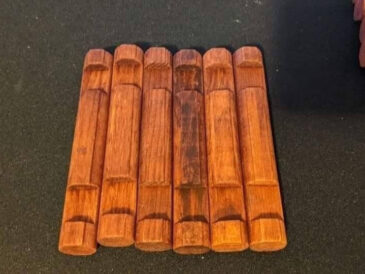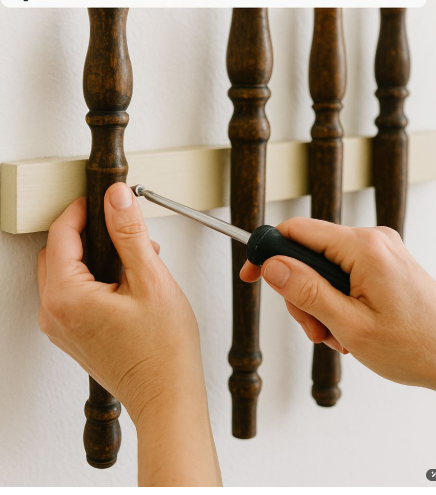
It starts quietly, the way all cultural shifts do. A woman salvages a few old chair spindles—those turned wooden rods once hidden beneath seats and backs—and fastens them to a simple wood board. No flashy materials. No expensive tools. Just discarded pieces, aligned with intention. The result is striking: sculptural, architectural, nostalgic, and somehow modern at the same time. Within weeks, the idea is everywhere—shared, copied, debated, praised. What looks like a small DIY experiment turns into a visual language that spreads across homes, workshops, and feeds worldwide.
This is not just about décor. It is about how meaning moves through materials, how forgotten objects re-enter our lives with new purpose, and why a humble chair spindle—once destined for the landfill—has become an unlikely symbol of creativity, restraint, and quiet rebellion against mass-produced sameness.
The Forgotten Beauty of Chair Spindles
Chair spindles are among the most overlooked elements of furniture history. For centuries, they were ubiquitous—turned on lathes, smoothed by hand, repeated with minor variations that revealed the touch of the maker. They supported backs, framed arms, and added rhythm to otherwise simple wooden forms. Then styles changed. Minimalism arrived. Upholstery swallowed structure. Chairs became slabs, shells, or molded curves. Spindles vanished from view, and with them, a tactile language of repetition and craftsmanship.
When old chairs are discarded, spindles are usually the first parts to be ignored. They look too specific to reuse, too narrow to repurpose easily, too outdated to feel relevant. That is precisely why mounting them on a wood board feels so arresting. The act reframes them. It removes function and leaves form. Suddenly, you see the negative space between them, the gentle variation in shape, the way light catches their curves. What once supported the body now speaks to the eye.
This transformation taps into something deep in our perception. Humans are pattern-seeking creatures. Repetition with variation—like a row of spindles—creates visual rhythm without monotony. It feels ordered but alive. By aligning spindles vertically or horizontally against a flat board, the maker turns an invisible furniture detail into a sculptural statement.
The Simple Construction That Changed Everything
Part of why this idea spreads so fast is its disarming simplicity. There is no complex joinery, no rare equipment, no technical gatekeeping. The materials are accessible: salvaged spindles, a plank of wood, screws or adhesive, and a willingness to experiment.
The construction process is almost meditative. First, the spindles are cleaned—sometimes sanded lightly to remove grime, sometimes left rough to preserve history. Then they are arranged. This step matters more than it seems. Spindles can be placed tightly together to create a dense, almost architectural surface, or spaced apart to let the wall breathe through them. They can be aligned precisely or staggered slightly for a more organic effect.
The board acts as both canvas and anchor. It gives context, grounding the vertical lines and allowing the whole piece to hang like art. Some makers stain the board dark to contrast with pale spindles. Others leave everything raw, celebrating wood-on-wood harmony. The choices are endless, yet the core idea remains the same: elevate the overlooked.
This is a democratizing kind of design. Anyone with patience and curiosity can attempt it. That accessibility fuels its rapid spread.
Why This Idea Exploded So Fast
Trends do not go viral by accident. They resonate because they answer a collective itch. This spindle-on-board phenomenon touches several nerves at once.
First, there is the hunger for authenticity. In a world saturated with factory-made décor designed to look “rustic” or “handmade,” people crave objects that actually carry history. Old chair spindles do not pretend. They show wear, variation, and age. Mounting them as art is an honest act. Nothing is disguised.
Second, the idea aligns perfectly with the current shift toward sustainability. Reuse is no longer a fringe virtue; it is a mainstream value. Turning waste into beauty feels morally satisfying as well as aesthetically pleasing. This project is a visible declaration: nothing here is new, yet everything feels intentional.
Third, the visual impact is immediate. A spindle panel reads well on camera. The vertical lines photograph beautifully. They create texture without chaos, structure without heaviness. On screens flooded with noise, this calm repetition stands out. People stop scrolling.
Finally, the idea invites interpretation rather than dictating meaning. Is it folk art? Minimalist sculpture? Rustic modern décor? The answer changes depending on context. That ambiguity allows many people to see themselves in it, and so they adapt it, share it, and pass it on.
The Emotional Pull of Reclaimed Objects
There is an emotional intelligence embedded in this trend that deserves attention. Old chair spindles carry traces of domestic life. They were once touched daily, leaned against, gripped absentmindedly during conversations. Even if we do not know their specific stories, we sense that they were part of something human.
By mounting them on a board, the maker does not erase that past. Instead, the past becomes part of the present. This resonates with people who feel disconnected from permanence in a disposable culture. The piece becomes a quiet anchor, a reminder that objects can outlive their original purpose and still matter.
There is also something subtly defiant about turning furniture parts into wall art. It challenges the idea that value comes from utility alone. Here, usefulness is not measured by sitting or supporting weight, but by evoking feeling, texture, and thought.
A New Kind of Wall Art
Traditional wall art is usually representational or abstract in predictable ways: paintings, prints, photographs. The spindle board occupies a different category. It is sculptural but flat enough to behave like art. It casts shadows, changes with the light, and interacts with the room over time.
This makes it especially compelling in modern interiors that often struggle with warmth. A spindle panel can soften concrete walls, balance sleek furniture, and add depth without clutter. It works in entryways, living rooms, stairwells, even bedrooms. Each placement changes how it reads.
What is striking is how adaptable the idea is across styles. In a farmhouse interior, it feels like a respectful nod to tradition. In a minimalist space, it becomes almost brutalist—repetition as structure. In eclectic homes, it reads as curated and intentional, a piece that invites questions.
Craft as Quiet Resistance
There is a philosophical undercurrent here that should not be ignored. Mounting old spindles on a board is not just decoration; it is a form of resistance. It resists planned obsolescence by extending the life of materials. It resists homogenization by celebrating irregularity. It resists passive consumption by inviting hands-on making.
This kind of craft does not shout. It whispers. It says: you do not need permission to create meaning from what you already have. That message travels fast because it is empowering. It reframes creativity as something ordinary people can do in ordinary spaces with ordinary tools.
In this sense, the viral spread of the idea is less about copying a look and more about sharing a mindset. People are not just mounting spindles; they are re-evaluating what they throw away, what they keep, and how they define beauty.
Variations That Keep the Trend Alive
As with any powerful idea, variation keeps it from stagnating. Some makers paint the spindles white for a crisp, modern feel. Others char them lightly for a dramatic, almost ceremonial effect. Some arrange them in gradients of thickness or height, creating subtle visual movement.
Boards evolve too. Wide planks become statements. Narrow strips feel graphic. Some makers mount spindles on reclaimed barn wood, others on smooth plywood. The background changes the conversation.
There are even versions where spindles are cut, layered, or intersected, pushing the idea toward true sculpture. Yet the most compelling examples often remain the simplest. There is strength in restraint.
Why This Resonates Beyond Décor
It would be easy to dismiss this trend as just another internet moment. But its staying power suggests something deeper. At its core, this idea speaks to a broader cultural reassessment of value.
People are questioning speed, excess, and novelty. They are drawn to objects that slow the eye and reward attention. A row of spindles does exactly that. It asks you to notice difference within sameness, to appreciate patience, to accept imperfection.
In a subtle way, this project mirrors emotional work many people are doing in their lives: taking fragmented or discarded parts of themselves and arranging them into something coherent and meaningful. That metaphor may not be conscious, but it is felt.
The Role of the “Lady” Behind the Idea
It is worth noting how often this story is framed: “Lady mounts old chair spindles…” The gendered language matters. It evokes domestic ingenuity, resourcefulness born not from abundance but from making do. Historically, women have been the keepers of household materials, the ones who repair, reuse, and adapt.
This framing taps into a lineage of quiet innovation that has often gone unrecognized. The viral spread of this idea, attached to an ordinary woman rather than a branded designer, challenges hierarchies of authorship. It suggests that meaningful design does not require fame, only vision.
That, too, is part of why the idea spreads. It feels attainable. It feels human.
From Internet Curiosity to Lasting Practice
Many viral ideas burn fast and disappear. This one has the markings of something more durable. It teaches a way of seeing rather than a single outcome. Once you see chair spindles as sculptural elements, you start seeing potential everywhere: table legs, banisters, drawer pulls, broken frames.
The board-and-spindle piece becomes a gateway. People begin experimenting, trusting their eye, and building confidence in their ability to transform space. That kind of shift does not vanish overnight.
What began as an unexpected DIY has become a small movement within the larger return to material awareness. It reminds us that design does not always mean adding more. Sometimes it means isolating, framing, and paying attention.
A Quiet Revolution in Wood and Shadow
In the end, the power of this idea lies in its humility. No bold claims. No forced symbolism. Just wood, arranged with care. Yet in that simplicity, it challenges assumptions about waste, beauty, and creativity.
Mounting old chair spindles on a wood board does not solve the world’s problems. It does something subtler and perhaps more important: it reawakens our capacity to look at what we already have and imagine differently.
That is why it is suddenly everywhere. Not because it is trendy, but because it feels true.
ChatGPT peut faire des erreurs. Envisagez de vé