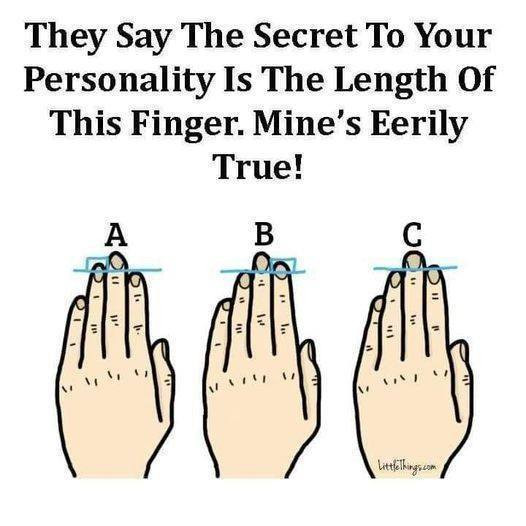
At first glance, the idea sounds like another harmless internet curiosity. A simple hand illustration, three options labeled A, B, and C, and a bold promise: the length of a single finger can reveal hidden truths about who you are. Most people approach it with skepticism, maybe even a smirk. And yet, time and time again, readers pause mid-scroll, stare at their own hands, and quietly admit something surprising — the description feels eerily on point.
This kind of personality test has circulated for years, resurfacing regularly because it taps into something deeply human: the desire to understand ourselves quickly, intuitively, and without effort. Unlike long questionnaires or psychological assessments, this one asks only for a glance at your hand. No thinking. No analyzing. Just observation.
What makes it so compelling is not whether it is scientifically precise, but how effectively it mirrors patterns people already sense about themselves. It feels personal. Immediate. Almost intrusive in its accuracy.
To understand why this simple finger-length comparison resonates so strongly, it helps to slow down and look at what it claims to reveal — and why so many people feel seen by it.
Why We’re Drawn to Physical Personality Tests
Humans have always searched for meaning in the body. Long before modern psychology, people believed character could be read in faces, palms, posture, and proportions. From ancient physiognomy to palm reading, the body was seen as a map of the inner self.
Finger-length personality tests fit neatly into this tradition. They suggest that who we are is not only shaped by experience but subtly etched into our physical form. Whether or not this is literally true, the idea itself is powerful.
When a trait appears “written” into the body, it feels permanent, validating, and deeply personal. It suggests that certain tendencies are not flaws or failures, but natural inclinations — things we were born with.
That sense of inevitability can be oddly comforting.
The Finger-Length Comparison Explained Simply
This test focuses on the relationship between two fingers on your hand: the index finger and the ring finger. The comparison is visual and immediate.
- In one case, the index finger appears longer than the ring finger
- In another, the ring finger extends beyond the index finger
- In the third, the two fingers appear roughly the same length
Each variation is said to correspond to a distinct personality pattern.
What makes this test stick is not complexity, but clarity. Each description is bold, specific, and emotionally resonant. People rarely read them neutrally. They either nod in recognition or react defensively — both signs of engagement.
Type A: When the Index Finger Is Longer
People whose index finger extends beyond the ring finger are often described as natural leaders, thinkers, and planners. The personality profile associated with this hand type emphasizes structure, responsibility, and mental strength.
These individuals are typically portrayed as confident without being loud. They prefer logic over impulse and tend to analyze situations before acting. Many are described as dependable, disciplined, and deeply self-aware.
There is often an emphasis on independence. People in this category are said to trust themselves, set their own standards, and resist external pressure. They are less likely to follow trends blindly and more likely to carve out their own path, even if it means standing alone.
Emotionally, this type is often described as reserved but intense. They may not express feelings openly, yet they experience them deeply. Loyalty, once earned, runs strong.
For many readers, this description resonates because it frames seriousness and caution as strengths rather than limitations. It suggests that restraint is not weakness — it is control.
Type B: When the Ring Finger Is Longer
This is the category that often generates the strongest reactions.
People whose ring finger is longer than their index finger are commonly described as charismatic, expressive, and emotionally intuitive. They are said to thrive in social settings, attract attention effortlessly, and possess a natural magnetism.
The associated personality traits often include creativity, confidence, risk-taking, and charm. These individuals are portrayed as comfortable with uncertainty, willing to act on instinct, and unafraid of bold moves.
There is often a strong emotional component in this description. People in this category are said to feel deeply, love passionately, and experience highs and lows more intensely than others. They may be spontaneous, sometimes impulsive, but rarely dull.
What makes this description hit home for many is its validation of emotional openness. Sensitivity, enthusiasm, and expressiveness are framed as strengths rather than excess.
Readers who identify with this type often say the description feels “exposed” — as if it names traits they’ve always sensed but never fully articulated.
Type C: When Both Fingers Are the Same Length
Those whose index and ring fingers appear equal in length are typically described as balanced, adaptable, and emotionally intelligent. This personality type is often portrayed as the mediator — someone who blends logic and emotion seamlessly.
People in this category are said to value harmony, fairness, and stability. They tend to avoid extremes, preferring thoughtful compromise over confrontation. They are often good listeners, reliable friends, and steady partners.
The descriptions frequently emphasize inner calm and emotional maturity. These individuals may not seek attention, but they command respect quietly. They are adaptable without being indecisive and principled without being rigid.
For many readers, this profile resonates because it reflects a sense of equilibrium — the feeling of being “in between” worlds, able to understand multiple perspectives without losing oneself.
Why These Descriptions Feel So Accurate
The real reason this test feels eerily true has less to do with finger length and more to do with psychology.
Each description is written broadly enough to apply to a wide range of people, yet specific enough to feel personal. This phenomenon is well-known in psychology: people naturally accept general personality statements as uniquely applicable to themselves, especially when those statements are flattering or emotionally resonant.
But there’s something else at work too.
When people look at their hands, they’re engaging in a physical act of self-observation. That small ritual creates focus. It slows the mind. It invites reflection. In that quiet moment, the description doesn’t feel like random text — it feels like a revelation.
And once a person recognizes even one accurate trait, the rest of the description begins to feel true by association.
The Comfort of Being “Seen” Without Explanation
One of the reasons these tests spread so easily is that they offer recognition without interrogation. No one asks about your childhood, your trauma, or your mistakes. The test doesn’t require justification.
It simply says: this is how you are.
For many people, that feels relieving.
In a world that constantly demands explanation, optimization, and improvement, a simple label can feel grounding. It offers a moment of self-acceptance, even if only temporarily.
Why People Share These Tests So Readily
Sharing a personality test is rarely about proving it right or wrong. It’s about connection.
When someone posts “Mine was eerily accurate,” they are inviting others to compare, discuss, and relate. It opens a low-stakes conversation about identity — one that feels playful rather than vulnerable.
People tag friends not to test science, but to say, “This reminded me of you.”
And in that sense, the test succeeds regardless of its scientific validity.
What This Test Really Reveals
Ultimately, this finger-length personality test does not reveal destiny, intelligence, or character in any absolute sense. What it reveals is something quieter but just as interesting: how eager people are to understand themselves through simple, symbolic frameworks.
It shows how much we crave reflection without judgment and insight without effort.
And perhaps most importantly, it reminds us that sometimes, feeling understood matters more than being measured.
Whether you see yourself as a thinker, a feeler, or a balancer, the moment you pause to reflect on who you are — even through something as small as your fingers — you’re doing something meaningful.
You’re paying attention to yourself.
And that, more than any test, says a lot about who you are.