Every household has them. They pile up quietly in drawers, fall behind washing machines, or end up tossed straight into the trash without a second thought. Laundry detergent caps are among the most overlooked plastic items in modern homes. Small, colorful, seemingly useless once the bottle is empty, they appear disposable by design. Yet this assumption is precisely what hides their true potential.
What looks like trash is, in fact, one of the most versatile, durable, and reusable plastic components you already own. With a little creativity and basic tools, detergent caps can be transformed into functional household items, storage solutions, organization systems, and even decorative objects that rival store-bought alternatives. Their uniform shapes, sturdy plastic composition, and built-in measurement markings make them uniquely suited for reuse in ways that most people never consider.
This is not about crafts for the sake of crafts. This is about saving money, reducing waste, and extracting real value from something that usually costs nothing. When reused thoughtfully, detergent caps stop being clutter and start becoming assets.
Why Detergent Caps Are More Valuable Than They Appear
At first glance, a detergent cap looks insignificant. It is small, hollow, and lightweight. But its design is not accidental. Manufacturers engineer these caps to withstand repeated exposure to chemicals, pressure, temperature changes, and physical handling. They are made to last for years, not weeks.
Most detergent caps are produced from high-density plastic that resists cracking, warping, and moisture absorption. They are designed to be gripped easily, poured accurately, and cleaned repeatedly. This makes them far more durable than many disposable containers sold for household use.
In addition, detergent caps share standardized dimensions. This uniformity is incredibly useful when repurposing them for modular projects, organization systems, or repeatable designs. When you have several identical caps, you essentially have free building blocks.
The Hidden Cost of Throwing Them Away
Throwing away detergent caps seems harmless, but it comes with hidden costs that most households never calculate.
Plastic waste accumulates quickly. Caps are small, but they add up over time. More importantly, they are often made from plastics that are not always recycled efficiently, depending on local waste systems. Many end up in landfills despite being perfectly reusable.
Replacing items that detergent caps could substitute costs money. Small containers, organizers, measuring cups, plant starters, cable holders, and craft supplies are all items people routinely buy, unaware they already own something capable of doing the job.
By reusing detergent caps, households reduce unnecessary purchases, lower plastic waste, and extend the lifecycle of materials already paid for.
Turning Detergent Caps Into Functional Household Tools
One of the most practical uses for detergent caps is converting them into everyday tools. Their size and shape make them ideal for tasks that require precision, containment, or repetition.
When cleaned thoroughly, detergent caps can be reused as measuring cups for non-food purposes. They are perfect for gardening additives, fertilizer mixes, cleaning solutions, paint ratios, or pet-safe cleaning recipes. The printed measurement lines inside many caps eliminate guesswork and improve consistency.
Caps can also become small funnels when trimmed or inverted. This is especially useful for transferring liquids, powders, or granules into narrow containers without spills. Their rigid plastic edges maintain shape better than paper or makeshift funnels.
In workshops and garages, detergent caps work well as holders for screws, nails, washers, bolts, and small hardware. Mounted to a board or stored in a drawer, they keep items sorted and accessible. Because the caps are stackable and identical, organization becomes easier and visually cleaner.
A Powerful Organizer for Craft Rooms and Offices
Craft supplies and office materials often suffer from the same problem: too many small items and nowhere to put them. Detergent caps solve this quietly and efficiently.
Glue sticks, beads, buttons, paper clips, push pins, sewing notions, erasers, thumb drives, and even rolled cords fit neatly inside detergent caps. Their rounded edges prevent snagging, and their solid base keeps them upright.
With a simple adhesive or hot glue, caps can be mounted onto pegboards, drawers, walls, or under shelves. This creates a modular storage system that costs virtually nothing but offers the same utility as commercial organizers.
For families with children, detergent caps become safe sorting tools for educational activities. Colors, shapes, coins, counting objects, and learning aids can all be separated and stored in a visually engaging way.
Gardening Uses That Save Money and Reduce Waste
In gardening, detergent caps shine even more brightly. Their size, durability, and water resistance make them ideal for both indoor and outdoor plant care.
Caps can be used as seed starters for herbs, flowers, or vegetables. When filled with soil and drainage holes added, they become compact planters that fit neatly on windowsills or trays. Their uniform size helps maintain consistent watering and growth conditions.
They also work well as plant labels when written on with permanent markers. Placed upside down near seedlings, they clearly mark plant types and planting dates without deteriorating in moisture.
For gardeners mixing fertilizers or pest control solutions, detergent caps serve as reliable scoops that prevent overuse and waste. Because they are easy to clean, switching between mixtures is safe and efficient.
Some people even use caps as drip irrigation regulators by piercing small holes and attaching them to bottles, allowing slow, controlled watering for potted plants.
Creative DIY Projects That Look Store-Bought
Detergent caps are not limited to practical uses. With minimal effort, they can become visually appealing objects that blend seamlessly into modern homes.
When painted, wrapped, or decorated, caps transform into candle holders, tealight stands, or small decorative containers. Their shape provides stability, and their plastic composition tolerates heat from LED candles safely.
Caps can be joined together to create modular wall art, textured panels, or geometric displays. When arranged symmetrically, their repeated form creates visually pleasing patterns that look intentional and modern.
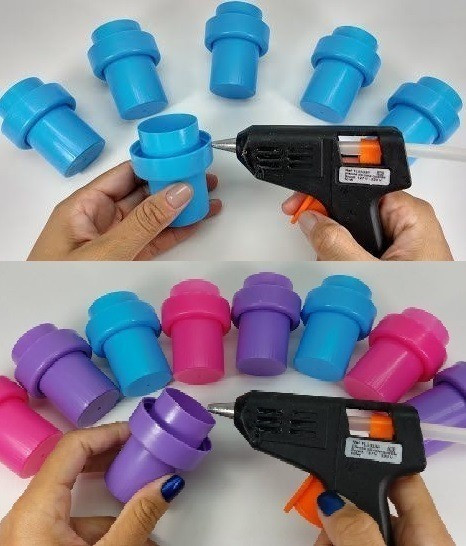
With a glue gun and a bit of patience, detergent caps can be stacked or connected to form organizers for makeup brushes, toothbrushes, razors, or desk supplies. These custom-built solutions often outperform generic store-bought versions because they are tailored to exact needs.
How Hot Glue Unlocks the Full Potential of Detergent Caps
Hot glue is the secret weapon that turns detergent caps from loose objects into structural components. Because detergent caps are heat-resistant, hot glue adheres well without warping the plastic.
By applying hot glue around the rim or base, caps can be attached securely to surfaces such as wood, metal, plastic, or fabric. This opens up endless possibilities for vertical storage, wall-mounted systems, and modular assemblies.
Hot glue also allows caps to be connected side-by-side or stacked vertically, creating honeycomb-style organizers or tiered storage towers. Once cooled, the bond is strong enough for daily use but still removable with heat if adjustments are needed.
This makes detergent caps ideal for renters or anyone who prefers non-permanent solutions.
Why This Simple Reuse Can Feel Like “Gold”
Click page 2 to continue