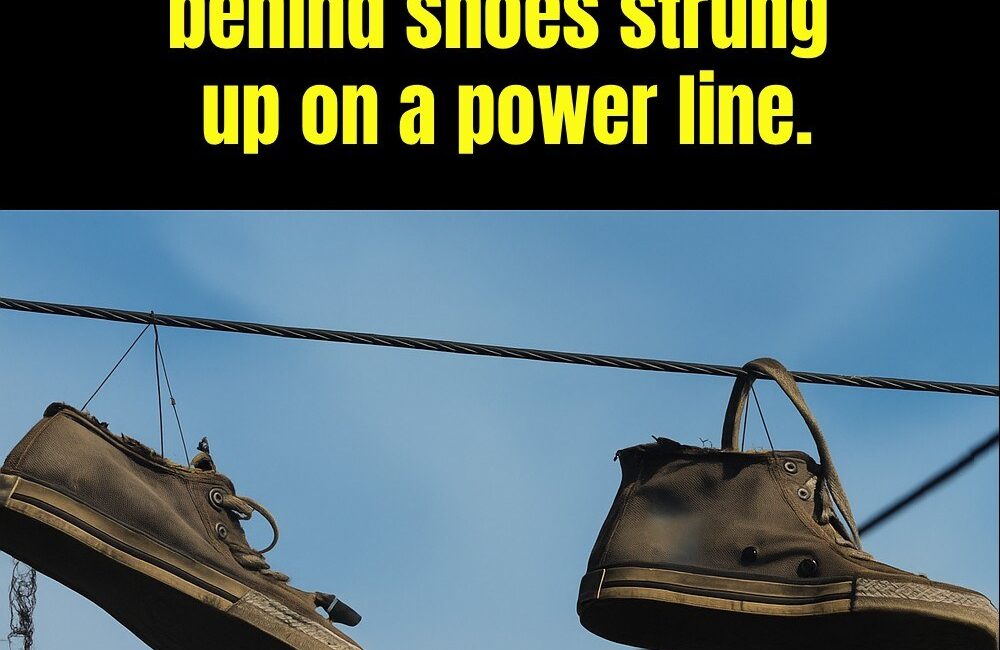
You have seen them, even if you barely registered them at first. A pair of worn sneakers tied together by their laces, dangling from a power line. Sometimes they sway gently. Sometimes they hang perfectly still, frozen against the sky. They appear in quiet suburbs, busy city streets, small towns, industrial zones, and places you would least expect. They are not rare. They are not accidental. And yet, they remain one of the most misunderstood visual symbols of modern life.
People slow down when they notice them. Some feel uneasy. Others feel nostalgic. A few feel curious enough to ask questions. What do those shoes mean? Who put them there? Why do they keep appearing generation after generation?
Despite countless theories, rumors, and assumptions, there is no single explanation. And that uncertainty is exactly why the phenomenon endures.
Shoes on power lines are not just an object. They are a message without a caption. A story without a narrator. A symbol that changes meaning depending on who is looking and where it appears.
WHY THIS IMAGE CAPTURES ATTENTION SO STRONGLY
Humans are wired to notice anomalies. We expect power lines to be functional, dull, invisible infrastructure. Shoes do not belong there. When something breaks expectation, the brain pauses. That pause invites interpretation.
Shoes are deeply personal objects. They carry the shape of the body, the wear of movement, the imprint of someone’s life. Seeing them removed from the ground and suspended in the air feels uncanny. It suggests intention.
Unlike graffiti, which clearly communicates rebellion or identity, shoes on a wire are ambiguous. They refuse to explain themselves. That ambiguity triggers storytelling.
THE GANG TERRITORY MYTH: WHY IT PERSISTED AND WHY IT’S MOSTLY WRONG
One of the most widespread beliefs is that shoes on power lines mark gang territory or drug-selling locations. This idea has circulated for decades, reinforced by movies, television, and sensational headlines.
The logic seems simple: visible marker equals territorial claim.
In reality, this explanation rarely holds up. Criminal organizations rely on discretion, not spectacle. Drawing attention to illegal activity using something as obvious as dangling shoes contradicts basic operational behavior. Law enforcement agencies and urban researchers consistently note that such markers are unreliable indicators of organized crime.
That said, isolated cases may exist where shoes coincidentally align with illicit activity. But coincidence became myth, and myth became assumed truth.
The persistence of this belief reveals more about fear, stereotypes, and media narratives than about the shoes themselves.
RITES OF PASSAGE: SHOES AS A SYMBOL OF TRANSITION
One of the most common and credible explanations is that shoe tossing marks a personal milestone. Humans have always created rituals to signify endings and beginnings. Shoes, as objects associated with movement and journeys, naturally lend themselves to symbolism.
Graduation is a frequent example. Finishing school represents the end of one structured path and the uncertainty of another. Tossing shoes becomes a physical release of the past.
Military service provides another context. Friends throwing boots before deployment may symbolize separation, courage, and solidarity. It is not a farewell object, but a moment frozen in time.
For teenagers especially, the act is often spontaneous, playful, and meaningful only to those involved. The meaning does not need to be formal to be real.
MEMORIALS WITHOUT WORDS: SHOES AS REMEMBRANCE
In some neighborhoods, shoes function as quiet memorials. They may honor someone who passed away young, someone known locally, or someone whose life left a mark on the community.
Unlike plaques or signs, shoes are anonymous. They do not explain who is remembered or why. That anonymity allows grief to exist without performance. It is a private tribute in public space.
These memorials are not standardized traditions. They arise organically, shaped by circumstance and emotion. Their rarity makes them powerful when they do occur.
PRANKS, BOREDOM, AND THE JOY OF DOING SOMETHING POINTLESS
Sometimes, the explanation is refreshingly simple. Teenagers throw shoes because they can. Because it is funny. Because gravity becomes a game. Because boredom seeks expression.
There is a long tradition of harmless rebellion in youth culture. Tossing shoes requires creativity, coordination, and a willingness to break minor norms. It leaves a trace without confrontation.
Not every act needs deep meaning. Yet even meaningless acts can evolve into symbols when repeated often enough.
QUITTING, LETTING GO, AND PERSONAL REINVENTION
Another enduring legend suggests that people throw shoes onto power lines to symbolize leaving something behind, often drug use, a difficult phase of life, or a past identity.
The imagery is compelling. Shoes represent paths walked. Throwing them away marks refusal to walk that path again.
While there is little evidence of this being a widespread, intentional practice, the story persists because it resonates emotionally. Humans crave narratives of transformation. The image fits.
Whether true or not, the belief adds another layer to the symbolism.
SHOES AS URBAN LANDMARKS AND UNOFFICIAL MAPS
In some places, shoes function as informal markers. They indicate a meeting spot, a friend’s house, a party location, or a local shortcut.
Before smartphones and digital navigation dominated daily life, physical markers mattered more. Shoes were visible, memorable, and unlikely to be mistaken.
This use transforms them from symbol into utility, blending practicality with tradition.
STREET ART AND MODERN FOLKLORE
For some, shoes on power lines are a form of unspoken street art. Not curated. Not commercial. Not signed.
They change the visual landscape without asking permission. They challenge the idea of who gets to modify public space.
Over time, this act has become urban folklore. No rules. No official origin. Just repetition passed down through observation rather than instruction.
One generation sees it. The next imitates it. Meaning becomes secondary to continuity.
HOW THE SHOES GET UP THERE: SKILL, PATIENCE, AND INVENTION
The mechanics of shoe tossing are almost as fascinating as the symbolism.
Most commonly, shoelaces are tied together, and the pair is thrown over the wire like a lasso. Others use weighted strings or improvised tools. Occasionally, extreme precision and luck play a role.
The effort involved suggests intention. This is not an accident. Someone wanted those shoes there badly enough to try repeatedly.
WHY THE IMAGE ENDURES ACROSS TIME AND PLACE
Shoes on power lines appear in different countries, cultures, and decades. That universality points to something fundamental.
It is not about gangs.
It is not about drugs.
It is not about one tradition.
It is about humans leaving marks.
The act is low-risk, semi-permanent, anonymous, and visible. It satisfies a basic urge to say, “I existed here.”
THE PSYCHOLOGY BEHIND LEAVING A TRACE
Anthropologists note that humans have always marked territory, transitions, and memory. Cave paintings. Handprints. Stacked stones. Shoes on wires are a modern expression of the same impulse.
In an era where much of life is digital and fleeting, a physical mark in the real world carries weight. It resists deletion. It outlasts a moment.
Even when the meaning is forgotten, the presence remains.
WHY THERE WILL NEVER BE ONE ANSWER
The greatest mistake is trying to reduce this phenomenon to a single explanation. Doing so strips it of its power.
The meaning of shoes on a power line depends on context, people, intention, and place. Sometimes it is meaningful. Sometimes it is meaningless. Often it is both.
And that flexibility is why the symbol survives.
FINAL THOUGHT: LOOK UP AND LET IT BE A QUESTION
Next time you see shoes swinging above a street, resist the urge to categorize them immediately. Instead, pause.
Someone tied those laces.
Someone threw them.
Someone laughed, cried, celebrated, or acted on impulse.
You may never know why.
But the fact that you noticed means the act succeeded.
Because at its core, shoes on a power line are not asking to be understood.
They are asking to be seen.