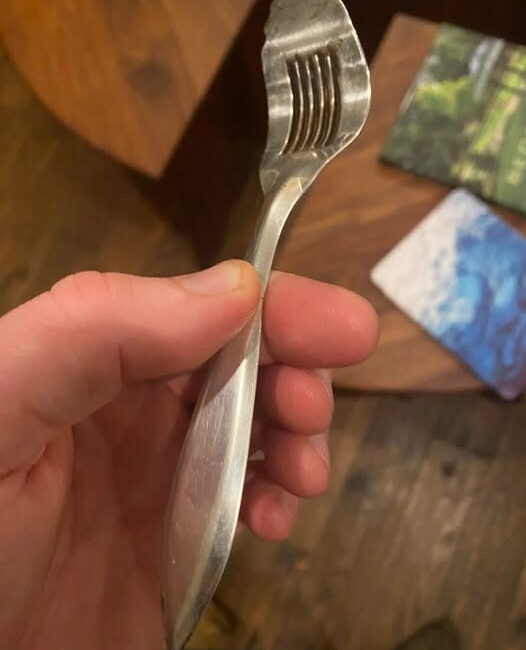
Open an old kitchen drawer in a house that has seen a few generations, and you might find it lying there quietly among mismatched forks and worn-handled knives. At first glance, it looks like a spoon that went terribly wrong. The bowl is oddly curved, not smooth but lined with parallel metal fins or ridges. It doesn’t look elegant. It doesn’t look intuitive. It doesn’t look like anything modern kitchens would bother designing today.
Most people who encounter it for the first time assume it must be broken, decorative, or experimental. Some think it’s a strange ladle. Others guess it’s for cheese, citrus, or something obscure that never caught on. And because we live in a time where tools are hyper-specialized and aggressively marketed, anything unfamiliar feels unnecessary.
But this spoon wasn’t unnecessary at all.
In fact, it solved a very real, very everyday problem that modern kitchens quietly eliminated — not because the problem disappeared, but because the way we consume food changed.
This is the butter scraper spoon.
And once you understand why it existed, you start to see how much of daily life has shifted without us even noticing.
THE FIRST IMPRESSION: WHY IT LOOKS “WRONG” TO MODERN EYES
The butter scraper spoon immediately challenges what we expect a spoon to be. Modern spoons are smooth, symmetrical, and designed to hold liquids or soft foods. This one breaks every rule. The bowl is curved but interrupted by ridges. Those ridges look sharp, mechanical, and almost hostile to the idea of scooping.
To a modern eye, it feels like bad design.
But good design is never about appearance alone. It is about function. And this spoon was built for a function we no longer design around.
WHAT A BUTTER SCRAPER SPOON ACTUALLY IS
The butter scraper spoon was designed for one specific task: dealing with cold, hard butter.
Before pre-cut butter sticks, before soft-spread tubs, before butter lived conveniently at room temperature in many homes, butter was often stored in solid blocks. These blocks were kept cold to preserve freshness. When needed, they were unyielding. Trying to spread them with a knife often resulted in torn bread, uneven chunks, or frustration.
The butter scraper spoon solved this.
Those ridges inside the bowl acted like a miniature grater. When dragged across the surface of cold butter, they shaved off thin curls or flakes. These flakes softened quickly because of their size and surface area. Instead of hacking at a block with a knife or waiting endlessly for butter to soften, you could produce spreadable butter instantly.
The curved bowl wasn’t decorative either. It guided the butter shavings into one place, making it easy to transfer them directly onto bread, vegetables, or into a mixing bowl.
It was practical, deliberate, and incredibly effective.
A TOOL DESIGNED AROUND REAL LIFE, NOT CONVENIENCE MARKETING
The butter scraper spoon emerged in an era when kitchens were built around raw ingredients and manual preparation. Butter came in blocks. Bread was dense. Time mattered, but patience was assumed.
This spoon respected that reality.
It didn’t ask you to change your habits. It adapted to them.
Instead of softening butter ahead of time or compromising texture, it gave you control in the moment. That kind of design philosophy — tools that adapt to human routines rather than forcing new ones — was once common.
Today, we solve the same problem by changing the product instead of the tool. Soft-spread butter, whipped butter, margarine tubs — all exist so we no longer need a spoon like this.
The problem didn’t vanish. The solution was outsourced.
A QUIET FIXTURE IN MID-CENTURY KITCHENS
Butter scraper spoons were especially common in mid-20th-century American kitchens. They lived in drawers, on serving tables, and sometimes next to butter dishes. They were not novelty items. They were expected.
Families used them daily — not just for spreading butter at the table, but also during cooking and baking. When a recipe called for a precise amount of butter, scraping off thin layers allowed for more accurate measurement without melting or cutting.
This mattered in an era where recipes were learned by repetition and feel, not pre-measured packaging.
Ask an older relative, and many will vaguely remember “that weird butter spoon” without ever having been told its name. It was just there. It worked. No explanation required.
MORE THAN JUST A BUTTER TOOL
One of the reasons the butter scraper spoon survived so long in kitchens is because it quietly earned its keep beyond its original purpose.
The same ridged design that shaved butter also made it useful for skimming foam or scum from soups, broths, and jams. The curved edge glided along the surface, while the ridges trapped impurities.
Some families used it to scrape soft cheeses. Others discovered it worked beautifully for shaving chocolate or firm ganache for baking. In households where buying new utensils wasn’t an option, tools were expected to multitask.
The butter scraper spoon wasn’t marketed as “multi-functional.” It simply proved itself useful wherever it could.
WHY IT DISAPPEARED — AND WHY WE STOPPED RECOGNIZING IT
The disappearance of the butter scraper spoon wasn’t due to poor design. It was due to a shift in food production and consumer habits.
Butter changed. Packaging changed. Refrigeration practices changed. Convenience became the priority.
When butter started coming pre-portioned and spreadable, the need to shave it disappeared. Once the problem vanished from daily life, the tool lost its context. And when context disappears, recognition follows.
Today, most people encountering a butter scraper spoon have never experienced the frustration it was designed to solve. Without that experience, the tool looks pointless.
Not obsolete — just misunderstood.
THE NOSTALGIC VALUE WE DIDN’T PLAN FOR
What makes the butter scraper spoon special now isn’t just its function. It’s what it represents.
It represents a time when tools were built to last decades, not product cycles. When one utensil did several jobs quietly. When kitchens were filled with objects chosen for durability rather than trend.
Finding one today connects you directly to the way your parents or grandparents cooked. Not in an abstract sense, but physically. Your hand grips the same shape. Your motion repeats theirs. The task feels slower, more deliberate, more grounded.
That connection is rare — and increasingly valuable.
WHY THROWING IT AWAY FEELS WRONG
In modern kitchens overflowing with single-use gadgets — avocado slicers, herb strippers, banana holders — it’s ironic that a truly useful, durable tool looks strange enough to be discarded.
The butter scraper spoon doesn’t advertise itself. It doesn’t explain itself. It waits for understanding.
And once understood, it earns respect.
FOUND ONE? HERE’S WHY YOU SHOULD KEEP IT
If you come across a butter scraper spoon in a thrift store, an old house, or a relative’s drawer, resist the urge to toss it aside. It still works exactly as intended. Cold butter hasn’t changed. Bread still tears. Chocolate still needs shaving.
Beyond function, it becomes a conversation piece — a reminder that kitchens once solved problems differently. It invites curiosity. It invites storytelling.
And it invites a small act of rebellion against disposable design.
A SMALL TOOL WITH A BIG STORY
The butter scraper spoon didn’t vanish because it failed. It vanished because we stopped needing to think about butter.
That alone should make us pause.
Because how many other quiet problems did we solve by redesigning food instead of respecting tools? How many objects disappeared simply because convenience replaced skill?
Holding a butter scraper spoon today feels like holding a fragment of everyday wisdom — not flashy, not loud, but deeply human.
And sometimes, that’s exactly what modern kitchens are missing.