A Mind-Bending Visual Challenge That Reveals How Your Brain Really Sees
At first glance, the image feels straightforward.
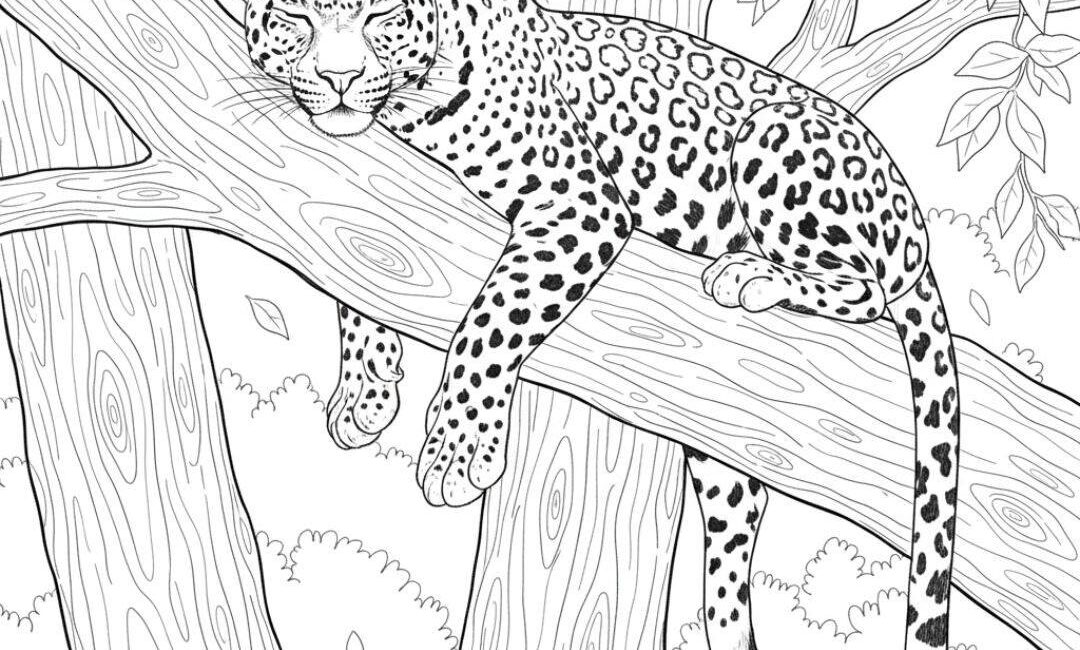
You see a leopard stretched lazily across tree branches. The lines are clean, the scene calm, almost soothing. Your eyes recognize the animal instantly, your brain labels it, and you move on—confident you’ve understood what you’re looking at.
But then comes the sentence that stops you:
“Not everyone can see the fish.”
Suddenly, the image changes.
Not visually—but mentally.
You look again. Slower this time. More carefully. And that’s when the challenge begins.
Why This Image Is More Than Just a Puzzle
This isn’t just a “find the hidden object” game. It’s a quiet demonstration of how perception works—and how unreliable it can be.
The fish is not obvious. It’s not highlighted. It’s not separated from the scene. It’s woven into the lines, shapes, and negative space of the drawing itself. The illusion depends entirely on how your brain organizes visual information.
Some people spot the fish almost immediately.
Others stare for minutes and still can’t see it.
And both reactions are completely normal.
The Real Challenge Isn’t Your Eyes — It’s Your Brain
Contrary to what most people assume, this puzzle has very little to do with eyesight quality.
It has everything to do with pattern recognition.
Your brain is constantly doing three things when you look at an image:
- Identifying familiar shapes
- Filtering out “irrelevant” details
- Filling in gaps to create a coherent scene
Once your brain decides, “This is a leopard on a tree,” it locks into that interpretation. Anything that doesn’t fit that narrative gets downgraded or ignored.
The fish exists in the image—but not as a separate object. It’s hidden in overlapping lines, contours, and spaces that your brain initially classifies as “background.”
Seeing it requires you to unlearn what you think you’re seeing.
Why Some People See the Fish Instantly
People who spot the fish quickly often share certain perceptual habits, even if they don’t realize it.
They tend to:
- Scan images instead of focusing on the main subject
- Notice negative space naturally
- Be comfortable with visual ambiguity
- Switch perspectives easily
Their brains don’t lock onto the first interpretation as rigidly. Instead of asking, “What is this?” they unconsciously ask, “What else could this be?”
That mental flexibility is the key.
Why Others Struggle (And Why That’s Not a Weakness)
If you can’t see the fish right away, it doesn’t mean you’re less observant or less intelligent.
In fact, it often means the opposite.
People who struggle tend to:
- Process images holistically
- Focus strongly on dominant figures
- Trust their first interpretation
- Prefer clarity over ambiguity
Your brain is doing its job efficiently. It sees a leopard, understands the scene, and moves on. From a survival perspective, that’s excellent design.
The difficulty comes when the rules change—and the image asks you to question what you already “know.”
The Power of the Hint (And Why It Works)
Many versions of this challenge mention that “the first comment gives a hint.” That’s not accidental.
Once your brain is told what to look for, it changes how it processes the image. Suddenly:
- Lines become contours
- Background becomes foreground
- Random shapes gain meaning
Click page 2 to continue