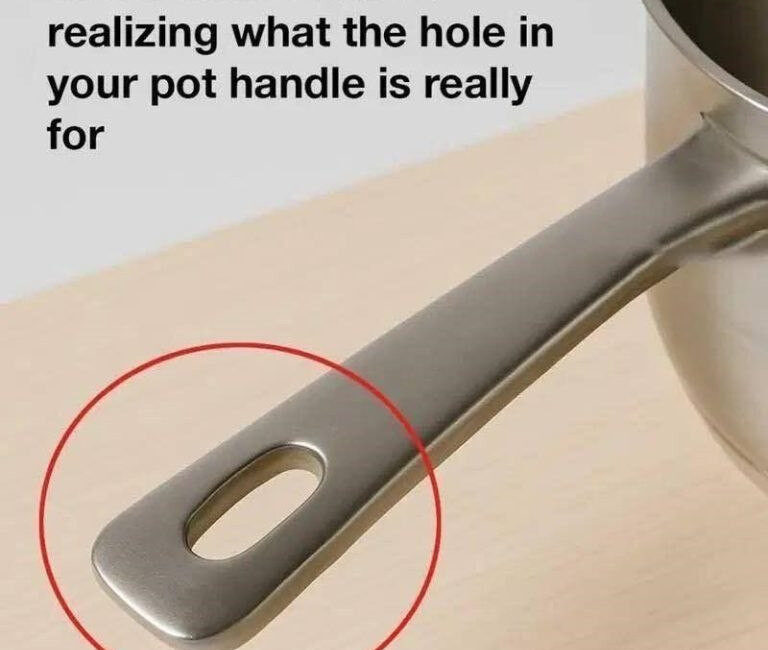
You’ve seen it a thousand times.
That small, perfectly round hole at the end of your pot or saucepan handle.
You probably assume it exists for one simple reason: to hang the pot on a hook.
And yes—hanging is one function.
But stopping there is like saying a smartphone is just a calculator.
That humble little hole is one of the most underappreciated pieces of kitchen design. It exists because cooks, engineers, and manufacturers quietly solved multiple problems with one tiny feature. Over time, its uses multiplied—some intentional, others discovered accidentally by people who spend enough time cooking to notice patterns.
Let’s slow down and look at that hole properly. Because once you understand what it can actually do, you’ll never see your cookware the same way again.
1. The Obvious Use — Hanging (But Smarter Than You Think)
Yes, the hole allows you to hang your pot. But this isn’t just about saving space.
Hanging cookware:
- Improves air circulation, reducing moisture buildup
- Prevents scratches from stacking
- Keeps frequently used pots within arm’s reach
- Reduces cabinet clutter and noise
In professional kitchens, hanging isn’t aesthetic—it’s functional efficiency. The hole is placed at a specific distance from the handle’s end so the pot hangs balanced, not tilted, keeping stress off the handle joint.
That detail matters. A poorly balanced hang would weaken the handle over time. This one doesn’t.
2. Built-In Spoon Rest (One of the Most Practical Uses)
This is the use people discover by accident—and then never stop using.
When you’re cooking:
- Sauces
- Soups
- Stews
- Pasta water
You’re constantly stirring. And every stir creates the same problem:
Where do you put the spoon without dirtying the counter?
That hole solves it.
Slip the handle of your wooden spoon, silicone spatula, or ladle through the hole, letting the spoon rest inside the pot while the handle stays elevated.
This does several things at once:
- Prevents drips on the counter
- Keeps the spoon from sliding into the food
- Reduces cross-contamination
- Keeps heat away from your hand
This is not a gimmick. Many modern pots are designed with hole sizes intentionally matched to standard utensil handles.
3. Controlled Pouring Without Drips
This one is subtle—but incredibly useful.
When pouring liquids from a pot (soup, stock, pasta water), the hole can act as a pressure release point.
Here’s how:
- As liquid pours from the lip, air needs to enter the pot
- Without airflow, liquid “glugs,” splashes, or spills
- The hole allows air to enter smoothly
This results in:
- More controlled pouring
- Less splashing
- Better accuracy
It’s especially helpful with heavier liquids like cream-based soups or sauces.
You won’t see this written on packaging—but engineers understand fluid dynamics very well.
4. Heat Management and Safety Signal
The hole also plays a quiet role in thermal behavior.
Metal handles expand when heated. The hole:
- Reduces overall mass at the handle’s end
- Helps manage expansion stress
- Prevents warping over time
Click page 2 for more