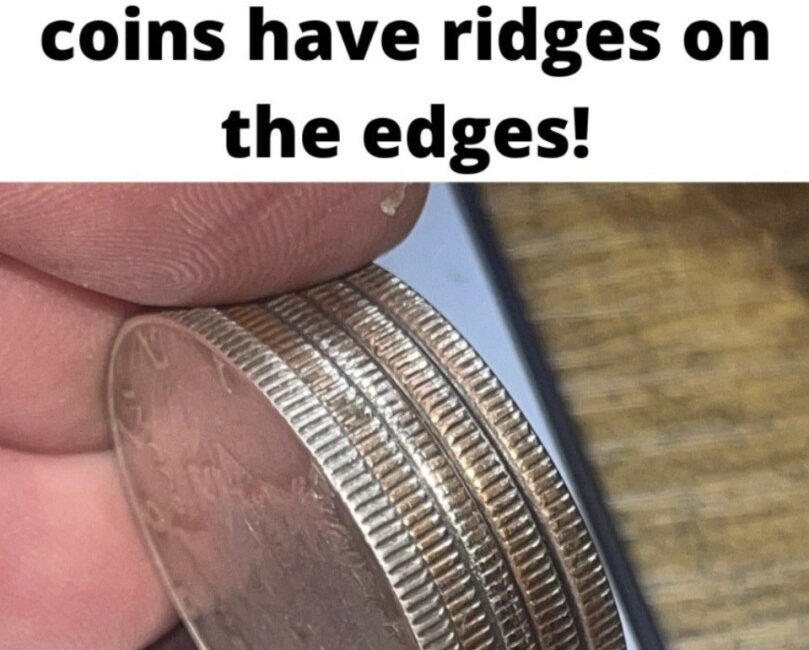
You’ve held them thousands of times.
You’ve dropped them into vending machines.
Slid them across counters.
Stacked them, flipped them, lost them in couch cushions.
But chances are, you’ve never really noticed them.
Those tiny ridges running along the edge of a coin.
They’re not decoration.
They’re not for grip.
They’re not random.
They are one of the oldest and most successful security technologies in human history — quietly doing their job for over three centuries.
And they were born out of crime.
When Money Was Literally Money
Today, money represents value.
But in the 1600s and early 1700s, money was value.
Coins weren’t symbolic. They weren’t backed by banks or trust systems. A silver coin was worth exactly the amount of silver it contained. A gold coin was worth its weight in gold.
Which meant one thing:
Coins were portable treasure.
And wherever there is portable treasure, there are people trying to steal it.
The Crime That Nearly Broke the Economy: Coin Clipping
Imagine a criminal who doesn’t rob banks or pick pockets.
Instead, they do something quieter.
They take a perfectly legitimate silver coin…
and shave a tiny sliver of metal from the edge.
Barely noticeable.
Then they spend the coin at full value.
One coin doesn’t matter much. But hundreds? Thousands?
Those shaved slivers were collected, melted down, and turned into pure silver bullion. The clipped coins kept circulating, slightly lighter each time, slowly draining precious metal from the economy.
This crime had a name: coin clipping.
And it was everywhere.
Entire economies were destabilized by it. Governments lost trust in their own currency. Honest people ended up holding underweight coins without knowing it.
The system was bleeding — literally from the edges.
Enter a Scientist with a Very Serious Job
In 1696, England appointed a man to fix the problem.
Not a politician.
Not a banker.
A physicist.
That man was Isaac Newton, and his new role was Warden of the Royal Mint.
Newton took the job personally.
Very personally.
He investigated counterfeiters, tracked criminals, ran sting operations, and personally prosecuted more than 100 forgers and clippers. Some were executed. This wasn’t theory — it was war.
But Newton knew punishment alone wouldn’t solve the problem.
The system itself needed armor.
The Elegant Solution: Reeded Edges
Newton’s breakthrough idea was deceptively simple.
If clipping happens at the edge…
make the edge impossible to alter without being noticed.
So the Mint began adding finely machined grooves — called reeding — around the edges of coins.
Suddenly, clipping became obvious.
A clipped coin had broken ridges.
Uneven grooves.
Missing patterns.
And here was the genius part:
No one outside the mint could reproduce the precision of those ridges.
It was 17th-century anti-fraud technology — mechanical, visual, and foolproof.
The moment reeded edges were introduced, coin clipping collapsed.
The crime didn’t evolve.
It died.
Why the Ridges Still Exist Today
Fast-forward to modern times.
Coins are no longer made of silver or gold (with rare exceptions). Most are copper-nickel alloys. There’s no precious metal to steal.
So why do ridges still exist?
Because good design doesn’t disappear — it adapts.
Reeded edges still serve three powerful purposes.
1. Anti-Counterfeiting (Yes, Still)
Modern counterfeiters can fake faces and surfaces.
Edges are harder.
The exact number, depth, spacing, and sharpness of ridges are part of a coin’s fingerprint. Banks, vending machines, and coin counters read the edge mechanically and electronically.
A fake coin often fails the edge test.
Fun detail:
- U.S. dimes have 118 reeds
- U.S. quarters have 119 reeds
That difference isn’t decorative. It’s intentional.
2. Accessibility for the Visually Impaired
Click page 2 for more