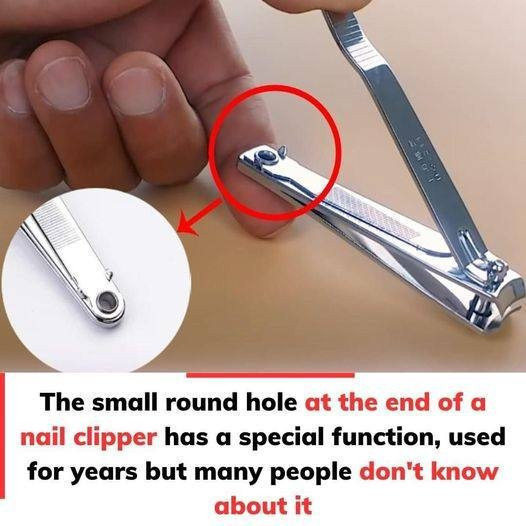
Nail clippers are a ubiquitous household tool, found in almost every home around the world. Their primary purpose is straightforward: trimming fingernails and toenails. Yet, beyond this simple function lies an intriguing design element that is often overlooked—the small round hole at the end of the lever. While many people dismiss it as a decorative or structural feature, this tiny circular opening has multiple practical applications that elevate the nail clipper from a simple grooming tool to a versatile everyday instrument. In this article, we will explore the design, hidden uses, and innovative potential of the small round hole on nail clippers.
The Design and Mechanics of Nail Clippers
To understand the power of the small round hole, it’s important first to examine the design and mechanics of nail clippers. Most modern nail clippers consist of three main parts:
- The lever: A flat, often slightly curved piece of metal that provides leverage for cutting.
- The cutting blades: Sharp, curved edges that trim nails cleanly and efficiently.
- The pin or rivet: A small central axis that connects the lever to the blades, allowing rotational motion.
The small round hole is usually located at the end of the lever, near the pivot point or at the far end. While it may seem insignificant, this tiny circular opening is a masterstroke of multifunctional design. By incorporating a hole of precise diameter and location, manufacturers have enabled users to perform tasks beyond nail trimming, expanding the utility of what would otherwise be a single-purpose tool.
The hole is carefully engineered to withstand pressure and manipulation. Its diameter is large enough to accommodate keyrings, wires, or small metal objects but small enough to maintain the structural integrity of the lever. This combination of strength and functionality is what makes it a surprisingly versatile feature.
Primary Use: Keychain Attachment
One of the most practical uses of the small round hole is as a keychain attachment. Many nail clippers are designed with portability in mind, and attaching them to a keyring ensures that the clipper is always accessible.
By threading a keychain through the small hole, users can:
- Prevent Loss: Small grooming tools are easy to misplace. Securing the clipper to a keychain ensures it stays within reach.
- Enhance Portability: Whether you are traveling, going to the gym, or heading to work, having the clipper attached to your keys eliminates the need for a separate grooming kit.
- Increase Functionality: Nail clippers on a keychain can double as an emergency tool. For instance, the clipper can be used in outdoor settings, camping trips, or office situations where immediate nail trimming is required.
The design ensures that even under repeated movement, the small round hole maintains its integrity. Keyrings slide in smoothly, providing convenience without compromising the clipper’s primary function.
Wire Bending and Manipulation
Beyond keychain attachment, the small round hole can serve as a mini tool for bending and shaping wires. Whether you are working on a small craft project, jewelry, or household repairs, inserting a thin wire into the hole and applying gentle pressure allows for precise manipulation.
Here’s why this works so effectively:
- Leverage: The clipper lever acts as a fulcrum. The small hole provides a pivot point, reducing the force required to bend the wire.
- Precision: Unlike using fingers alone, the nail clipper allows for controlled bending, minimizing the risk of kinks or accidental damage.
- Safety: Fingers are susceptible to cuts or abrasions when bending sharp wires. Using the clipper as a tool mitigates this risk.
This use is particularly effective for lightweight wires used in electronics, craft projects, or minor household fixes. For example, bending floral wires, securing cable ends, or adjusting paperclips can be done effortlessly using the clipper’s hole as a leverage point.
Screwdriver Alternative
The small round hole can also serve as an improvised screwdriver in certain situations. While it cannot replace a full-sized screwdriver for heavy-duty tasks, it works surprisingly well for:
- Small Screws: Particularly those found in eyeglasses, electronics, and battery compartments.
- Emergency Repairs: If a proper screwdriver is unavailable, the clipper can temporarily function as a tool to tighten or loosen small fasteners.
- Portable Convenience: Carrying a nail clipper as a keychain tool provides an on-the-go solution for minor assembly or disassembly tasks.
To use the hole as a screwdriver:
- Insert the tip of the screw into the small round hole.
- Apply gentle pressure while rotating the clipper lever.
- Adjust the angle as needed to maintain torque without slipping.
While this function may seem unconventional, it exemplifies how simple design features can transform everyday objects into multifunctional tools.
Opening Sealed Items
Another lesser-known but highly practical use of the small round hole is for opening sealed items. Certain packaging, such as sealed plastic containers, small tins, or twist caps, can be maneuvered using the hole as leverage:
- Twist Cap Assistance: Insert the end of a small cap into the hole to gain extra torque for twisting open stubborn caps.
- Pull Tabs: The hole can be used to hook onto pull tabs on small packaging. By applying upward or rotational force, you can open packages that would otherwise require fingernail strength or additional tools.
This function is particularly useful for individuals with reduced grip strength or arthritis, making nail clippers an accessible, ergonomic tool for daily life.
As a Mini Lever for Small Tasks
The physics of the nail clipper lever can be extended beyond nails. The small round hole enables users to utilize the clipper as a mini lever for small prying tasks:
- Removing Staples: Slide the hole under a staple to gain leverage and lift it out cleanly.
- Separating Components: In electronics or crafts, the clipper can be used to gently separate glued or pressed components.
- Lifting Small Objects: The clipper’s leverage can lift tiny objects that are difficult to pick up with fingers, such as beads, pins, or screws.
By thinking of the nail clipper as a multi-purpose tool rather than a single-function device, the small round hole opens a world of possibilities limited only by creativity.
Historical Context: Why the Hole Exists
The origin of the small round hole on nail clippers is rooted in both convenience and manufacturing efficiency. Nail clippers evolved over decades from simple scissors-like tools to compact, lever-based designs. Early inventors recognized that adding a small hole could serve multiple purposes without increasing manufacturing costs or compromising structural integrity.
Click page 2 for more