Every day, people step into fitting rooms, hotel bathrooms, or public restrooms without a second thought. Mirrors line the walls, bright lights reflect their image, and for a moment, we trust what we see. But what if that mirror isn’t just reflecting you? What if, behind that glass, someone else can see you too?
The idea of hidden surveillance in supposedly private spaces can be deeply unsettling — and unfortunately, it’s not just a myth. With advancements in micro-camera technology, two-way mirrors, and covert monitoring systems, privacy violations have become a growing concern in hotels, gyms, fitting rooms, and even Airbnbs.
Understanding how to tell the difference between a real mirror and a two-way mirror isn’t just a fun life hack; it’s a vital personal safety tip that everyone should know.
In this in-depth guide, you’ll learn how mirrors work, what makes a two-way mirror different, the science behind reflection and transparency, and the practical, step-by-step methods to identify them in real-world settings — all while exploring the psychological and legal aspects of privacy in public and commercial spaces.
Understanding the Science of Mirrors
Before learning how to spot a two-way mirror, it helps to understand how ordinary mirrors work.
A mirror is a sheet of glass coated on one side with a thin layer of reflective metal, usually aluminum or silver, that reflects light. When you look into it, light bounces off your body, hits the metal coating, and reflects back through the glass toward your eyes — creating the familiar image you see.
In a standard mirror, the reflective coating is applied to the back surface of the glass. That means there’s a layer of glass between the reflective metal and the room you’re in. This construction ensures that light doesn’t pass through — it only bounces back.
A two-way mirror, however, is built differently.
What Is a Two-Way Mirror?
A two-way mirror (also called a one-way mirror) is a special kind of glass that is partially reflective and partially transparent. It’s designed to allow light to pass through from one side while reflecting light on the other.
The key to how it works lies in lighting conditions:
- The bright side acts as a normal mirror — people on this side see their reflection.
- The dark side is where observers can see through the glass into the brighter room.
This design is commonly used in interrogation rooms, surveillance areas, security control rooms, and psychological observation labs. It’s perfectly legal in those settings when used with consent or for official purposes.
But the use of such mirrors in private spaces like fitting rooms, bathrooms, or hotels without consent is not only unethical — it’s illegal in most jurisdictions.
Unfortunately, the misuse of this technology has led to numerous privacy violations across the world. That’s why knowing how to identify a two-way mirror is so important.
Why Hidden Two-Way Mirrors Are a Privacy Concern
Imagine walking into a clothing store to try on a new outfit. You close the door behind you, look into the mirror, and begin changing — unaware that someone might be watching from the other side.
This is more than just a violation of trust. It’s a criminal invasion of privacy.
Hidden two-way mirrors or covert cameras have been found in:
- Fitting rooms
- Public bathrooms
- Hotel rooms
- Dance studios
- Gyms and spas
- Airbnbs and rental properties
The psychological impact of realizing you’ve been watched without consent can be devastating. Victims often report feelings of anxiety, paranoia, embarrassment, and loss of safety. Beyond emotional trauma, these incidents can have serious legal and social consequences for both victims and perpetrators.
Knowing how to protect yourself and identify red flags is your first line of defense.
How to Tell the Difference Between a Real Mirror and a Two-Way Mirror
Here’s the heart of the topic — practical, real-world methods to detect if a mirror is genuine or hiding something behind it. You don’t need special equipment; your eyes, fingers, and awareness are your best tools.
Let’s explore several reliable techniques.
1. The Fingernail Test
This is the most popular and simple way to check a mirror.
How to Do It:
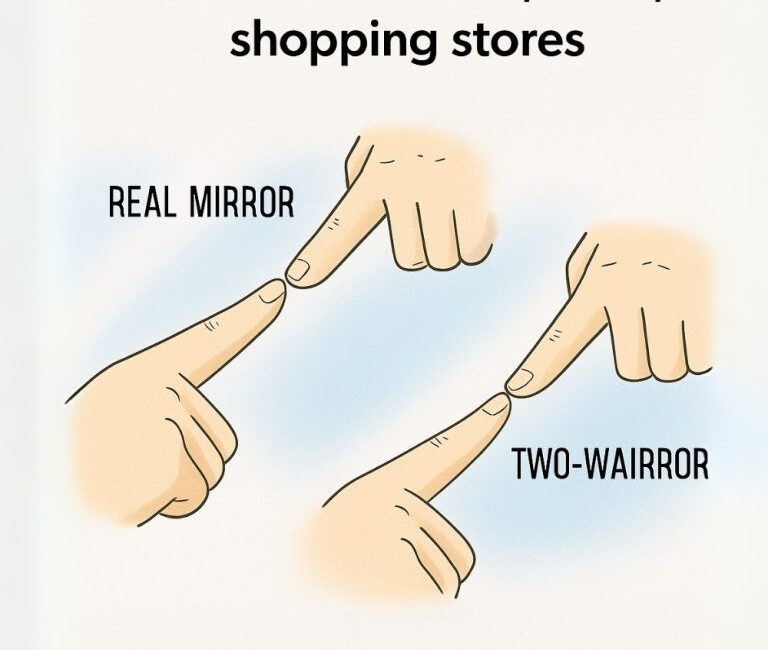
- Place your fingernail or fingertip gently against the surface of the mirror.
- Look closely at the reflection of your finger.
- If there’s a small gap between your finger and its reflection, the mirror is real — the reflective layer is behind the glass.
- If there’s no gap and your reflection directly touches your finger, it may be a two-way mirror.
Why This Works:
Real mirrors have a protective layer of glass over the reflective metal coating, creating a visible separation. Two-way mirrors don’t; their reflective layer sits on the front surface, giving the illusion that your reflection touches you.
Caution:
While this test is often reliable, lighting and angle can sometimes affect results. Use it in combination with other tests for certainty.
2. The Knuckle Test (Sound Reflection)
How to Do It:
Gently tap or knock on the mirror with your knuckle.
- A real mirror usually produces a solid, dull sound, because it’s backed against a wall.
- A two-way mirror often sounds hollow, as there’s an empty space behind the glass.
You can also use a pen or ring to tap — listen for the echo. Hollow sound? Proceed with caution.
3. The Light Test (Using a Flashlight or Phone)
This method works best when you can dim the lights in the room.
How to Do It:
- Turn off or reduce the room lights.
- Shine your phone flashlight or a small torch directly at the mirror from up close.
If the mirror is real, you’ll see the light reflect back strongly, and nothing behind it.
If it’s a two-way mirror, the flashlight might reveal objects or space behind the glass — such as wiring, a wall cavity, or even movement.
4. The Mirror Mount Test
Check how the mirror is installed.
- In public or commercial fitting rooms, real mirrors are usually mounted on the wall’s surface.
- Two-way mirrors are often set into the wall, with the edges framed tightly to hide gaps.
Run your fingers around the frame. If it seems unusually built-in or thick, it could be hiding a space behind it.
5. The Transparency Test (Cup Your Hands)
Stand close to the mirror, cup your hands around your eyes, and look closely at the surface — just like you’d peer into a window.
By blocking out surrounding light, you reduce reflection and increase your chances of seeing through the glass.
If you notice any dimly lit area or equipment behind the mirror, it could indicate a two-way mirror setup.
6. The Light and Privacy Balance Principle
Remember: lighting is the key factor in a two-way mirror’s effectiveness.
If you’re in a bright fitting room and there’s a darker room or hallway behind the wall, the conditions are perfect for two-way viewing.
A simple trick is to turn off the fitting room light for a moment. If you can still see some glow or light behind the mirror, that’s suspicious.
What to Do If You Suspect a Two-Way Mirror
If you ever feel uneasy about a mirror or notice something off, it’s important to stay calm but act strategically.
Here’s what you can do:
- Do not undress or change until you’ve verified the space.
- Use your phone’s flashlight to inspect corners, walls, and ceilings.
- Check for hidden lenses or small holes — covert cameras are often disguised in vents, hooks, or smoke detectors.
- Report your suspicion immediately to the store or facility manager.
- If you’re not satisfied, contact local authorities or consumer protection agencies.
- Document what you observe — photos or notes can be useful evidence.
Your privacy is not negotiable. You have every right to question suspicious setups in any space where you’re expected to be alone.
Why Hidden Surveillance Happens
Although rare, privacy invasions through two-way mirrors or hidden cameras can happen for a variety of reasons:
- Security surveillance: Some establishments misuse monitoring systems under the guise of safety.
- Voyeurism: Unfortunately, certain individuals install hidden viewing devices for illegal and exploitative purposes.
- Corporate negligence: Some buildings or stores might unknowingly use two-way glass left over from previous installations.
Understanding the motives behind such setups reinforces why awareness is essential.
Legal Implications of Hidden Mirrors and Cameras
The use of two-way mirrors in private areas without consent is a serious crime in many countries.
Most jurisdictions have invasion of privacy laws that protect individuals from being recorded or observed in private spaces such as:
- Bathrooms
- Fitting rooms
- Bedrooms
- Restrooms
- Medical facilities
Click page 2 for more