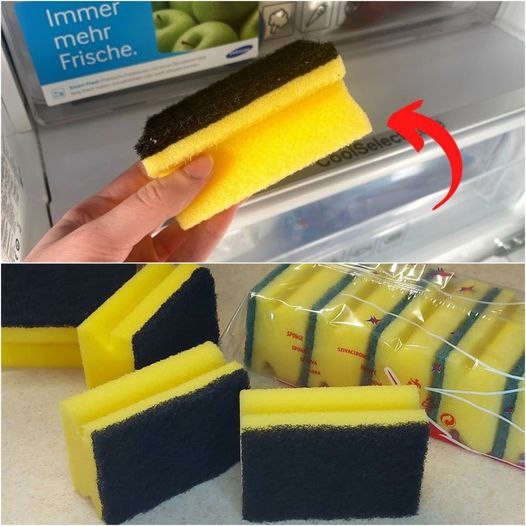
We all struggle with two persistent fridge hassles:
- Excess moisture — condensation, droplets, water pooling, humid drawer environments that accelerate spoilage
- Bad odors — leftover smells, fish, onions, ammonia, musty smells that cling to containers and surfaces
Many deodorizing tricks exist — baking soda boxes, charcoal packets, activated carbon, odor absorbers — but there’s a low‑cost, everyday hack that many people swear by: placing a clean sponge (or a sponge treated in a particular way) inside the refrigerator to absorb moisture and neutralize smells.
That sponge trick shows up in kitchen hack lists, home remedy guides, and social media kitchen tip threads. The claims are:
- The sponge absorbs excess moisture, reducing humidity and condensation
- It helps prevent dripping or pooling inside the vegetable drawers
- The sponge also traps or neutralizes odor compounds
- It helps preserve the freshness of fruits, vegetables, and other perishables
What’s compelling is how something so ordinary could make a difference in freshness extension, odor control, and kitchen storage optimization. The trick may seem trivial — but in many kitchens, it makes an appreciable difference.
In this article, I’ll walk you through:
- The mechanisms by which a sponge can help with moisture and odor
- How to implement the sponge method: types of sponge, placement, maintenance
- Step‑by‑step setup and variations (sponges + baking soda, scented sponges, dual sponges, etc.)
- When and where this hack works best, and when it fails
- Pitfalls, hygiene risks, and how to mitigate them
- How to integrate the sponge trick into a full fridge freshness routine
- Optimization tips, troubleshooting, and long-term care
By the end, you’ll have a full blueprint to test it in your own fridge—and you may wonder why you didn’t start sooner.
Why a Sponge Might Help: The Science of Moisture, Adsorption & Odor Control
To see why this hack works (sometimes surprisingly well), we need to understand how moisture and odors behave inside refrigerators—and how a sponge can interact with them.
1. Moisture Control: Absorption, Condensation & Boundary Layers
In a refrigerator:
- Warm air, when cooled, releases moisture (condensation).
- Some surfaces become cold, moisture condenses on them, drips, or pools.
- When food items release water (cut fruits, unsealed containers), humidity rises.
- High humidity accelerates mold, spoilage, sogginess, and water droplet formation.
A sponge is porous and absorbent. Key properties:
- Absorbent Matrix: The sponge’s pores can draw in water vapor or small droplets, reducing free moisture in the air/near surfaces.
- Moisture trapping: Some moisture that would otherwise condense onto food or fridge walls is intercepted by the sponge.
- Boundary layer disruption: A sponge placed near dripping or condensation zones can interrupt where moisture would collect, redirecting it into the sponge instead.
In effect, the sponge acts as a passive moisture buffer or micro dehumidifier at a local scale. By capturing micro quantities of water and regulating localized humidity, it reduces dripping, pooling, and high-humidity stress on produce.
2. Odor Adsorption & Neutralization
Odors in fridges come from volatile organic compounds (VOCs) released by food (spoiling meat, dairy, pungent food, gases from enzymes). Odor control mechanisms include:
- Adsorption / absorption of odor molecules
- Chemical neutralization (acid-base reaction, reactive surfaces)
- Trapping volatile compounds in porous media
A sponge helps in two ways:
- Physical trapping: VOC molecules may adhere to the sponge’s surfaces or pores, especially when humidity and diffusion drive gas contact.
- Supporting odor neutralizers: Many people combine a sponge with baking soda or charcoal. The sponge serves as a carrier medium for these odor-neutralizing agents, increasing surface area and contact time with gasses.
Because the sponge is porous and has many internal surfaces, it increases gas-sponge interactions, enhancing odor capture.
3. Extending Produce Freshness
Excess moisture, high humidity, and localized condensation cause fruits/vegetables to rot faster—microbial growth, cell wall breakdown, softness. By reducing humidity and surface moisture, the sponge can:
- Delay microbial/mold growth
- Prevent “wet spots” that promote spoilage
- Reduce direct condensation drip onto produce
So in many setups, produce stored near a sponge in the crisper drawer or adjacent compartment will remain crisper / fresher longer.
Implementation: How to Use the Fridge Sponge Trick Step by Step
Now that you understand mechanisms, here’s how to try it practically with best results.
Choosing the Right Sponge
Not all sponges are equally suited. Choose:
- A clean, unused sponge (or one dedicated solely for this purpose).
- Preferably cellulose or natural fiber sponge, rather than heavily chemical-treated or scented ones.
- A sponge of moderate thickness—not so dense that it saturates quickly, not so thin that it dries out too fast.
- A sponge size appropriate for your fridge—big enough to cover moisture zones but not blocking air circulation.
Optionally, you may use dual sponges or two smaller sponges in separate zones (top shelf, crisper drawer, door shelf).
Pre‑Treatment (Optional but Helpful)
You can improve performance by:
- Lightly dampening the sponge (not soaking) so it’s already active in absorbing moisture
- Sprinkling baking soda or activated charcoal powder onto or into the sponge to enhance odor trapping
- Using a mesh pouch or covering the sponge with breathable fabric so food doesn’t directly contact it
The pre-treatment improves odor adsorption while maintaining moisture absorption.
Placement Strategy
Where to put it for best effect:
- Place inside the crisper tray / vegetable drawer — moisture often accumulates there
- On a mid-level shelf, away from food, ideally near a condensation zone or drip point
- Against a fridge wall near the back, where cold surfaces and condensation occur
- In the fridge door (if space), though door zones may fluctuate in temperature
- Avoid blocking airflow or contact with food containers
Leave space around the sponge so air can circulate past it rather than bypassing it.
Periodic Maintenance & Replacement
To keep the trick working and hygienic:
- Check sponge every few days. If it is saturated, wring it, or replace.
- If you used baking soda, replenish the powder occasionally.
- Once per week or two, sanitize or sun‑dry the sponge to kill any bacteria or mold.
- Replace sponge entirely if it smells, molds, stains, or loses absorption capacity (typically every 2–4 weeks, depending on usage).
- Never let a soaked sponge sit indefinitely—it becomes a breeding ground instead of a savior.
Example Setup Workflow
- Clean the interior, wipe down surfaces, discard spoiled food
- Place the clean sponge (optionally with baking soda dusted on) in the crisper drawer or back wall
- Monitor moisture in drawers / condensation spots
- Replace or wring sponge as needed
- Over weeks, observe whether produce stays fresher, odors reduce
Variants & Enhancements: Boosting the Sponge Hack
You can augment the basic trick with several enhancements.
Sponge + Baking Soda / Activated Charcoal
- Use the sponge as a carrier / reservoir for baking soda or charcoal powder. The sponge gives structure and increases contact area.
- Baking soda neutralizes odor chemically (acidic/alkaline VOCs), while sponge provides physical adsorption.
- Charcoal (activated carbon) can be embedded in or dusted onto the sponge for powerful odor absorption.
Dual Sponge System
- Use two sponges in different zones (one near produce, one near meat or pungent foods).
- This segmenting prevents cross‑contamination of smells and localizes moisture control.
Breathable Cover or Pouch
- Enclose sponge in a breathable mesh pouch to avoid food touching it directly, while not blocking airflow.
- This helps avoid sponge getting food residue or being considered dirty by contact.
Rotate / Move Sponge
- Periodically reposition the sponge to different zones (drawer, shelf) to prevent blind spots.
- During high-moisture seasons, rotate frequently.
Combine with Other Deodorizing Strategies
- Use sponge + baking soda or sponge + charcoal in the same fridge
- Maintain proper fridge ventilation, airflow, door sealing
- Clean drip pans, drainage channels, fan grills so moisture sources are reduced
When & Where This Hack Works Best (and When It Doesn’t)
The sponge trick isn’t magical—but it has sweet spots and limitations.
Ideal Conditions
- Fridges in humid climates, or those exhibiting moisture buildup
- Vegetable drawers or crisper sections that show condensation or dripping
- Kitchens where odors develop (leftover foods, strong-smelling items)
- Medium to large refrigerators (enough space for airflow)
- People who maintain periodic sponge replacement
In those contexts, the sponge trick can reduce dripping, slow spoilage, cut down odors, and help maintain cleaner fridge interiors.
Limitations & Failure Modes
- If sponge gets saturated and not replaced, it becomes a microbial hazard
- Very cold freezers or fridges with strong airflow may bypass the sponge’s impact
- Strong pungent odors from spoiled food or spills may overwhelm sponge capacity
- If general fridge hygiene is poor (dirty surfaces, spills, dripping containers), the sponge can’t solve all problems
- Food stored in open containers may still off-gas heavily, overpowering the sponge
- In very large refrigerators, one sponge may be insufficient; you may need multiple or larger-scale moisture control solutions
Thus, the sponge trick is best seen as a low-cost supplemental measure—not a replacement for cleaning, good storage practices, or odor control systems.
Hygiene & Safety: Avoiding Contamination Risk
Because you are putting a sponge inside the fridge, you must consider food safety and hygiene carefully.
Use Dedicated, Clean Sponges
- The sponge used should never be one used for dishes or surfaces—keep it exclusively for fridge use.
- Choose a brand-new or thoroughly sanitized one at the start.
Avoid Contact with Food & Containers
- Place sponge in a zone where it doesn’t touch food directly.
- Use breathable covers or mesh to prevent direct contamination.
- Avoid placing sponge under open food or containers that can drip onto it.
Replace / Sanitize Regularly
- Do not let sponge stay moist and dirty too long—replace or sanitize weekly or biweekly.
- Sun‑dry or air‑dry occasionally to prevent bacterial growth.
- If you detect mold, smell, or discoloration, throw it out immediately.
Monitor for Spoilage
- If the sponge appears slimy, black, or odorous, remove it immediately.
- Never allow the sponge to drip or leak liquid onto shelves.
Pair with Cleaning & Hygiene Practices
- Use sponge trick only after a clean fridge interior (wipe up spills, sanitize surfaces).
- Make sure drainage channels and drip pans are clean so the sponge doesn’t fix symptoms rather than root problems.
Full Fridge Freshness Routine: How the Sponge Hack Fits In
Click page 2 for more