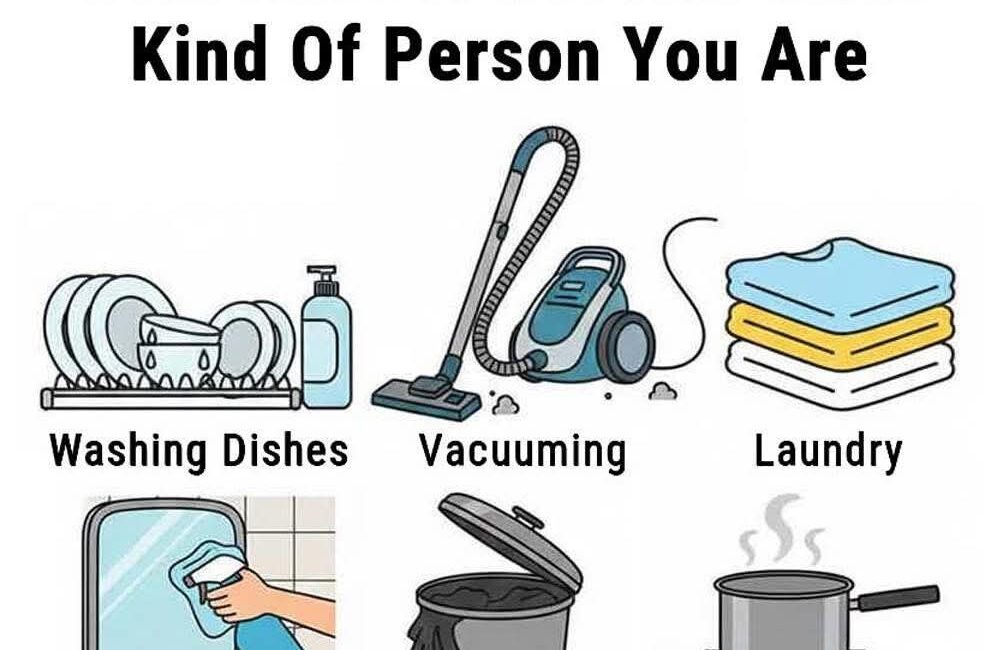
At first, the question feels simple—almost playful:
“If you could eliminate one household chore forever, which one would it be?”
No negotiation. No delegation. No shortcuts. Just one task—gone.
Most people answer quickly. Some hesitate. Others feel strangely exposed by the choice.
Because beneath the surface, this is not really about chores.
It is about:
- How you handle responsibility
- How you deal with discomfort
- How your mind reacts to repetition, control, and closure
- How your emotional world operates quietly, without you realizing it
The chore you avoid is not random.
It reflects:
👉 What drains you
👉 What you resist
👉 What your mind tries to escape
And when you understand why, you don’t just learn about chores—you learn about yourself.
This article will go deep into each choice, but more importantly, it will teach you psychological concepts, behavior patterns, and emotional mechanisms behind your preferences.
By the end, you will not just know what you chose—you will understand what it means.
Why This Question Works: The Psychology Behind Everyday Avoidance
Before analyzing each chore, you need to understand something powerful:
👉 Avoidance is never random.
Concept to Learn: Emotional Avoidance
Emotional avoidance is when:
- You avoid tasks that trigger discomfort
- Not because they are hard—but because of how they make you feel
For example:
- A task may feel endless → creates frustration
- A task may feel invasive → creates discomfort
- A task may feel repetitive → creates boredom
So your brain says:
👉 “Let’s avoid this.”
Concept to Learn: Cognitive Load
Cognitive load refers to:
👉 The mental energy required to complete a task
Some chores are not physically hard—but mentally exhausting.
Your choice reveals:
- What type of mental load you struggle with
- What type of effort drains you the most
If You Chose Washing Dishes: The Need for Closure and Emotional Resolution
If washing dishes is the chore you would eliminate, this reveals something very specific about your mind.
What It Means
You are someone who:
- Dislikes unfinished things
- Needs closure
- Feels uncomfortable with lingering mess
Dirty dishes are not just dishes to you.
They represent:
👉 Something incomplete
Your Personality Pattern
You likely:
- Prefer clear beginnings and endings
- Feel stressed by things left unresolved
- Want emotional clarity
You don’t mind effort.
What drains you is:
👉 Repetition without a sense of completion
Deep Concept: Closure Psychology
Closure means:
- Finishing something emotionally or mentally
People who need closure:
- Struggle with ambiguity
- Want clear answers
- Prefer resolution over uncertainty
Your Strength
- You are decisive
- You bring order
- You value clarity
Your Challenge
You may:
- Rush to “finish” situations emotionally
- Struggle with ongoing processes
- Feel overwhelmed by things that never fully end
If You Chose Vacuuming: The Resistance to Maintenance and Routine
Vacuuming is not hard. But it is repetitive.
If you avoid it, your brain is telling something important.
What It Means
You are someone who:
- Dislikes constant upkeep
- Prefers big progress over small maintenance
- Gets bored with repetitive details
Your Personality Pattern
You likely:
- Think in big ideas
- Focus on results
- Lose interest in small tasks
Deep Concept: Motivation vs Maintenance
There are two types of effort:
- Motivation-driven tasks (exciting, new, impactful)
- Maintenance tasks (repetitive, necessary, invisible)
You thrive in:
👉 Motivation
But struggle with:
👉 Maintenance
Your Strength
- You are creative
- You think strategically
- You move forward
Your Challenge
You may:
- Ignore small details
- Delay necessary upkeep
- Lose consistency
If You Chose Laundry: The Struggle with Endless Cycles
Laundry is one of the most psychologically draining chores.
Why?
Because it never ends.
What It Means
You are someone who:
- Feels suffocated by repetition
- Craves change and variety
- Dislikes cyclical tasks
Your Personality Pattern
You likely:
- Get bored quickly
- Want progress
- Need novelty
Laundry represents:
👉 A loop with no finish line
Deep Concept: Psychological Fatigue
Psychological fatigue happens when:
- Tasks repeat endlessly
- There is no visible progress
- Your brain feels “stuck”
Emotional Layer
Clothes are also personal.
They carry:
- Memories
- Identity
- Emotional associations
So laundry may also trigger:
👉 Subtle emotional discomfort
Your Strength
- You are dynamic
- You seek growth
- You adapt quickly
Your Challenge
You may:
- Avoid routine
- Struggle with consistency
- Feel trapped in repetition
If You Chose Bathroom Cleaning: Emotional Boundaries and Discomfort
This is one of the most telling choices.
What It Means
Click page 2 to continue