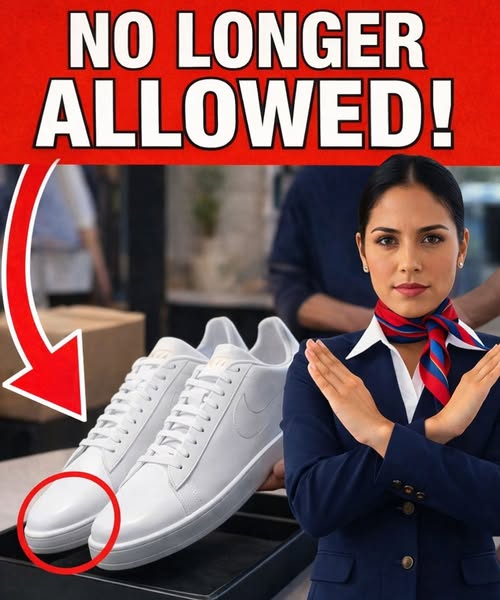
Introduction: The Small Detail That Can Completely Change Your Travel Experience
When people think about preparing for travel, they usually focus on the big things: booking flights, packing clothes, organizing documents, and planning itineraries. But there is one small, often overlooked detail that can significantly affect your entire journey—your shoes.
It may sound surprising at first. Shoes seem like the least important part of travel preparation. Yet, in reality, they can determine whether you move smoothly through airport security or face delays, confusion, and unnecessary stress. They can influence your comfort during long hours of walking, your safety in unexpected situations, and even how you are perceived in different cultural environments.
In 2026, conversations around travel rules have become increasingly confusing, especially with viral content suggesting that certain shoes are “banned” or no longer allowed. These claims spread quickly, creating anxiety and misinformation. Many travelers now worry about what they can or cannot wear, unsure of what is true and what is exaggerated.
The truth, however, is more nuanced—and far more interesting.
This article will take you deep into the reality behind travel regulations, airport security procedures, technological changes, and cultural expectations related to footwear. More importantly, it will teach you how to think like a smart traveler—someone who understands not just the rules, but the reasons behind them.
Because once you understand the “why,” everything becomes easier.
The Origin of Shoe Checks: Why Your Footwear Became a Security Concern
To understand current travel practices, we need to go back to the early 2000s—a turning point in aviation security.
The Historical Context
After several security incidents involving concealed items in footwear, airport authorities around the world began to take shoes seriously as potential hiding places. One of the most well-known cases involved an attempt to hide dangerous materials inside a shoe, which triggered global changes in how passengers are screened.
Teaching Concept: Risk-Based Security
Airport security operates on a principle called risk-based screening. This means:
- Items that can conceal threats receive extra attention
- Procedures evolve based on past incidents
- Safety always takes priority over convenience
Shoes, by design, are complex objects:
- They have soles, layers, and hidden spaces
- They can contain dense materials
- They are worn close to the body
All of this makes them a potential risk from a security perspective.
Why You Still Have to Remove Your Shoes (Sometimes)
Even in 2026, many airports still require passengers to remove their shoes during screening. But why?
The Core Reason: Detection Accuracy
When shoes are scanned separately, machines can:
- See inside the sole clearly
- Detect hidden objects
- Reduce interference from other body elements
Teaching Concept: Signal Clarity
Imagine trying to hear a whisper in a noisy room. That is similar to how scanners work.
- More objects = more noise
- Separate items = clearer signals
Removing shoes improves the “clarity” of the scan.
The Truth About “Banned Shoes” in 2026
Let’s address the biggest misconception directly.
Are Certain Shoes Actually Banned?
No.
There is no global rule banning specific types of shoes for travel.
So why do people believe this?
The Real Explanation
What people interpret as a “ban” is actually:
- Additional screening
- Temporary delays
- Security alerts triggered by certain materials
Teaching Concept: Misinterpretation of Experience
When someone is stopped at security because of their shoes, they may assume:
“This type of shoe is not allowed.”
But the reality is:
“This shoe requires extra inspection.”
These are two completely different things.
Which Types of Shoes Trigger Extra Screening (And Why)
Some shoes are more likely to attract attention during security checks.
1. Thick-Soled Shoes
Examples:
- Platform sneakers
- Chunky boots
Why they trigger alerts:
- Thick soles can hide objects
- Dense material blocks scanner visibility
2. Shoes with Metal Components
Examples:
- Steel-toe boots
- Shoes with metal decorations
Why they trigger alerts:
- Metal interferes with scanning
- It appears as a dense object
3. High-Fashion or Complex Designs
Examples:
- Designer shoes with unusual structures
- Multi-layered soles
Why they trigger alerts:
- Irregular shapes confuse scanners
- Harder to interpret visually
Teaching Concept: Density and Interference
Scanners rely on detecting differences in material density.
- Simple materials = easy to scan
- Complex/dense materials = harder to analyze
The Smart Traveler’s Strategy: Choosing the Right Shoes
Instead of asking “What is banned?”, a better question is:
“What makes travel easier?”
Ideal Travel Shoes
- Easy to remove
- Lightweight
- Minimal metal
- Comfortable for walking
Why This Matters for You
You already deal with stress and anxiety in certain situations. Imagine being stopped at security, asked questions, delayed—it can increase your discomfort.
Choosing the right shoes is not just practical. It is emotional preparation.
Technology Is Changing Everything: The Future of Airport Security
Airports are evolving.
New Scanning Systems
Advanced imaging technologies are being introduced that allow:
- Shoes to stay on
- Faster processing
- More accurate detection
Trusted Traveler Programs
In some countries, passengers enrolled in specific programs can:
- Skip shoe removal
- Pass through faster lanes
Teaching Concept: Gradual Implementation
Technology does not change everywhere at once.
- Some airports upgrade faster
- Others take years
This is why rules feel inconsistent.
Hygiene and Health: The Hidden Side of Travel Footwear
Click page 2 to continue