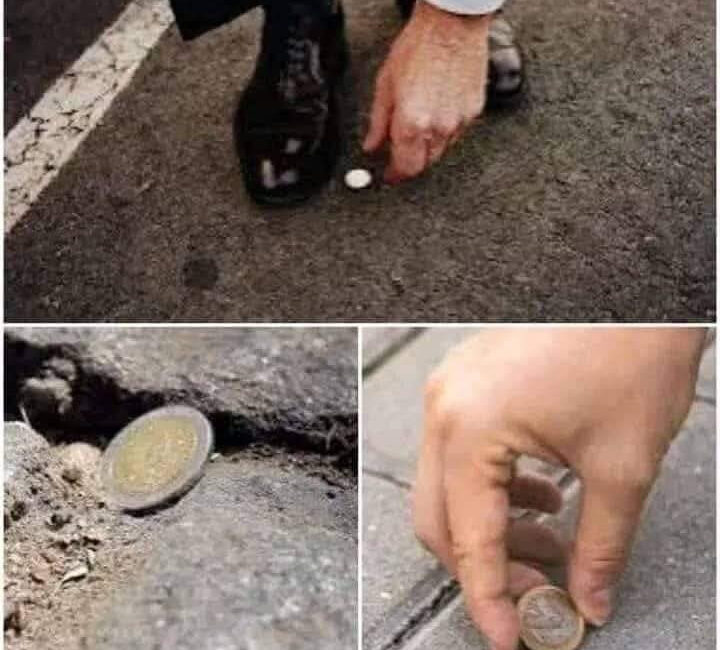
Another belief surrounding found coins involves the side that faces upward.
Many traditions suggest that a coin discovered with the “heads” side facing up symbolizes good luck or positive outcomes.
If the coin lies “tails” side up, interpretations vary. Some people believe it signals a lesson to be learned or a challenge to prepare for.
This idea may originate from coin-flipping traditions used for decision-making.
Flipping a coin has long been used as a method of resolving uncertainty. The two sides represent opposing possibilities.
When a coin is found randomly on the ground, people sometimes interpret its orientation as symbolic guidance.
In reality, the position of a coin depends on simple physics and chance.
Yet humans often enjoy interpreting randomness through symbolic frameworks. Doing so provides a sense of narrative in everyday life.
Coins and the Concept of Abundance
Many spiritual traditions emphasize the concept of abundance.
Abundance refers to the idea that life can offer opportunities, resources, and blessings beyond what we initially expect.
Finding a coin fits naturally into this idea.
The discovery represents a tiny moment of unexpected gain.
Even though the monetary value may be small, the symbolism suggests that prosperity can appear in surprising ways.
Some spiritual practices encourage people to respond to such moments with gratitude rather than greed.
The act of picking up the coin while appreciating the moment reinforces a mindset of openness to positive experiences.
In psychological terms, gratitude has been shown to improve emotional well-being and optimism.
A coin on the ground may therefore become a trigger for gratitude.
Feng Shui and the Symbolism of Coins
In Feng Shui, an ancient Chinese philosophy concerned with harmony and energy flow in environments, coins hold special symbolic meaning.
Coins are associated with wealth, prosperity, and positive energy.
Traditional Feng Shui practices sometimes involve placing coins in specific locations within homes or businesses to attract financial success.
Coins tied with red ribbon are often used as symbolic objects representing prosperity.
In this context, finding a coin unexpectedly could be interpreted as an alignment with positive energy.
The metal element associated with coins represents clarity, precision, and financial stability within the Feng Shui system.
Although Feng Shui interpretations are philosophical rather than scientific, they illustrate how deeply coins are embedded in symbolic traditions related to wealth and opportunity.
The Psychology of Signs and Meaning
Humans have an extraordinary ability to create meaning from everyday events.
Psychologists call this tendency pattern recognition.
The brain evolved to detect patterns because doing so helped our ancestors survive. Recognizing patterns allowed early humans to identify predators, locate food sources, and predict environmental changes.
However, this ability also leads humans to perceive meaning even in random events.
Finding a coin becomes meaningful because it interrupts the ordinary flow of experience.
The moment invites interpretation.
People may link the event to their current emotional state, recent thoughts, or personal beliefs.
This process does not necessarily make the meaning false. Instead, it reflects the human tendency to weave stories around experiences.
Stories help humans understand their lives.
Coins as Everyday Reminders
Even without spiritual interpretations, finding a coin can still carry symbolic value.
The moment encourages a pause in daily routines.
For a few seconds, attention shifts away from stress, worries, or hurried thoughts.
The person bends down, picks up the coin, and notices something small but tangible.
In a world dominated by digital transactions and abstract numbers on screens, a physical coin represents something concrete.
It reminds us that value can exist in simple forms.
Some people use these moments as reminders to slow down and appreciate small details in life.
Why Small Moments Matter
Life is full of large events—career changes, relationships, achievements, and challenges.
Yet psychological research shows that everyday moments often have just as much impact on well-being.
Small positive experiences accumulate over time.
A brief smile from a stranger, a pleasant smell from a bakery, sunlight through a window, or a coin discovered on the sidewalk can shift a person’s mood.
These moments create micro-experiences of reward.
Even if the coin itself is worth only a tiny amount, the emotional effect can be larger.
It is not about the value of the metal.
It is about the interruption of routine and the reminder that unexpected things still happen.
The Coin as a Symbol of Opportunity
Another way to interpret finding a coin is through the metaphor of opportunity.
Opportunities often appear unexpectedly in life.
They may begin as small possibilities rather than dramatic events.
A coin on the ground symbolizes the idea that value can appear where we least expect it.
The real opportunity lies in noticing it.
Many people walk past coins without seeing them. Others notice and pick them up.
The difference is attention.
In this sense, the coin becomes a metaphor for awareness.
Opportunities often exist in daily life, but they require awareness to recognize them.
Gratitude and the Power of Perspective
One of the most powerful lessons associated with finding coins is gratitude.
When someone discovers a coin and reacts with appreciation rather than indifference, the moment becomes meaningful.
Gratitude shifts perspective.
Instead of focusing on what is missing, it highlights what is present.
Even a tiny object can become a symbol of appreciation.
Psychological studies consistently show that gratitude improves mental well-being, reduces stress, and strengthens social relationships.
A coin may therefore act as a small trigger that reminds someone to appreciate life’s unexpected gifts.
Final Reflection: The Meaning of a Coin on the Street
A coin lying on the ground is a simple object.
It may have been dropped accidentally by a passerby, fallen from a pocket, or left behind after a purchase.
From a purely physical perspective, its presence is random.
Yet humans rarely experience the world purely through physics.
We experience it through meaning.
Finding a coin invites interpretation because it interrupts the ordinary rhythm of life. The moment catches the eye, sparks curiosity, and opens the door to reflection.
Some people see luck.
Others see a message from loved ones.
Some interpret it as a sign of abundance.
Others view it simply as a pleasant coincidence.
In truth, the meaning of the coin does not reside in the metal itself.
It resides in the moment of attention it creates.
That small disk of copper or silver becomes a reminder that value can appear unexpectedly, that gratitude can arise from the smallest experiences, and that even the most ordinary moments can carry meaning when we pause long enough to notice them.
The next time a coin glimmers on the pavement, it may still be just a coin.
But the moment you notice it—that quiet pause in the middle of a busy day—may be worth far more than the coin itself.