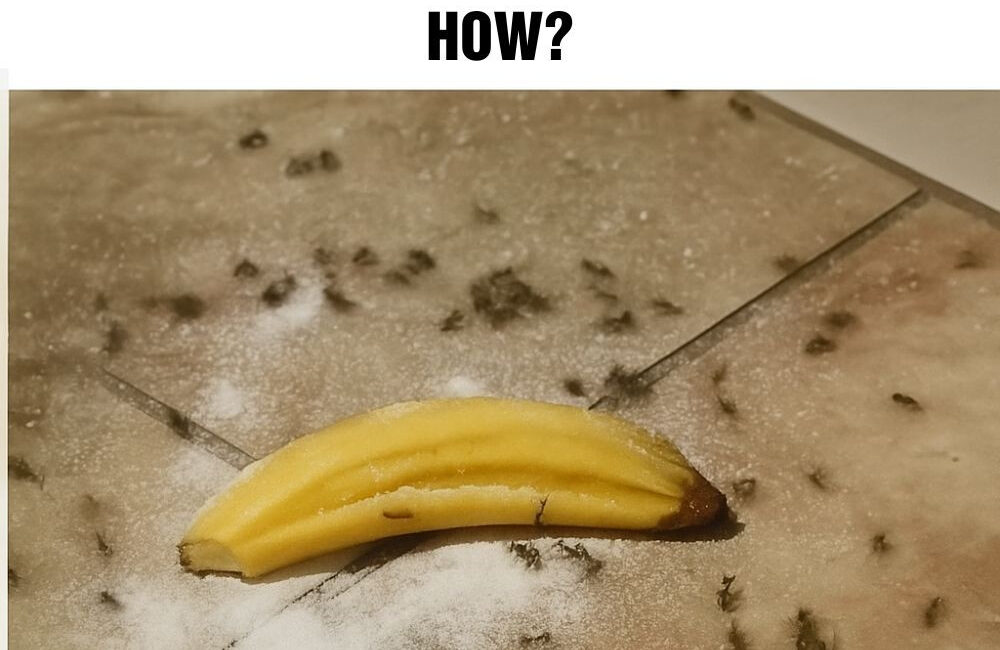
The banana peel method is simple and requires only a few household ingredients.
The basic approach involves creating small bait pieces that ants will carry away.
First, a ripe banana peel is cut into small pieces.
Next, the peel pieces are lightly coated with a mixture containing a small amount of borax and water.
The mixture should be mild enough that ants do not die immediately after eating it. If it is too strong, they may die before returning to the nest.
The peel pieces are then placed near ant trails or entry points.
Common placement areas include:
- Near kitchen counters
- Along windowsills
- Near cracks in walls
- Around doors
- Near garbage bins
Within hours, ants usually begin collecting the bait.
Over several days, the number of ants typically declines as the bait reaches the colony.
Why This Method Is Considered Eco-Friendly
One reason banana peel pest control has gained popularity is its environmental friendliness.
Traditional pesticides often involve synthetic chemicals that can persist in the environment.
The banana peel method relies mainly on:
- organic kitchen waste
- minimal chemical use
- targeted bait rather than widespread spraying
Because the bait is localized and used in small quantities, it reduces unnecessary chemical exposure.
It also repurposes food waste that would otherwise be discarded.
For environmentally conscious households, this approach represents a balanced solution between effectiveness and sustainability.
Additional Natural Ways to Prevent Ant Infestations
While banana peels can help eliminate an existing ant colony, prevention is equally important.
Ants enter homes primarily in search of food and water.
Reducing these attractants can significantly lower the chances of future infestations.
Simple prevention strategies include:
Keeping Surfaces Clean
Even tiny crumbs can attract ants.
Regularly wiping kitchen counters and sweeping floors removes food sources.
Sealing Entry Points
Small cracks in walls, window frames, or doorways can act as entry routes.
Sealing these openings helps prevent ants from entering.
Storing Food Properly
Sugar, flour, cereal, and snacks should be stored in sealed containers.
This prevents ants from accessing food supplies.
Managing Moisture
Ants often seek water sources.
Fixing leaking pipes and keeping sinks dry can reduce attraction.
The Fascinating Intelligence of Ant Colonies
Ants may be tiny, but their colonies operate with extraordinary coordination.
Scientists often describe ant colonies as superorganisms, meaning the colony functions almost like a single living entity.
Individual ants communicate using pheromones, touch, and vibration signals.
Through these communication systems, colonies can:
- locate food sources
- organize defense strategies
- build complex underground tunnels
- transport objects many times their body weight
In some species, ants even practice forms of agriculture by cultivating fungus or farming aphids for sugary secretions.
This remarkable intelligence is why ants can be so difficult to control.
They adapt quickly to environmental changes and can relocate their nests if threatened.
Understanding their behavior helps explain why bait methods—like the banana peel technique—are often more effective than direct spraying.
Why Natural Pest Control Is Becoming More Popular
Across the world, people are becoming more aware of the impact of chemicals on health and ecosystems.
As a result, natural pest control solutions are gaining popularity.
Homeowners are experimenting with simple ingredients such as:
- vinegar
- citrus oils
- cinnamon
- diatomaceous earth
- coffee grounds
- banana peels
While not every natural remedy works equally well, many offer practical alternatives to chemical pesticides.
The appeal lies in simplicity. Instead of relying on complex formulas, these methods use everyday materials in clever ways.
The banana peel trick is one example of how household waste can become a useful tool.
When to Seek Professional Help
Although natural methods can work well for small infestations, there are situations where professional pest control may be necessary.
Large or persistent infestations—especially those involving carpenter ants or structural damage—may require specialized treatment.
Professional pest control services can locate hidden nests and apply targeted solutions.
However, even in those situations, prevention and natural strategies can still play a role in long-term pest management.
The Hidden Lesson in a Banana Peel
At first glance, a banana peel seems like nothing more than kitchen waste.
But nature often hides surprising potential in simple things.
What makes the banana peel ant method interesting is not just its effectiveness. It represents a broader principle: solutions do not always require complexity.
Sometimes, understanding the behavior of a problem is more powerful than attacking it with force.
Ants follow food trails. They share food with their colony. They transport resources back to the nest.
The banana peel method simply works with that natural behavior rather than against it.
By turning ants’ own instincts into a delivery system, the problem solves itself.
Final Thoughts: Small Ideas, Big Impact
Household pest problems can be frustrating, but they also provide opportunities to rethink how we interact with nature.
Ants are not malicious invaders. They are simply organisms following their biological programming in search of survival.
Instead of responding with heavy chemical solutions, many people now prefer approaches that are safer for homes, families, and the environment.
The banana peel method illustrates how creativity and observation can produce effective solutions using materials already available in the kitchen.
A small piece of fruit peel, strategically placed, can help disrupt an entire colony of ants.
In the end, it is a reminder that innovation does not always come from laboratories or complex technology.
Sometimes, it begins with something as ordinary—and as underestimated—as a banana peel.