Ants are among the most common household visitors in the world. At first, they appear harmless—just a few tiny explorers wandering across the kitchen counter or marching along a wall. But anyone who has faced a full ant invasion knows how quickly those few scouts can turn into an entire army.
The typical reaction is to reach for chemical insect sprays, powdered pesticides, or commercial traps. These solutions promise fast results, but they often come with a hidden cost. Many chemical ant killers contain toxic compounds that can affect indoor air quality, contaminate food surfaces, or pose risks to children and pets.
In recent years, people have begun searching for safer, more environmentally responsible ways to deal with pests inside their homes. One surprisingly simple solution has gained attention: banana peels.
It may sound unusual at first. After all, banana peels are usually considered kitchen waste. Yet gardeners and natural pest-control enthusiasts have discovered that this everyday item can be used as a powerful and eco-friendly ant control method.
This article explores the science behind ants, why they invade homes, how banana peels can help control them, and how to use this natural trick safely and effectively. Along the way, we will also explore the fascinating biology of ants and why natural solutions sometimes work better than chemical ones.
Understanding Why Ants Invade Homes
To solve a problem, it helps to understand the reason behind it. Ants do not enter houses randomly. Their behavior follows a highly organized survival strategy.
Ants live in complex social colonies that can contain anywhere from a few hundred to several million individuals. Within each colony, ants have specialized roles:
- Workers search for food and maintain the nest.
- Soldiers protect the colony.
- Queens reproduce and sustain the population.
Worker ants are responsible for the ant trails people see inside homes.
These workers are constantly searching for food sources. When they discover something edible—such as sugar, crumbs, fruit, or spilled liquids—they leave a chemical signal called a pheromone trail.
This trail acts like a scent-based road map that guides other ants directly to the food source.
Once the trail is established, hundreds of ants may follow it within hours.
Homes provide ideal conditions for ants because they offer three things ants need to survive:
- Food
- Water
- Shelter
Kitchen crumbs, fruit bowls, garbage bins, and even pet food can attract them. Moist areas like sinks or bathroom corners also provide water.
Understanding this behavior is important because controlling ants is not just about killing the ones you see. The real goal is to disrupt the colony’s food supply and communication system.
Why Many People Avoid Chemical Ant Killers
For decades, chemical insecticides have been the most widely used solution for household pests. While they can be effective, they often come with concerns.
Many commercial ant killers contain synthetic chemicals designed to disrupt insect nervous systems. These substances can linger on surfaces and in indoor air.
Some potential concerns associated with heavy chemical pesticide use include:
- Indoor air contamination
- Accidental exposure to children or pets
- Environmental pollution
- Harm to beneficial insects
In addition, spraying visible ants does not always solve the underlying problem. Killing a few ants on the counter does nothing to eliminate the colony hidden behind walls or under floors.
Because of these concerns, many homeowners now prefer natural pest control methods that focus on prevention and safer solutions.
This is where banana peels enter the picture.
The Surprising Pest-Control Power of Banana Peels
Banana peels contain a variety of natural compounds that influence insects in unexpected ways.
The most important factor behind the banana peel ant trick involves boric acid or borax, which is often combined with the peel in natural pest control techniques.
However, even plain banana peels have properties that attract ants due to their sugar content. When used strategically with natural compounds, they can become an effective bait system.
The idea is not simply to repel ants.
Instead, the method works by attracting ants to a bait that they carry back to their colony.
Once the bait reaches the nest, it can disrupt the colony’s survival.
This strategy mirrors how many professional pest control solutions work. The difference is that the banana peel method uses simple household materials rather than harsh chemical sprays.
Why Ant Bait Works Better Than Killing Ants Directly
When people see ants indoors, their instinct is to eliminate them immediately. Sprays, powders, and traps are used to kill the visible ants.
But here is the key scientific insight: the ants you see are only a small fraction of the colony.
Most of the colony remains hidden underground, inside walls, or beneath floors.
Worker ants are simply gathering food for the rest of the colony.
If those workers are killed instantly with a spray, they never return to the nest.
That means the colony continues producing more workers, and the infestation returns.
Bait systems take a different approach.
Instead of killing the ants immediately, bait allows them to collect the food and carry it back to the colony.
There, the substance spreads through the colony’s food-sharing system, eventually reaching many ants—including the queen.
This method targets the entire colony rather than just the workers.
How Banana Peels Fit Into This Strategy
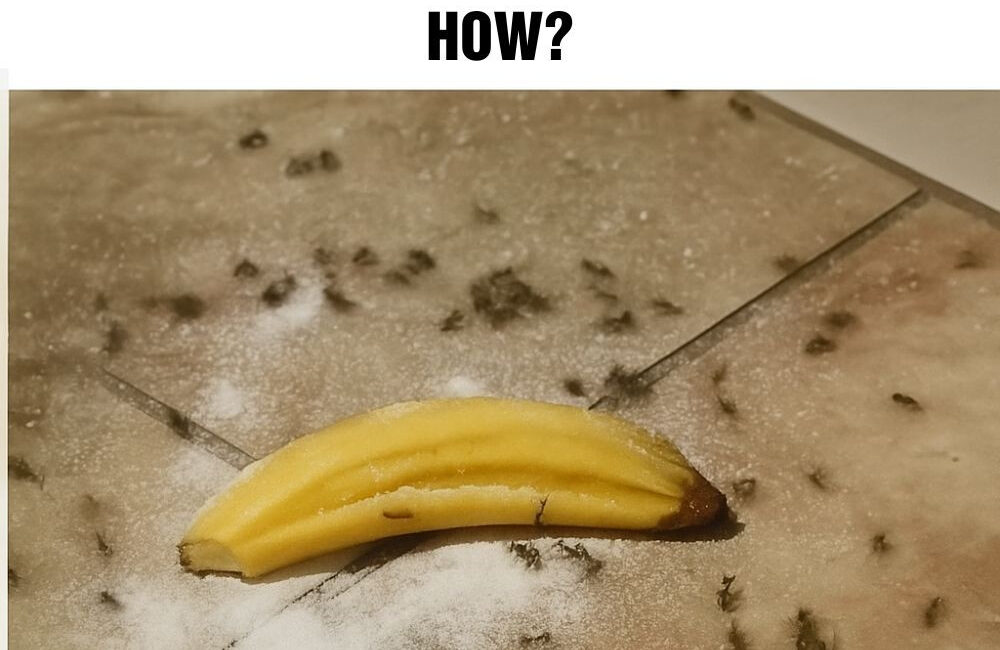
Banana peels act as a natural food attractant for ants.
Their sweet scent and sugar content make them appealing to foraging ants.
When combined with a small amount of borax or boric acid, the banana peel becomes a delivery vehicle for the bait.
The ants feed on the mixture and carry it back to the colony.
Over time, the colony’s population declines.
The banana peel serves two important purposes:
- It attracts ants naturally.
- It disguises the bait so ants accept it as food.
Because the bait is hidden within natural food material, ants are less likely to reject it.
How to Use Banana Peels to Control Ants at Home
Click page 2 to continue