One of the most common mistakes when growing onions is planting them too deeply.
Onions prefer to sit relatively close to the soil surface. In fact, mature onion bulbs often rise slightly above the soil line as they expand.
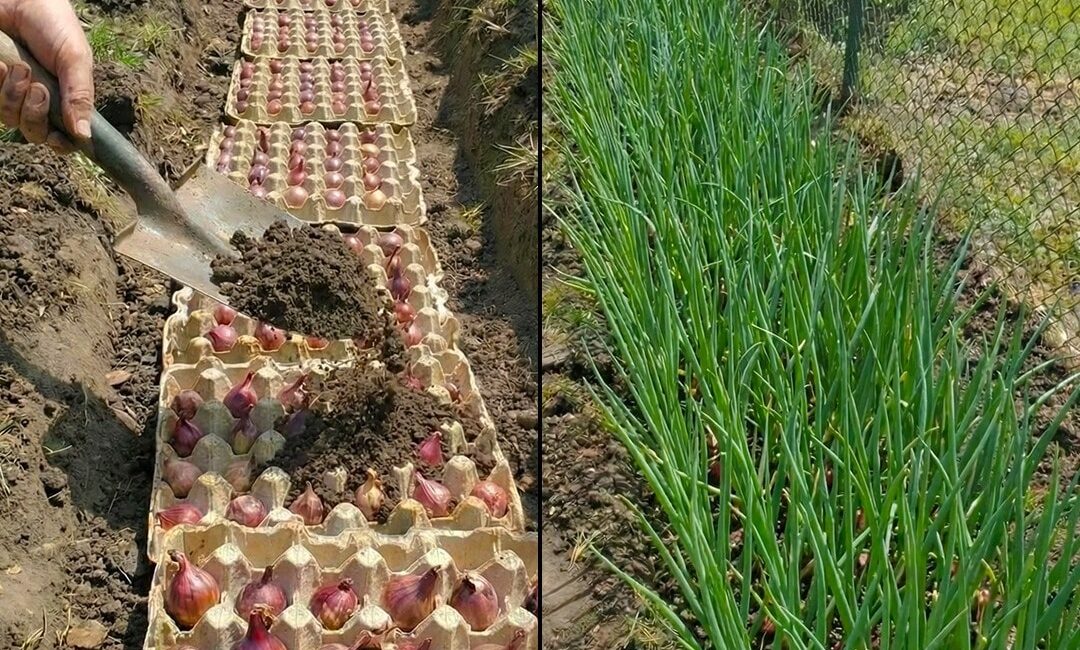
The ideal planting depth is about half an inch to one inch of soil covering the set.
Planting deeper than this can cause several problems:
- Delayed bulb formation
- Increased risk of rot
- Slower early growth
The egg carton trays naturally help prevent over-planting. Because the cups hold the sets near the surface, gardeners only need to sprinkle a light soil layer on top.
This design encourages correct planting depth automatically.
Watering Strategies for Healthy Onion Growth
Water management is a crucial part of onion cultivation.
Onions require consistent moisture, especially during early leaf development. However, excessive water can be just as harmful as drought.
A general rule is to provide about one inch of water per week, including rainfall.
Deep watering is better than frequent shallow watering. Deep watering encourages roots to grow downward, increasing plant stability and resilience.
During the early growth phase, the soil should remain evenly moist but never saturated.
Later in the season, when the bulbs begin to mature and the tops start to fall over, watering should gradually decrease.
Reducing water at this stage improves storage quality and prevents rot during curing.
Feeding Onions: Why Nitrogen Matters Early
Onions are unique among vegetables in their nutritional needs.
Early in the season, they require generous amounts of nitrogen, the nutrient responsible for leafy growth.
Since each leaf corresponds to a ring inside the bulb, more leaves translate directly into larger onions.
A simple feeding schedule might look like this:
- Compost added during soil preparation
- Light nitrogen fertilizer once plants reach four to six inches tall
- Additional feeding every few weeks during early growth
However, nitrogen should be reduced once the bulbs begin to swell. Continued heavy fertilization at that stage can delay maturity and reduce storage life.
Understanding this timing ensures the plant invests energy into bulb development at the right moment.
Weed Control and Why the Cartons Help
Weeds are one of the biggest threats to onion crops.
Because onions have shallow roots, they struggle to compete with aggressive weeds that steal water and nutrients.
The egg carton trays act as a partial mulch layer that blocks sunlight from reaching weed seeds in the soil.
This reduces germination dramatically.
However, some weeds may still appear in the open spaces between cups. These should be removed early before they become established.
Weeding should always be shallow and gentle to avoid disturbing onion roots.
Adding additional mulch around the edges of the bed can provide extra protection against weeds.
Common Onion Problems and Their Solutions
Even with good planting techniques, onions can face several challenges.
Bolting
Bolting occurs when the plant produces a flower stalk prematurely. This often happens when onions experience cold stress followed by warm weather.
Large onion sets are more likely to bolt.
Using smaller sets and planting at the correct time reduces this risk.
Small Bulbs
Several factors can cause undersized onions:
- Too much shade
- Crowded spacing
- Insufficient nitrogen during early growth
Ensuring full sunlight and proper feeding usually solves this issue.
Bulb Rot
Poor drainage and excessive watering can cause bulbs to become soft or mushy.
Raised beds and well-draining soil help prevent this problem.
Thrips
Thrips are tiny insects that leave silvery streaks on onion leaves.
Strong water sprays or insecticidal soap treatments can control infestations if necessary.
Harvesting Onions at the Right Time
Knowing when to harvest onions is both art and science.
For green onions, harvesting can begin once the stems reach pencil thickness.
Bulb onions require patience.
They are ready when approximately half of the plant tops fall over and turn yellow. This indicates that the plant has completed bulb formation.
At this stage, the onions can be gently pulled from the soil.
The egg carton remnants usually have decomposed by this time, leaving the bulbs free to lift easily.
Curing Onions for Long-Term Storage
Freshly harvested onions contain high moisture levels and cannot be stored immediately.
They must first go through a process called curing.
Curing involves drying the outer layers and sealing the neck of the onion so bacteria and fungi cannot enter.
The process usually takes about 10 to 14 days.
Onions should be placed in a warm, dry, shaded area with good air circulation. Direct sunlight should be avoided, as it can damage the bulbs.
When curing is complete, the outer skins become papery and the necks feel tight and dry.
The tops can then be trimmed to about one or two inches or braided for decorative storage.
Properly cured onions can last for several months in a cool, dry environment.
The Broader Lesson: Simple Tools Can Transform Gardening
The egg carton grid method demonstrates an important principle in gardening: innovation does not always require complexity.
A recycled paper tray—something normally discarded—can solve multiple gardening challenges simultaneously.
It provides spacing, weed control, moisture retention, and soil protection, all while naturally decomposing into the garden ecosystem.
This approach reflects a broader philosophy of sustainable gardening: using materials creatively, reducing waste, and working with natural processes rather than against them.
For small gardens, raised beds, or urban plots, this method can dramatically improve organization and productivity.
And perhaps most importantly, it shows that effective gardening techniques often arise from observation, experimentation, and a willingness to see everyday objects in new ways.
The humble egg carton may seem insignificant—but in the hands of a thoughtful gardener, it becomes a tool for growing healthy, abundant onion harvests season after season.