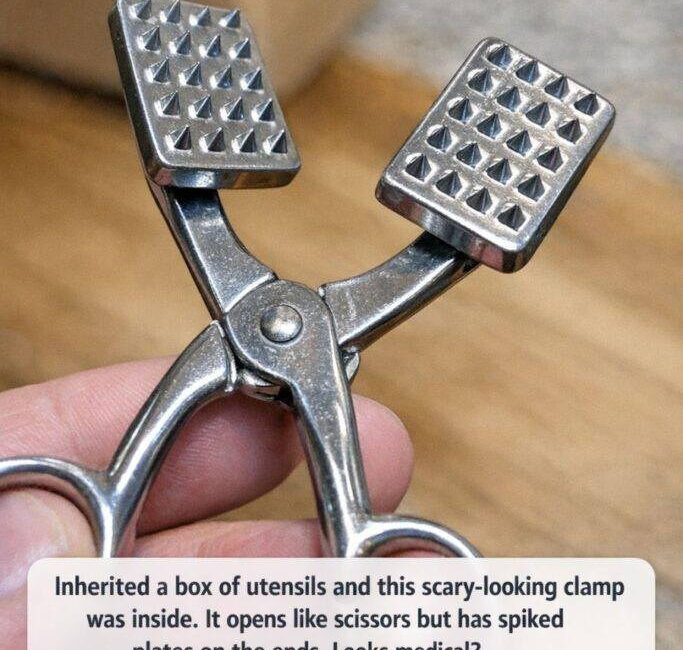
Tools like this often ended up mixed with kitchen utensils for a simple reason:
They were stored in kitchen drawers.
When electric refrigerators replaced iceboxes, the tools became obsolete.
But throwing things away was not common in earlier generations.
Instead, items were saved.
Stored.
Moved from drawer to box.
And eventually inherited.
Your “mysterious clamp” survived not because it was strange — but because someone did not see a reason to discard it.
The Aesthetic of Early 20th-Century Tools
There is a design language to antique tools.
They are:
- Heavy
- Metal
- Exposed in mechanism
- Mechanically honest
There is no attempt to hide screws or soften angles.
Industrial design from the late 1800s and early 1900s emphasized durability over comfort.
Compare that to modern kitchen gadgets made from molded plastic and silicone.
The clamp feels intimidating because it belongs to a design era that did not prioritize emotional reassurance.
It prioritized effectiveness.
Could It Be Valuable?
Antique ice tools do have collector value — though typically not extremely high unless rare or in exceptional condition.
Factors influencing value include:
- Age
- Manufacturer markings
- Condition
- Rarity of design
- Provenance
Most antique ice tongs and breakers sell modestly in antique markets. However, unique designs or well-preserved examples can attract collectors interested in early domestic technology.
More importantly, it holds historical value.
It tells a story about how kitchens functioned before electricity reshaped domestic architecture.
The Psychology of Misidentifying Old Tools
Why do so many people assume such tools are medical or torturous?
Because we are disconnected from older technologies.
When a tool’s original context disappears, imagination fills the gap.
Without understanding the icebox era, the clamp appears alien.
Humans are pattern-recognition machines. When we see metal clamps and spikes, our brain searches familiar categories:
- Medical instrument
- Farming device
- Mechanical part
Without historical literacy, interpretation becomes guesswork.
And guesswork often leans toward the dramatic.
How to Confirm Its Identity
If you want certainty:
- Look for manufacturer stamps on the metal.
- Compare the spike arrangement to antique ice tongs online.
- Measure the size — ice breakers are typically palm-sized to medium-sized.
- Examine wear patterns — scratches from hard material like ice are common.
If it lacks medical-grade precision and has blunt industrial finishing, it is almost certainly a kitchen ice tool.
A Window Into Generational Life
Objects like this are more than tools.
They are time capsules.
Imagine your grandmother standing in her kitchen, gripping this clamp, cracking ice into a bowl before guests arrived. Imagine summer afternoons when cold drinks required effort, not a button on a refrigerator door.
Domestic labor was physical.
Preservation required planning.
Convenience was mechanical, not digital.
That clamp represents adaptation — a solution to the constraints of the era.
The Quiet Evolution of Kitchens
The disappearance of tools like this marks a broader transformation.
Electric refrigeration changed:
- Food safety standards
- Grocery shopping habits
- Meal planning
- Architecture
- Gender roles in domestic labor
When refrigerators became widespread in the 1930s and 1940s, ice delivery declined rapidly.
By the 1950s, many households had no need for ice tools at all.
The clamp became obsolete — a relic of transitional technology.
And yet it survived.
Why It Feels Scary
There is something primal about sharp metal tools.
Spikes imply penetration.
Clamps imply force.
But in reality, this tool was associated with hospitality — cold lemonade, iced tea, chilled desserts.
The same spikes that look menacing were once part of preparing something refreshing.
Context transforms perception.
Without context, it looks like an instrument of harm.
With context, it becomes a tool of domestic comfort.
Should You Keep It?
That depends on what you value.
If you appreciate tangible links to history, it is worth keeping.
If you enjoy antique kitchen aesthetics, it can become a conversation piece.
If you prefer minimalism, you might pass it along to someone who appreciates early household tools.
But before discarding it, consider this:
You inherited not just metal.
You inherited a fragment of daily life from another era.
The Larger Lesson: Objects Outlive Their Explanations
When tools outlast their purpose, they become mysterious.
And mystery invites imagination.
But understanding restores dignity.
Your inherited clamp is not a surgical relic. Not a torture device. Not a medical curiosity.
It is a humble, mechanical solution to the simple problem of breaking ice in a world before refrigeration.
It is proof that everyday life once required ingenuity we now take for granted.
The next time you open a freezer and scoop ice effortlessly, remember: someone once needed a spiked metal clamp to achieve the same result.
And that ordinary object, tucked inside a box of utensils, quietly carries that entire history within its metal frame.