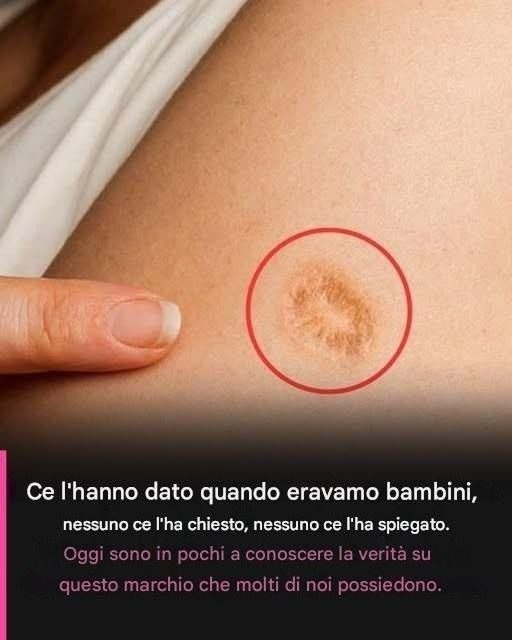
Look closely at the upper arm of someone born before the 1980s. You may notice a small, round, slightly sunken scar — often on the left arm. It may look insignificant. It may resemble a faint burn, a childhood injury, or even a birthmark. Many people carry it without thinking much about it. Some do not even remember how they got it.
Yet that small circular mark is not random.
It is a silent monument to one of the greatest achievements in human history: the eradication of smallpox.
This article explores the story behind that scar — how it was created, why it was necessary, how it differs from other vaccine scars, what it means medically today, and why it represents one of the most profound victories of science over disease. That tiny depression in the skin tells a story of global cooperation, medical innovation, fear, courage, and the triumph of persistence.
The scar is small. The history behind it is enormous.
The Disease That Haunted Humanity for Millennia
Before understanding the scar, we must understand the enemy it represents.
Smallpox was not an ordinary illness. It was one of the deadliest infectious diseases humanity has ever faced.
Caused by the variola virus, smallpox had plagued civilizations for thousands of years. Historical evidence suggests it existed as far back as ancient Egypt. Mummies from the time of Pharaoh Ramses V show pockmarked skin consistent with smallpox lesions. Ancient Chinese and Indian medical writings describe symptoms that strongly resemble the disease.
By the time smallpox reached Europe and later the Americas, it became a catastrophe.
The symptoms were devastating. It began with fever, fatigue, and body aches. Then came the rash — red spots that evolved into fluid-filled blisters. These lesions covered the entire body: face, arms, legs, torso. The blisters filled with pus, hardened into scabs, and eventually fell off, often leaving permanent scars.
Mortality rates were staggering. In many outbreaks, about 30% of infected individuals died. Some strains were even more lethal. Survivors were frequently left blind or severely scarred.
In the 20th century alone — before eradication — smallpox killed an estimated 300 to 500 million people.
To grasp the scale of that number, imagine entire nations wiped out over time. That is the shadow smallpox cast over human history.
The Birth of Vaccination: A Radical Idea
The fight against smallpox gave birth to one of the most transformative ideas in medicine: vaccination.
In 1796, an English physician named Edward Jenner observed something curious. Milkmaids who had contracted cowpox — a much milder disease from cattle — rarely developed smallpox.
Jenner hypothesized that exposure to cowpox could protect against smallpox.
To test his theory, he inoculated an eight-year-old boy with material from a cowpox sore. Later, he exposed the boy to smallpox. The child did not develop the disease.
It was a risky experiment by modern ethical standards, but it marked the beginning of immunology — the science of how the body defends itself against disease.
The word “vaccine” itself comes from “vacca,” the Latin word for cow.
Jenner’s discovery did not immediately eliminate smallpox. But it created a weapon.
Over the next century, vaccination campaigns spread across Europe and beyond. Yet it would take nearly 200 years — and unprecedented global coordination — to defeat the virus entirely.
How the Smallpox Vaccine Created That Circular Scar
The scar on the arm is not accidental. It is the physical result of how the smallpox vaccine was administered.
Unlike modern vaccines delivered with a single syringe injection into muscle, the smallpox vaccine used a specialized instrument called a bifurcated needle.
This needle had two prongs at the tip. A small droplet of vaccine was placed between them. The healthcare worker then rapidly punctured the skin — typically 10 to 15 times in the same small area.
The process did not inject the vaccine deep into muscle. Instead, it introduced the virus into the superficial layers of the skin.
This technique triggered a localized infection.
Within days, a small bump appeared. It became a blister. Then it filled with pus. The area became inflamed and sometimes painful. Eventually, a scab formed and fell off, leaving behind a circular, depressed scar.
This was not a side effect. It was expected.
The visible reaction was evidence that the vaccine had “taken” — meaning the immune system had responded properly.
In other words, the scar was proof of protection.
Why the Scar Was Usually on the Left Arm
Many people wonder why the scar is most often on the left arm.
There was no universal global law requiring the left side. However, in many countries, health authorities standardized the placement to the upper left arm for consistency and record-keeping.
Using a standard location made it easier for health workers to check vaccination status quickly, especially during outbreaks.
In communities where medical records were limited, the scar itself served as documentation.
It was a biological passport — visible, permanent, and verifiable.
The Global Eradication Campaign: Humanity’s Boldest Health Mission
The real turning point in smallpox history came in the 20th century.
By the mid-1900s, vaccination existed, but smallpox still circulated in many regions. Outbreaks continued in Asia, Africa, and South America.
In 1967, the World Health Organization launched an intensified global eradication program.
This was not a small initiative. It required:
- Coordinated international funding
- Mass vaccination campaigns
- Rapid outbreak detection
- Mobile response teams
- Door-to-door vaccination strategies
Health workers traveled to remote villages, conflict zones, dense urban centers, and isolated rural communities.
One of the key strategies was “ring vaccination.” Instead of vaccinating entire populations blindly, teams would identify a smallpox case and vaccinate everyone who had been in contact with that person — and then vaccinate contacts of contacts. This created a protective ring around outbreaks.
It was epidemiology in action — strategic, targeted, data-driven.
By 1977, the last naturally occurring case of smallpox was recorded in Somalia.
In 1980, the World Health Organization officially declared smallpox eradicated.
It remains the only human infectious disease ever completely eliminated worldwide.
Pause and consider that.
For thousands of years, smallpox terrorized humanity. In less than two decades of coordinated effort, it was removed from nature.
The scar on the arm is the residue of that victory.
Smallpox vs. BCG: Understanding the Difference in Scars
A common question arises: could that circular scar be from another vaccine?
One candidate is the BCG vaccine, used to prevent tuberculosis.
Both vaccines can leave marks, but they differ in appearance and placement.
The BCG vaccine often leaves a raised, irregular scar. It may be slightly oval or uneven. In many countries, it is administered on the right arm.
The smallpox scar, in contrast, is typically:
- Round and symmetrical
- Slightly sunken (depressed)
- Well-defined
- Usually on the upper left arm
The difference lies partly in administration method. The BCG vaccine is injected intradermally using a single needle, creating a small blister-like reaction. The smallpox vaccine involved multiple punctures, producing a deeper, more structured lesion.
Over time, experienced clinicians could often distinguish between the two at a glance.
Why Routine Smallpox Vaccination Stopped
Click page 2 to continue